

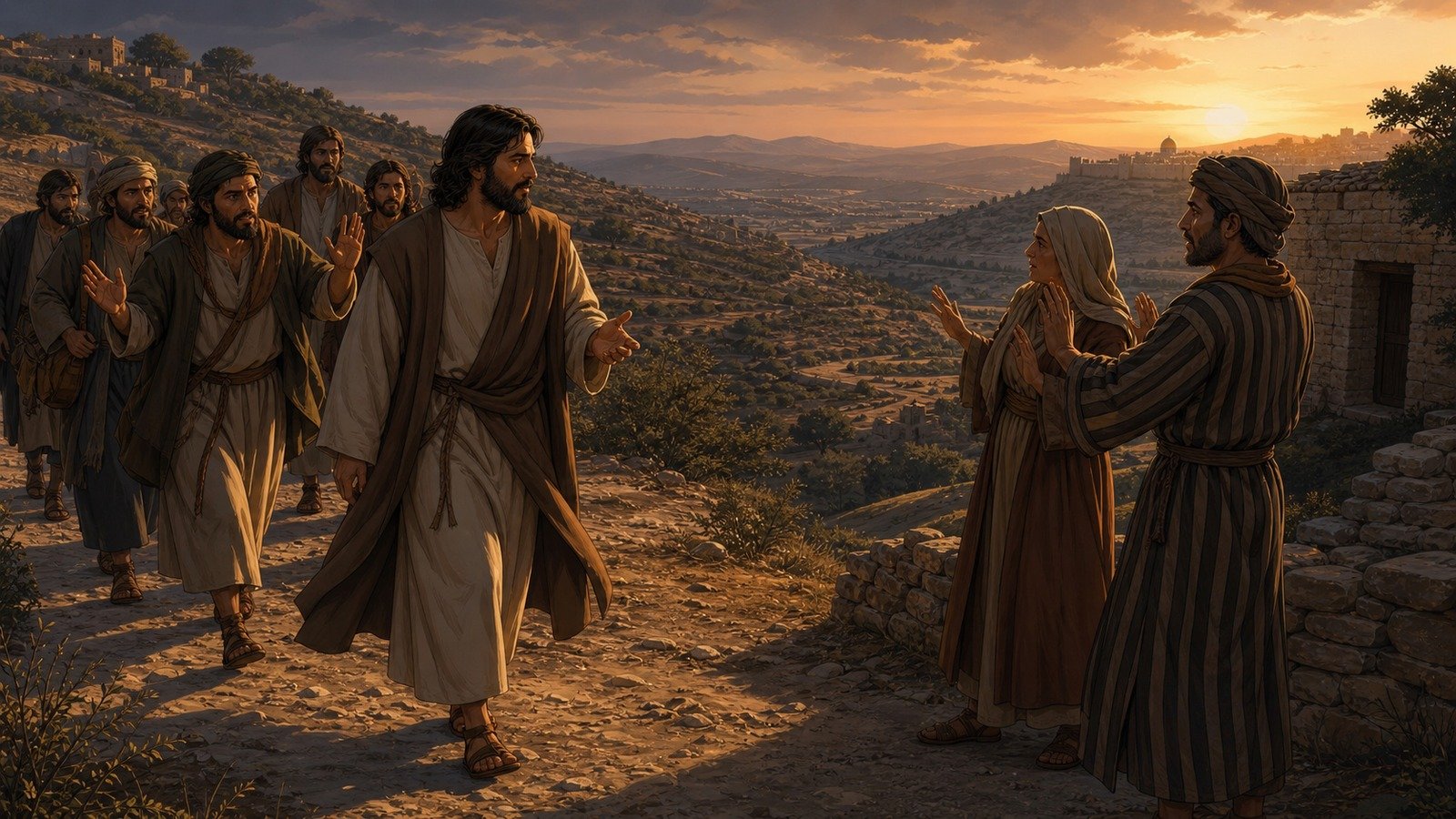
Luke turns a corner here: Jesus "resolutely set out for Jerusalem," beginning a broader journey narrative; a Samaritan village refuses him hospitality because of his destination, and Jesus rebukes his disciples' desire to call down fire on it.
Further context
3 min readAs the time approached for him to be taken up to heaven, Jesus resolutely set out for Jerusalem.
The Greek is stronger than any English rendering: he set his face to go. The idiom comes from the prophets, where setting the face towards something means fixed, deliberate intent, often of judgement, and one of the servant songs has the line about setting the face like flint under abuse.
From here the journey to Jerusalem runs for ten chapters of Luke, longer than any other stretch of travel narrative in the Gospels, and much of the best known teaching sits inside it.
Messengers are sent ahead into a Samaritan village to get things ready, and the village will not receive him because he is heading for Jerusalem.
That refusal needs its history. The Samaritans were descended from the population of the northern kingdom after the Assyrian conquest, mixed to some degree with settlers brought in by the Assyrians, and they held to the five books of Moses alone. Their central conviction, and the point of the quarrel, was that the place God chose for worship was Mount Gerizim, not Jerusalem. They had built a temple there, and a Jewish ruler had destroyed it about a century and a half earlier, which was still remembered. Josephus records Samaritans scattering human bones in the Jerusalem temple courts at Passover to defile it, and Jewish pilgrims being attacked on the road through Samaria.
The most direct route from Galilee to Jerusalem ran straight through Samaritan territory, and many Jewish pilgrims took the longer way round through the Jordan valley to avoid trouble. Sending messengers ahead to arrange lodging in a Samaritan village was therefore not a small thing.
James and John ask whether they should call fire down from heaven to destroy them. That is not invented on the spot: Elijah had called fire down twice on soldiers sent to arrest him, and the mountain where that happened is not far from where they are standing. The pair had been given the name Sons of Thunder, and here is the reason.
He turns and rebukes them. Some later copies add a sentence explaining that the Son of Man came not to destroy people's lives but to save them, and whether it belongs is disputed among those who study the manuscripts.
They simply go to another village.
Three would-be followers appear immediately afterwards, and each is given an answer that costs something: foxes have dens and birds have nests, but the Son of Man has no place to lay his head; let the dead bury their own dead; no one who puts a hand to the plough and looks back is fit for service in the kingdom of God.
The stretch that begins here is the least structured part of any of the Gospels geographically. Places are mentioned rarely, the route doubles back, and at one point he is still said to be travelling towards Jerusalem several chapters after setting out. Whether that is a journey narrative in the ordinary sense or a frame holding a large body of teaching has been argued for a long time.
What is not in doubt is the direction. From the moment his face is set, everything moves towards a city where the leadership has already begun asking where he is.