

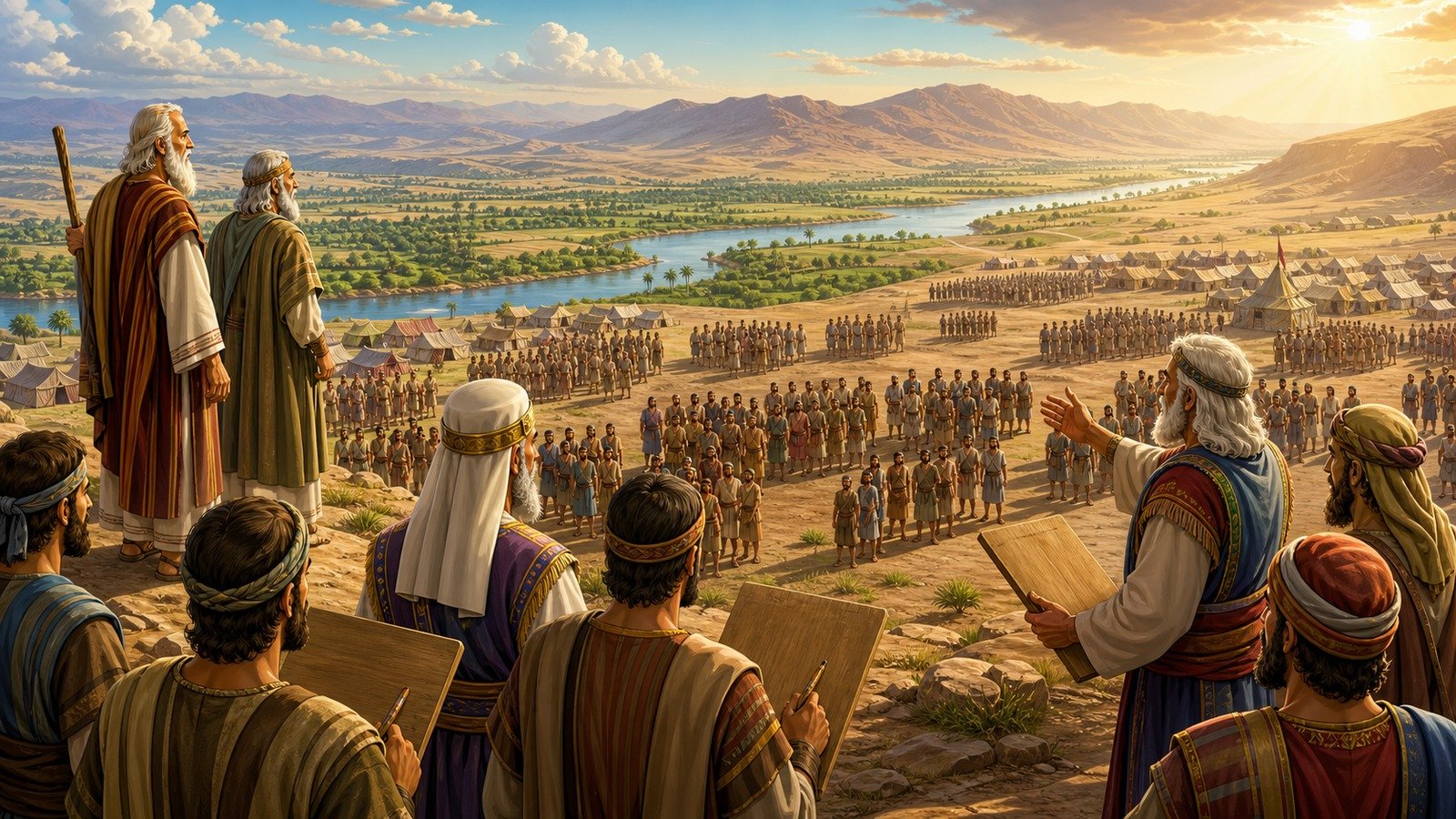
A new census counts the generation about to enter Canaan, confirming that none of the men counted at Sinai, except Joshua and Caleb, survive to see the promised land.
Further context
2 min readThe counting is repeated thirty-eight years later, on the plains of Moab across from Jericho, and the comparison between the two sets of figures is why it exists.
The stated purpose is practical. The land is to be divided among these tribes according to the number of names, with a larger group receiving a larger inheritance, and the allocation made by lot. This is a preparation for distributing territory rather than for fighting.
The total is 601,730 men aged twenty and over. The first count produced 603,550. Across thirty-eight years the nation is 1,820 people smaller, which is to say it neither grew nor collapsed. Everything that happened in the wilderness, the plagues, the rebellions and the daily provision, produced a population almost exactly the size it started at.
Individual tribes moved a great deal even though the total did not. Simeon falls from 59,300 to 22,200, by far the sharpest decline, and it is difficult not to connect that with Peor, where the man killed by Phinehas was a Simeonite family leader. Manasseh rises from 32,200 to 52,700. Ephraim falls, Benjamin and Asher rise substantially, and Judah remains the largest.
The sentence that gives the whole exercise its weight comes at the end. Not one of them was among those counted by Moses and Aaron in the Desert of Sinai, because they had been told they would surely die in the wilderness, and not one was left except Caleb son of Jephunneh and Joshua son of Nun. The judgement pronounced at Kadesh Barnea is recorded here as complete, and the arithmetic is the proof of it. Every name on the first list is gone.
One question the second count raises is where the replacements came from. A population that neither grew nor shrank across thirty-eight years, while an entire adult generation died off, means the birth rate barely covered the deaths. Nothing is made of that, and no famine or plague accounts for it beyond the several already described. The children who were said to be at risk of becoming plunder are now the fighting strength of the nation, and there are almost exactly as many of them as there were of their parents.
One family is singled out in the middle of the tribal lists and it produces a legal development. Zelophehad of the tribe of Manasseh had no sons, and his five daughters are named: Mahlah, Noah, Hoglah, Milkah and Tirzah. They come before Moses, Eleazar, the leaders and the whole assembly at the entrance to the tent, and argue that their father's name should not disappear from his clan simply because he had no son, and ask for property among their father's relatives.
Moses takes the case upward and the answer is that they are right. A ruling is issued which becomes general law: if a man dies leaving no son, his inheritance passes to his daughter, and only then to brothers or uncles. Five women arguing a case in front of the national assembly change the inheritance law of Israel, and both the argument and the outcome are recorded without either being treated as remarkable.