

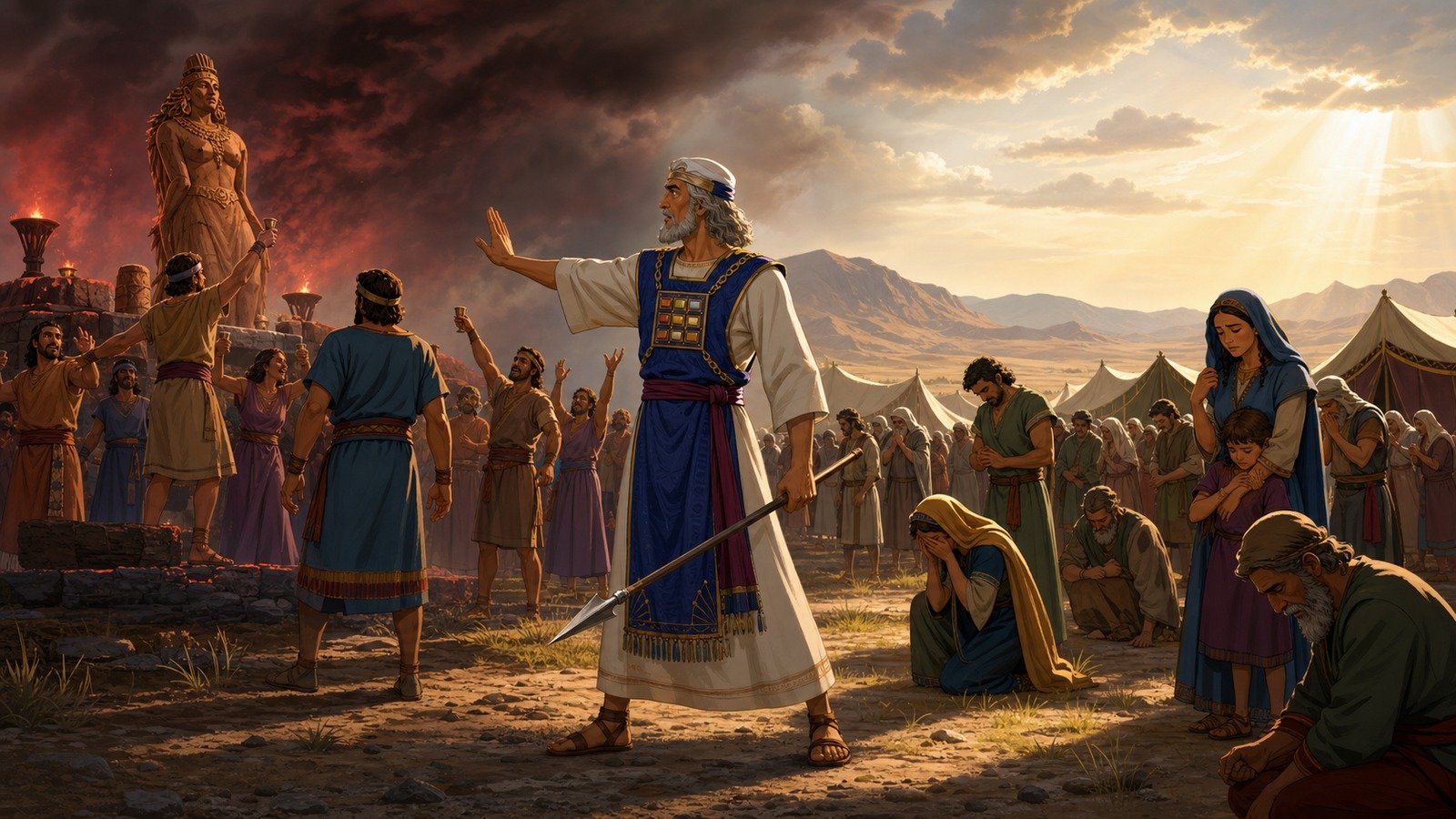
Israelite men engage in sexual immorality and idol worship with Moabite women at Baal Peor; a plague kills 24,000 before Phinehas' decisive intervention ends it, and he is rewarded with a covenant of lasting priesthood.
Further context
2 min readFour oracles of blessing are followed immediately by a collapse, and the sequence is the point. What could not be done from outside by a hired professional happens from inside within a few days.
Israel is camped at Shittim on the plains of Moab. The men begin sexual relationships with Moabite women, who invite them to the sacrifices offered to their gods. The Israelites eat the sacrificial meals and bow down, and they are described as yoking themselves to the Baal of Peor. Shared meals at a shrine were the ordinary social form of religious allegiance across that world, so what is described is a plausible progression rather than a dramatic conversion: a relationship, an invitation, a meal, and then participation.
A plague breaks out. In the middle of it, while the community is weeping at the entrance to the tent, an Israelite man brings a Midianite woman into his tent in full view of Moses and the assembly. Phinehas, grandson of Aaron, follows them and drives a spear through both, and the plague stops. Twenty-four thousand are dead. The two are named afterwards: Zimri, a leader of a Simeonite family, and Cozbi, the daughter of a Midianite tribal chief. Both were people of rank, which is what made the act a public confrontation rather than a private killing.
Phinehas receives a covenant of peace and a lasting priesthood for his descendants, and a psalm written centuries later says the act was credited to him as righteousness.
This is a hard episode and the difficulty should not be smoothed away. A summary killing without trial is approved and rewarded, in a legal system that elsewhere requires two or three witnesses and a hearing before any death sentence. Nothing explains the exception, and the honest position is that an act of this kind is presented as stopping a national catastrophe at its height, and that no general principle is drawn from it anywhere.
Paul refers to the episode and gives the figure as twenty-three thousand rather than twenty-four. The difference has been explained as a rounded number, as a count of those who died on one particular day, or as a variation in the tradition, and no explanation is demonstrably right.
What follows is an instruction to treat the Midianites as enemies, on the grounds that they treated Israel as enemies in the matter of Peor, which is the background to a campaign six chapters later where Balaam's part in it is finally stated.
Peor sits inside a pattern the whole period keeps repeating. Military threats are survived. Two Amorite kingdoms have just been destroyed and a professional curse has been neutralised. What defeats Israel is an invitation to dinner. Nothing in the wilderness years does as much damage as a set of ordinary social relationships with neighbours, and the laws about intermarriage that follow are written by people who had watched it happen.
The generation that dies here is largely the one that had grown up in the wilderness, and the country they are about to enter is full of exactly this. Everything the following books say about the danger of the shrines on the hills of Canaan has already been demonstrated on the far side of the river, before anybody crossed it.