

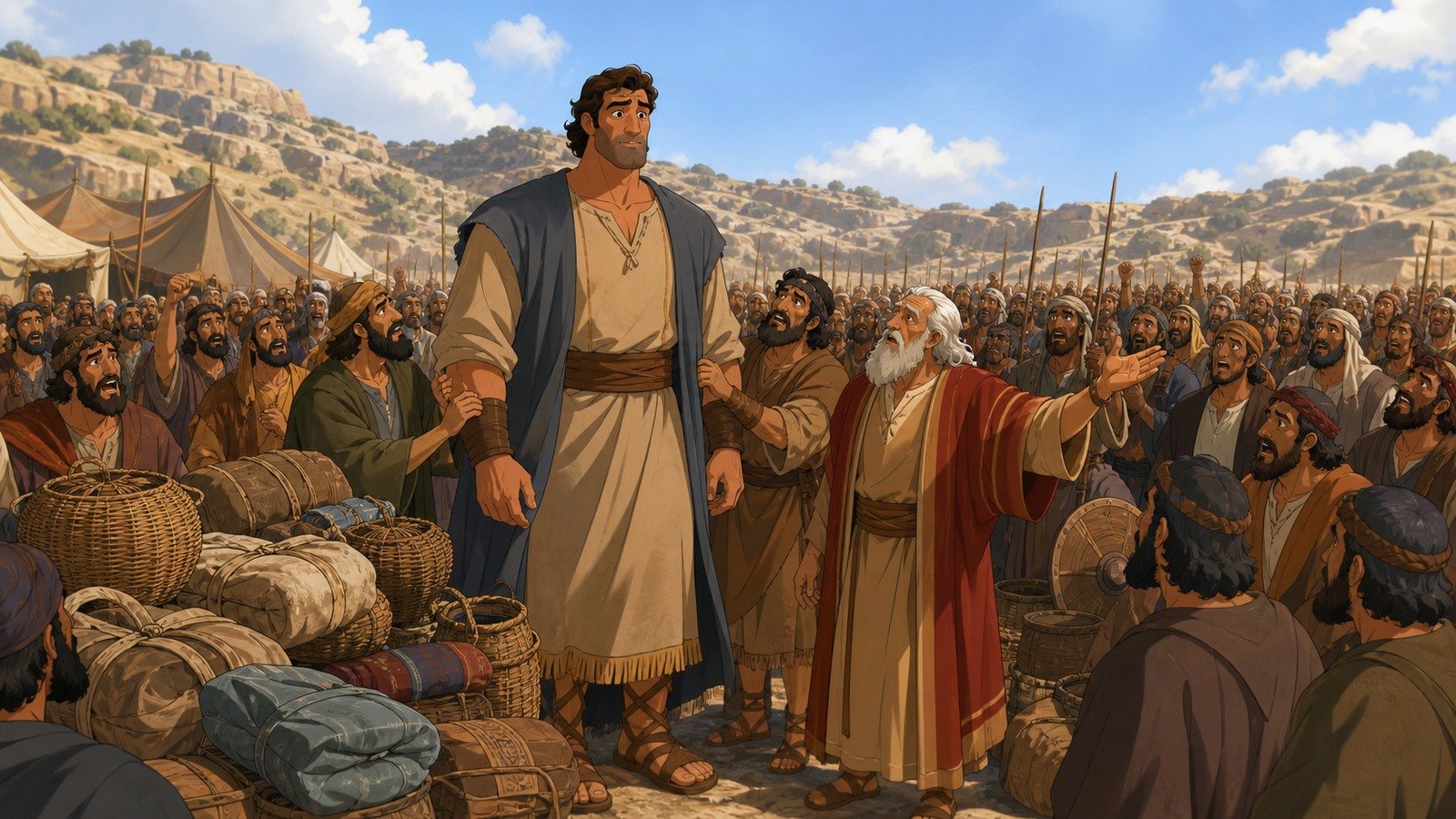
Saul is chosen by lot before the assembled tribes at Mizpah and publicly acclaimed king, despite hiding among the supplies out of reluctance, and despite a group of troublemakers who openly doubt he can save Israel.
Further context
2 min readMizpah is a town in Benjamin about thirteen kilometres north of Jerusalem, and it had been the assembly point for national business for generations. The whole nation is summoned there, and Samuel opens the proceedings with a speech that is not a coronation address. This is what the LORD says: I brought Israel up out of Egypt and delivered you from the power of the Egyptians and all the kingdoms that oppressed you. But you have now rejected your God, who saves you out of all your disasters, and you have said, no, appoint a king over us.
The selection is then made by lot. The field is narrowed in stages, tribe by tribe, then clan, then family, then individual, which removes human preference from the outcome and makes the result impossible to dispute. The lot falls on Saul son of Kish.
He is not there. They have to ask where he is, and the answer comes back that he has hidden himself among the supplies. He is fetched out and stands a head taller than everyone, and Samuel says, do you see the man the LORD has chosen? There is no one like him among all the people. The crowd shouts, long live the king.
Then Samuel does something that shows what kind of monarchy this is meant to be. He explains the regulations of the kingship, writes them on a scroll and deposits it before the LORD. The king is being placed under a written constitution on the day he is acclaimed, and the document is lodged at the sanctuary rather than in the palace, because there is no palace.
Gibeah is worth a note because of what had happened there. It was the town whose men assaulted the Levite's concubine at the end of the previous era, triggering the civil war that reduced Benjamin to six hundred survivors. The first king of Israel comes from the tribe that was nearly wiped out and from the town that caused it, and both facts were known to everyone standing at Mizpah.
Everyone goes home, including Saul, who goes back to Gibeah accompanied by valiant men whose hearts God had touched. There is no capital, no court, no throne and no salary. He returns to his farm.
Not everyone is convinced. A group described as troublemakers ask how this fellow can save them, and they bring him no gift, which was the customary token of allegiance. The objection is left standing, and Saul's response is one clause: he kept silent.
The threat behind the whole exercise was real and immediate. The Philistines held a technological advantage described in unusual detail a few chapters later: no blacksmith was permitted anywhere in Israel, so Israelite farmers went down into Philistine territory to have ploughshares, mattocks, axes and sickles sharpened, and on the day of one battle only Saul and his son Jonathan had a sword or a spear. That picture fits the archaeological transition from bronze to iron, when control of ironworking was a strategic asset and the Philistines held it.
A tall farmer with a private constitution, a group of volunteers and no weapons is what the demand for a king actually produced.