

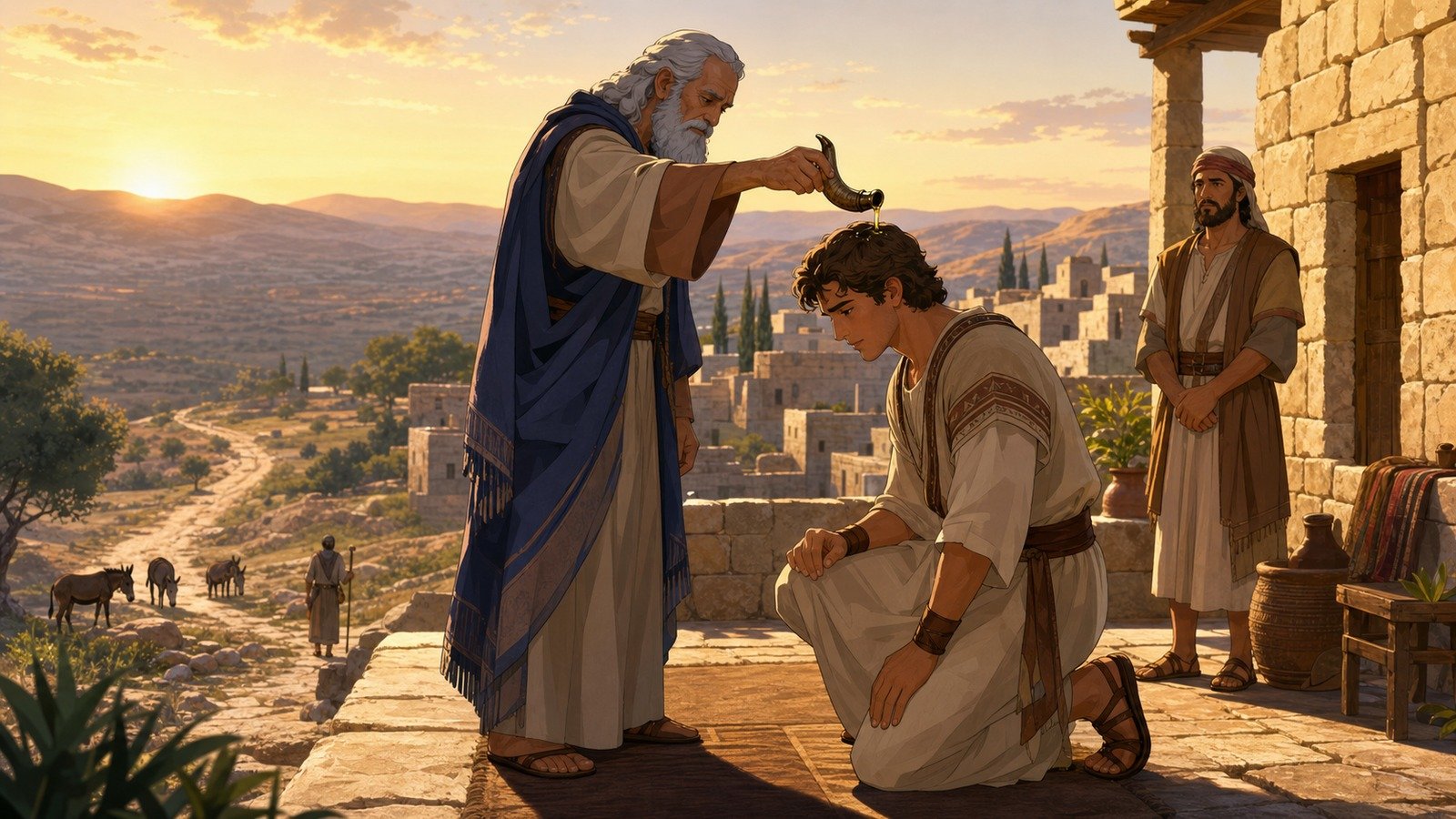
Samuel privately anoints Saul, a tall Benjamite out searching for his father's lost donkeys, telling him God has chosen him to lead Israel, though Saul himself hides the news from his own family.
Further context
2 min readA young man goes looking for his father's lost donkeys and comes back a king. That is the whole shape of it, and it is told with a domestic ordinariness that is unusual for a royal accession.
Saul is a Benjamite, son of Kish, from the smallest of the tribes and from a clan he himself calls the least of it. He is described as impressive and a head taller than anyone else in Israel, which is the sort of thing that mattered when a nation was choosing someone to go out before them and fight their battles.
The donkeys are missing and he and a servant search three districts without success. When Saul wants to give up because his father will start worrying about them instead, it is the servant who suggests consulting the man of God in the nearby town, and Saul's objection is that they have no gift to bring. The servant has a quarter of a shekel of silver. A short explanatory note is attached about the word for a prophet having formerly been seer, which means the story was old enough by the time it was written down to need a gloss.
Samuel has been told the day before that a man from Benjamin will arrive and is to be anointed leader over God's people. When he sees him he says, this is the man I spoke to you about, and then tells him not to worry about the donkeys because they have been found, and adds a question Saul cannot possibly follow: to whom is all the desire of Israel turned, if not to you and your whole family?
Saul's answer is the objection of a man who thinks he has been mistaken for somebody else.
He is given the place of honour at a meal for thirty guests, with a portion set aside in advance, and in the morning Samuel takes a flask of oil, pours it on his head, kisses him and says the LORD has anointed him ruler over his inheritance. Three signs are given to confirm it, and all three happen the same day, including an encounter with a procession of prophets during which the Spirit comes on him and he prophesies with them, which produces a proverb people were still quoting: is Saul also among the prophets?
He then goes home and tells his uncle about the donkeys and says nothing whatever about the kingship.
The three signs given to him are worth listing because of what the third one does. He will meet two men who tell him the donkeys are found. He will meet three men going up to Bethel carrying goats, bread and wine, who will give him two loaves. And he will meet a procession of prophets coming down from the high place with lyre, tambourine, pipe and harp, and the Spirit will come on him and he will prophesy and be changed into a different person. The first two confirm the message. The third changes the man.
How long he reigned is unrecoverable. The sentence that should give his age at accession and the length of his reign is damaged in the Hebrew, with the numbers missing, and the forty years usually quoted comes from a speech of Paul's recorded centuries later.