

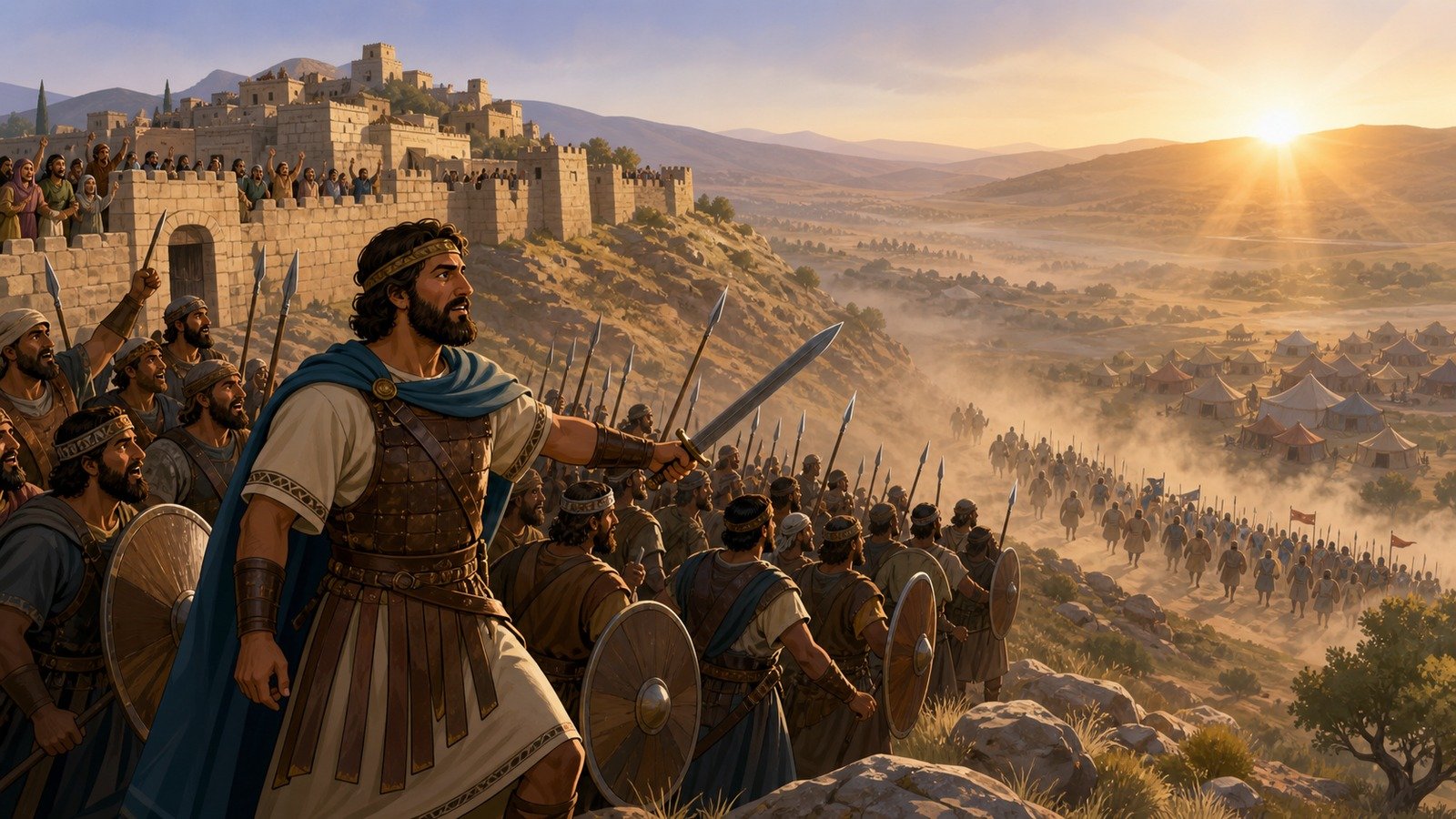
Saul rallies Israel to relieve Jabesh-Gilead, besieged by Nahash the Ammonite, winning a decisive victory that silences earlier doubts about his kingship and leads to its public confirmation at Gilgal.
Further context
2 min readNahash the Ammonite besieges Jabesh Gilead, east of the Jordan, and the town offers to surrender and become his subjects. His terms are deliberately humiliating: he will make a treaty only on condition that he gouges out the right eye of every man, and so bring disgrace on all Israel. A copy of this material found among the Dead Sea Scrolls includes a longer introduction explaining that he had already done this to the Gadites and Reubenites east of the Jordan, and that seven thousand men had escaped to Jabesh.
The elders of Jabesh ask for seven days to send messengers throughout Israel, and Nahash grants it, which tells you how confident he was that nobody would come.
The messengers reach Gibeah and the town weeps aloud. Saul is coming in behind his oxen from the fields, which is where the newly acclaimed king of Israel still is, and he asks why the people are weeping. When he hears, the Spirit of God comes powerfully on him and he burns with anger. He takes a pair of oxen, cuts them into pieces and sends the pieces through the whole country by messenger with a warning: this is what will be done to the oxen of anyone who does not follow Saul and Samuel.
The method is a deliberate echo of the appalling episode that closed the previous era, when a Levite cut up his dead concubine and sent the pieces through Israel to summon a war. Saul uses the same summons with livestock, and where the earlier one produced a civil war that nearly destroyed a tribe, this one produces a national army.
Three hundred and thirty thousand respond, according to the figures given. They march overnight, attack in three divisions during the last watch, and by the heat of the day the Ammonites are scattered so completely that no two of them are left together.
The response is also the last time the old system works. Nobody is conscripted, no tax is levied, and no standing army exists; a man behind a plough sends out a summons and a nation turns up. Within two generations the same country will need twelve districts, a monthly supply rota and a minister for forced labour to do considerably less.
The aftermath is the making of him. Some in the crowd want the men who had questioned his fitness brought out and put to death. He refuses, and the ground he gives is that nobody will be executed today, because this is the day the LORD has rescued Israel.
Samuel then takes the whole nation to Gilgal, where the kingship is confirmed and fellowship offerings are made, and everyone celebrates.
That is the high point of Saul's reign and it comes almost at the beginning. He is decisive, generous to his opponents, and correct about who won the battle. Almost everything after it runs the other way.