

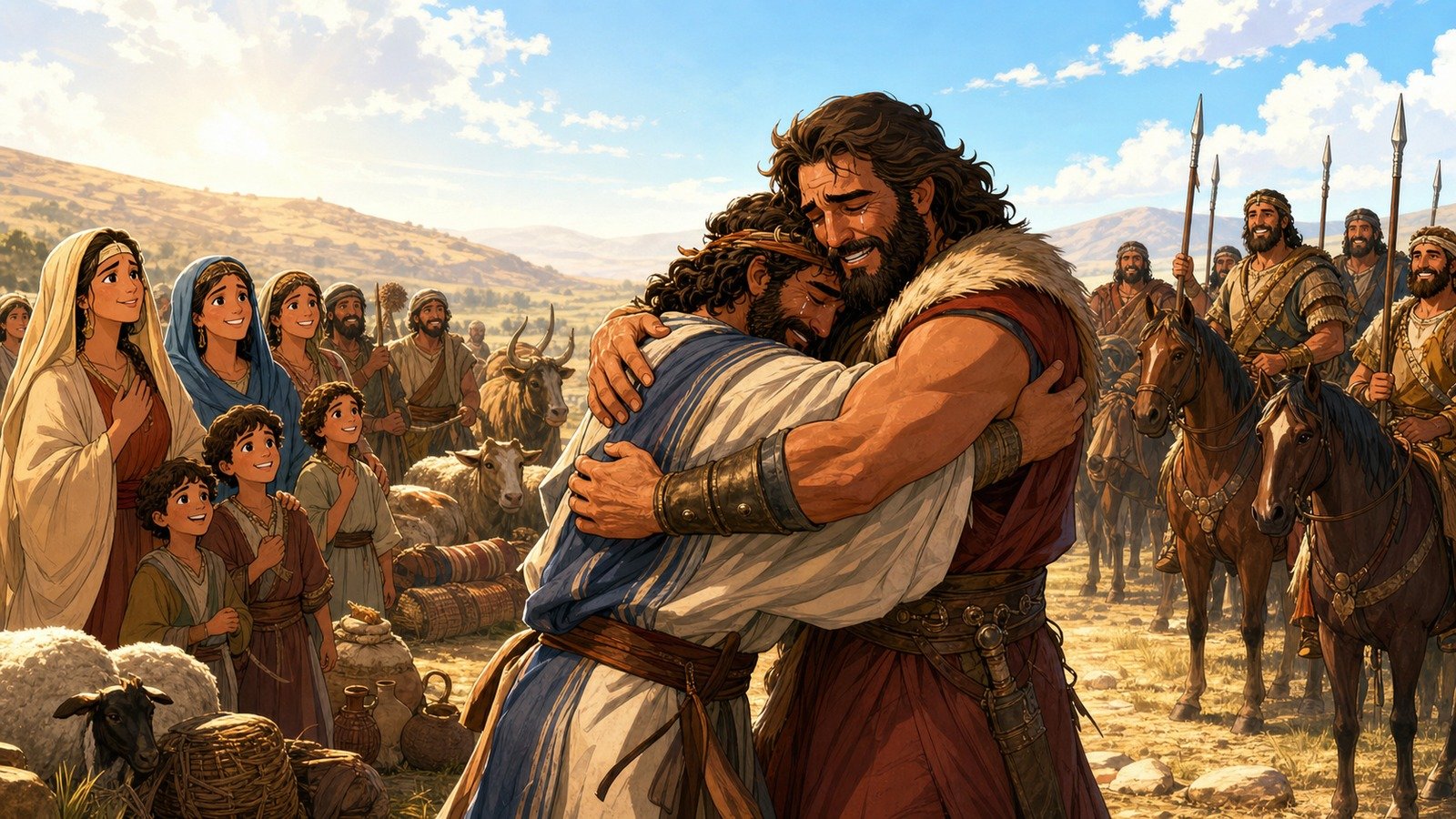
After twenty years apart, Esau runs to meet Jacob, embraces him, and weeps; the feared confrontation becomes a reconciliation, and the brothers part peacefully to settle in different regions.
Further context
3 min readJacob looks up and sees his brother Esau coming with four hundred men, and his first act is to arrange his family for what he expects to be an attack. He divides the children among the four women and sets them in order: the two servants and their children in front, Leah and her children behind them, Rachel and Joseph at the back.
The order is a ranking and everyone standing in it could see where they had been put. The people most likely to survive are the ones he loves most, and the ones he loves least stand where the blow will land first. That is reported without a word of comment.
He then goes ahead of them all and bows to the ground seven times as he approaches. That is diplomatic protocol rather than personal humility. Letters from Canaanite rulers to the Egyptian court in the fourteenth century BC open with almost identical language, the writer falling at the feet of his lord seven times and seven times, and Jacob is approaching his brother the way a vassal approaches an overlord.
None of it turns out to be necessary. Esau runs to meet him, throws his arms around his neck and kisses him, and they weep. Nothing explains the change, and Esau makes no speech about forgiveness. He asks who the women and children are, and then asks what all the droves of animals were for.
The exchange over the gift is the heart of it. Esau says he has plenty and Jacob should keep what is his. Jacob presses him, and two of his sentences carry the weight. The first is that seeing his brother's face is like seeing the face of God, which repeats the name he gave the ford the night before. The second is the word he uses for the present: in Hebrew it is his blessing (berakah), the same noun used for what he took by deceit twenty years earlier. He is handing the blessing back, and Esau accepts only after being urged.
Esau proposes travelling together and Jacob declines, saying the children are young and the flocks and herds are nursing, and that he will come on to Seir at his own pace. He then goes to Succoth and afterwards to Shechem, in the opposite direction. He is never recorded visiting Seir, and the two brothers appear together once more, at their father's burial.
What Esau does not do is as striking as what he does. He asks no questions about the blessing, demands no restitution for the birthright, and makes no reference to either. He arrives with four hundred men and uses them as an escort rather than a weapon. The brother described as a man of the open country, given a future of living by the sword, turns out to be the one in the family who lets something go.
It ends with a purchase. He buys a plot of ground at Shechem from the sons of Hamor for a hundred pieces of silver, using an obsolete unit that occurs only three times in the whole Hebrew Bible and whose value is unknown. This is the second piece of land the family has ever owned in Canaan, after the burial cave at Hebron, and Joseph is eventually buried in it. He sets up an altar there and calls it God, the God of Israel, using the name he was given at the river.