

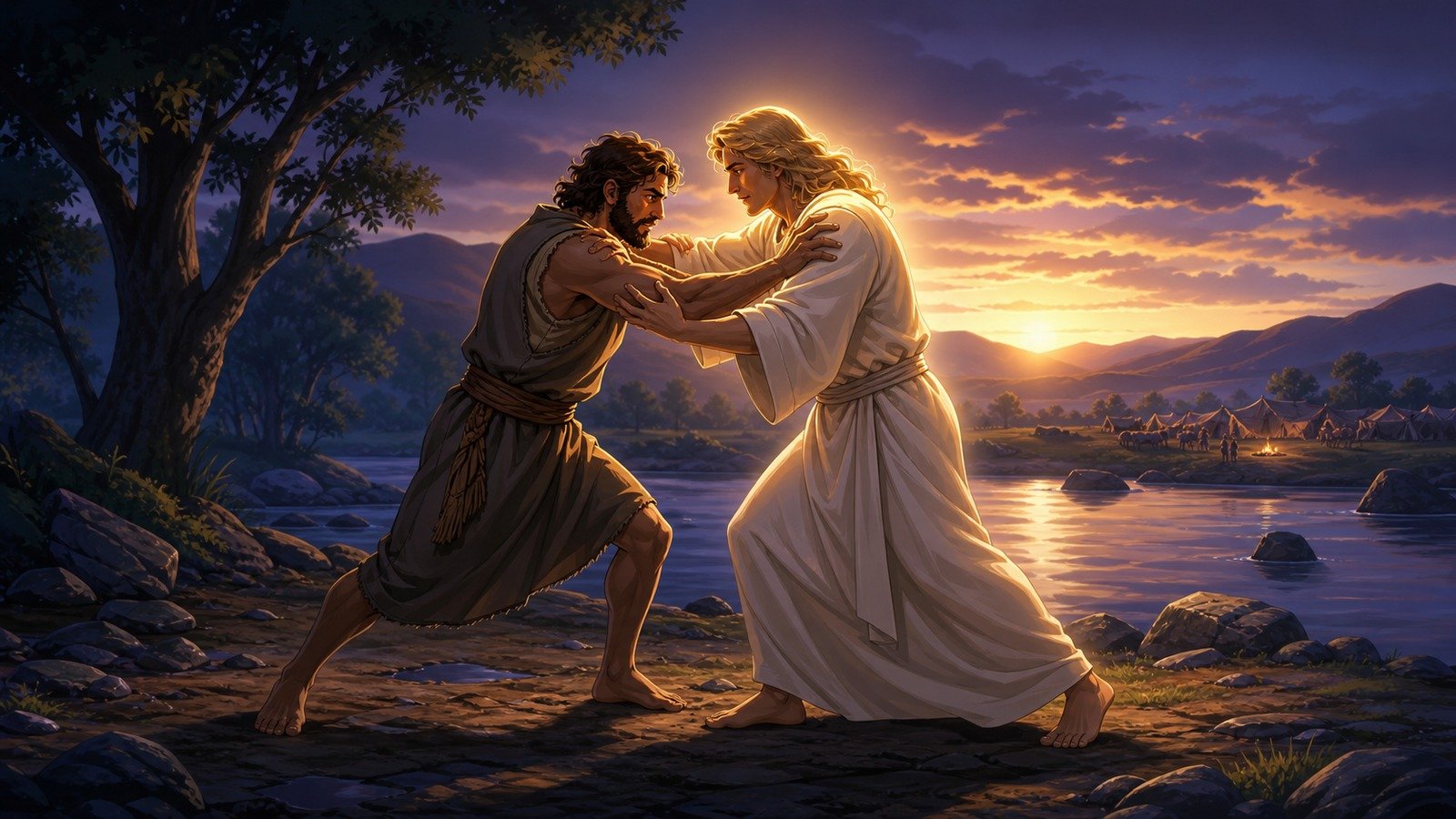
On the way to meet Esau, Jacob wrestles through the night with a divine figure, is given the name Israel ("he struggles with God"), and comes away with a permanent limp and a changed identity ahead of the reunion he fears.
Further context
2 min readThe messengers he sends ahead to his brother come back with one fact and no message: Esau is coming to meet you, and four hundred men are with him. He is in great fear and distress, and everything that follows is built out of what a frightened man does.
He divides the camp in two, so that if one is attacked the other may escape. Then he prays, and it is the first prayer of his recorded anywhere. It reminds God of the instruction to return, admits he is unworthy of the kindness shown him, and states a fact he has never mentioned before: I had only my staff when I crossed this Jordan, but now I have become two camps. Then he asks to be saved from his brother.
Then he sends presents, and the inventory is exact: two hundred female goats and twenty males, two hundred ewes and twenty rams, thirty female camels with their young, forty cows and ten bulls, twenty female donkeys and ten male. Five hundred and fifty animals, dispatched in separate droves with instructions to space them out, each servant repeating the same message, so that Esau meets a sequence of gifts before he meets his brother.
That night he takes his family across the ford of the Jabbok, the stream now called the Zarqa which joins the Jordan from the east, and is left alone. The names in that sentence are almost a pun on each other in Hebrew: Ya'aqov at the Yabboq, and the verb for wrestling (ye'aveq).
A man wrestles with him until daybreak. Who the man is never gets stated. When he sees that he cannot overpower Jacob he touches the socket of his hip and wrenches it, and Jacob holds on anyway. The exchange that follows is short. Let me go, for it is daybreak. I will not let you go unless you bless me. What is your name?
The last time Jacob was asked his name, in a darkened room by a blind father, he answered Esau. Here he answers Jacob, which is itself an admission, since the name means one who supplants.
The reply gives him a new one. You will no longer be called Jacob, but Israel, because you have struggled with God and with humans and have overcome. How the new name should be derived is debated, with proposals including "he struggles with God" and "God rules".
He asks the man's name in turn and is refused, which is the clearest indication in the whole episode of what he has been dealing with. He calls the place Peniel, face of God, saying he saw God face to face and his life was spared. The sun comes up as he passes the place, and he is limping.
Hosea refers back to it centuries later, saying he struggled with the angel and overcame him, and that he wept and begged for favour. That last detail appears nowhere in the original scene.
The limp is permanent. The man who has spent his life outmanoeuvring people, and who has just spent a night refusing to let go, walks out of it with a new name, his brother's army still on the horizon, and a hip that will not work properly again.