

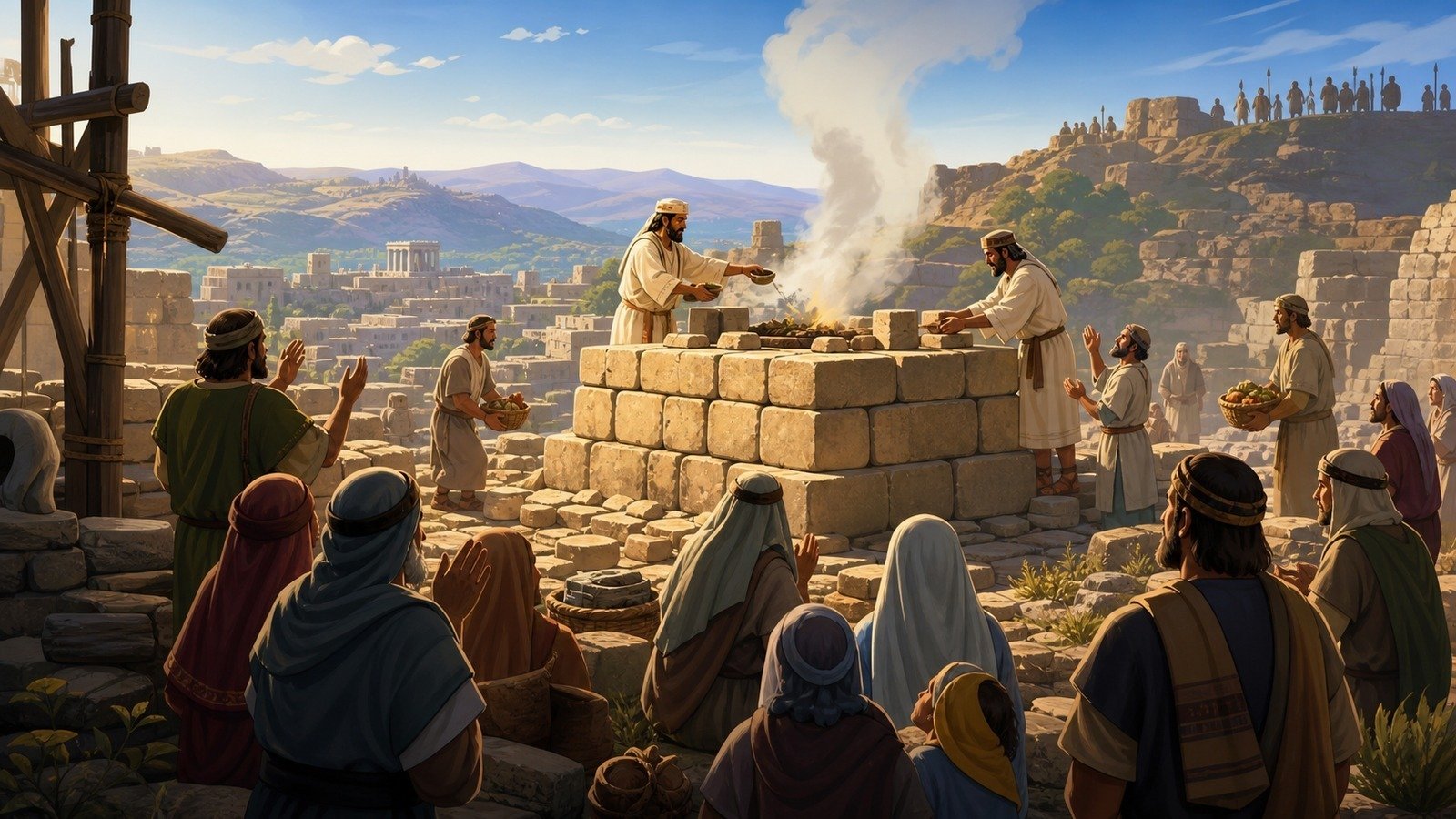
The returned exiles rebuild the altar on its original site and resume sacrifice despite their fear of surrounding peoples, restoring regular worship before the Temple itself is rebuilt.
Further context
3 min readIn the seventh month, with the people settled in their towns, they assemble as one in Jerusalem, and the first thing built is not the temple.
Joshua the high priest and Zerubbabel rebuild the altar of the God of Israel to sacrifice burnt offerings on it, in accordance with what is written in the Law of Moses. The building it belongs to does not exist, the foundations have not been laid, and the platform is a ruin, and they put up an altar on it and start the daily offerings.
The reason given for the timing is fear: despite their fear of the peoples around them, they built the altar on its foundation and sacrificed burnt offerings on it to the LORD, both the morning and evening sacrifices.
Then the Festival of Tabernacles is celebrated with the required number of burnt offerings for each day, and after that the regular morning and evening sacrifices, the new moon sacrifices and those for all the appointed sacred festivals, as well as those brought as freewill offerings.
The seventh month is the one containing the new year, the Day of Atonement and Tabernacles, so they have arrived at the fullest point of the calendar and are keeping all of it on a bare platform.
Tabernacles is also the most pointed festival they could have chosen to start with. It requires living in temporary shelters for a week as a reminder of the years in the wilderness between Egypt and the land, and a community that has just come back from fifty years in Mesopotamia and is camping in ruins is keeping a festival about being between places.
The daily sacrifice matters more than it looks. Morning and evening offerings had run continuously at the first temple and had stopped when the building burned, and starting them again on a rebuilt altar is the resumption of something interrupted for half a century rather than the beginning of something new. The same daily sacrifice is what a Greek king stops in the second century BC, and the phrase used for that is the removal of the regular burnt offering.
One thing is missing permanently and its absence is never explained. The ark had been in the innermost room of the first temple and it is not in the inventory of returned vessels, not mentioned at the dedication of the second building, and never referred to again. What happened to it when the Babylonians stripped the temple is unknown, and the later Jewish and Christian traditions about it are speculation.
Nothing has been built. There is no roof, no sanctuary, no ark, no lampstand and no priesthood fully certified, since three families cannot document their descent. There is an altar on an old foundation, and the offerings are being made twice a day at the correct hours.
The altar goes up before anything else, on its old foundations, and the reason given is fear: despite their fear of the peoples around them they built the altar and sacrificed burnt offerings on it to the LORD, both the morning and evening sacrifices.
The Feast of Tabernacles is kept, with the correct number of offerings for each day, and then the regular cycle resumes: the daily sacrifices, the new moons and all the appointed festivals.
None of that requires a building. What it requires is a stone platform, a supply of animals and priests who know the order of service, and the point of doing it first is that worship restarts before the architecture does.
Money is paid to masons and carpenters, and food, drink and olive oil are sent to Sidon and Tyre so that cedar logs can be floated down the coast from Lebanon to Joppa, which is the same arrangement Solomon had made four centuries earlier.