

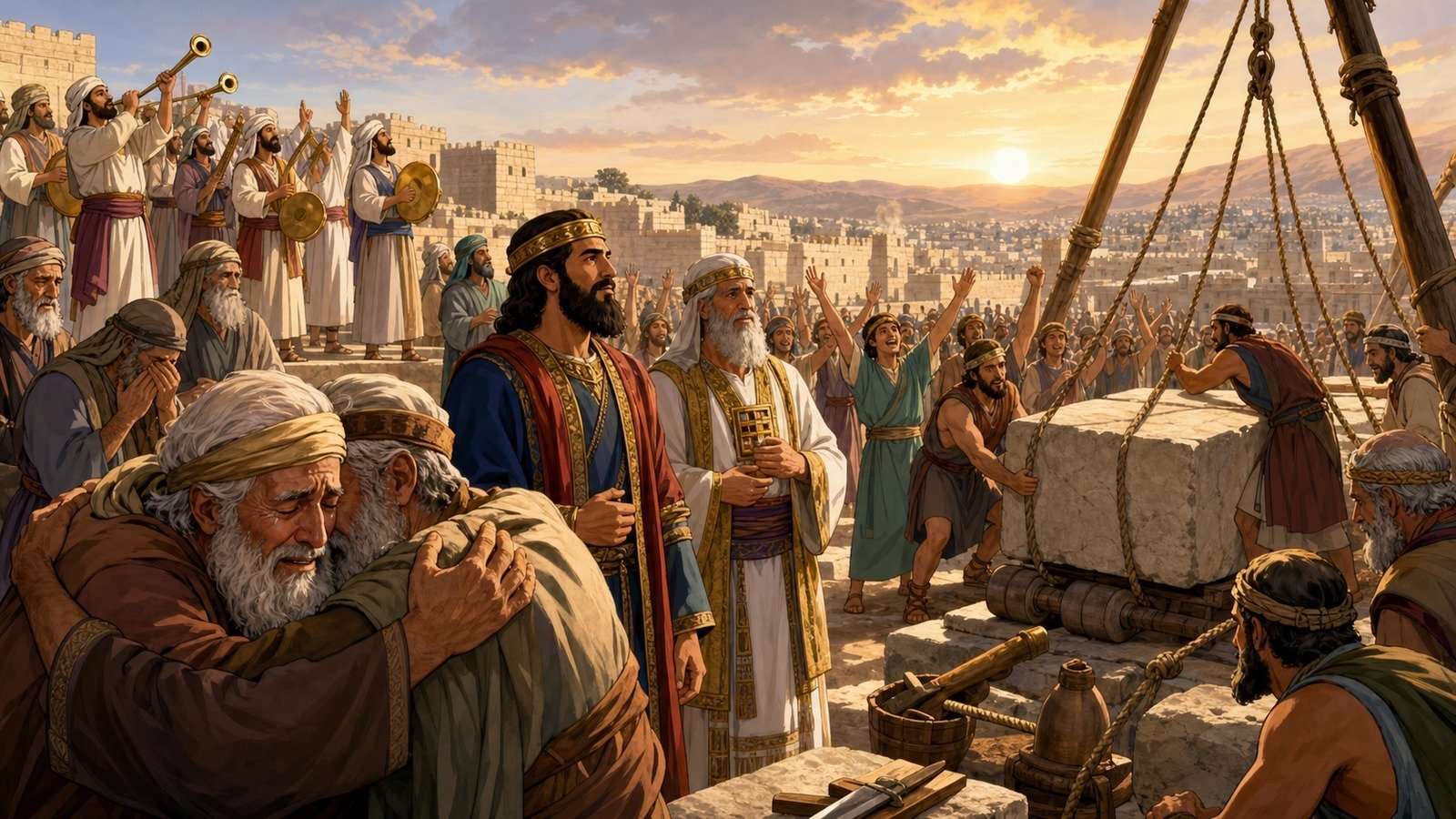
The Temple's foundation is laid amid mixed reactions: older exiles who remembered Solomon's Temple weep at the comparison, while others shout for joy at the restoration beginning at all.
Further context
3 min readMoney is given to masons and carpenters, and food, drink and olive oil are sent to Sidon and Tyre so that cedar logs can be floated by sea from Lebanon to Joppa, which is the same arrangement Solomon had made four and a half centuries earlier and is authorised by Cyrus.
The work begins in the second month of the second year after arriving, and Levites aged twenty and over are appointed to supervise it.
When the builders lay the foundation, the ceremony is staged with the old order: priests in their vestments with trumpets, Levites with cymbals, taking their places to praise the LORD as prescribed by David king of Israel. They sing responsively, with praise and thanksgiving: he is good; his love towards Israel endures for ever. And all the people give a great shout of praise, because the foundation of the house of the LORD is laid.
Then the sentence that makes this episode unlike any other dedication in these books.
Many of the older priests and Levites and family heads, who had seen the former temple, wept aloud when they saw the foundation of this temple being laid, while many others shouted for joy. No one could distinguish the sound of the shouts of joy from the sound of weeping, because the people made so much noise, and the sound was heard far away.
The men weeping are over sixty. They were children in Jerusalem before it burned and they are standing on the same platform looking at a foundation that is visibly smaller than the one they remember. The people shouting are the ones born in Babylonia who have never seen a temple at all.
The building itself was substantially smaller than Solomon's, and the imperial decree specifies dimensions of sixty cubits in height and width, which is why the men who remembered the first one wept. Nothing of the second structure survives either, since Herod's reconstruction four and a half centuries later replaced it entirely.
Neither reaction is corrected and neither is presented as the right one. The two noises are described as indistinguishable at a distance, which is as accurate an image of a diminished restoration as anyone has produced.
Haggai returns to that comparison sixteen years later when the work has stalled, and asks the survivors directly: who of you is left who saw this house in its former glory? How does it look to you now? Does it not seem to you like nothing? And then a promise that does not deny the comparison: the glory of this present house will be greater than the glory of the former house.
The building that eventually stands there is the one Herod later enlarges enormously, and it is the temple of the Gospels. Nothing of Solomon's survives except the platform, and the western retaining wall of the later expansion is the wall people still pray at.
The foundation ceremony has a detail nobody would invent. When the builders laid the foundation, the priests came in vestments with trumpets and the Levites with cymbals, and the people gave a great shout of praise.
But many of the older priests and Levites and family heads, who had seen the former temple, wept aloud when they saw the foundation of this temple being laid, while many others shouted for joy. No one could distinguish the sound of the shouts of joy from the sound of weeping, because the people made so much noise that the sound was heard far away.
Those who wept were men in their seventies and eighties who had seen Solomon's building as boys, fifty years earlier, and were now looking at the outline of something much smaller.
Haggai addresses them directly a few years later: who of you is left who saw this house in its former glory? How does it look to you now?