

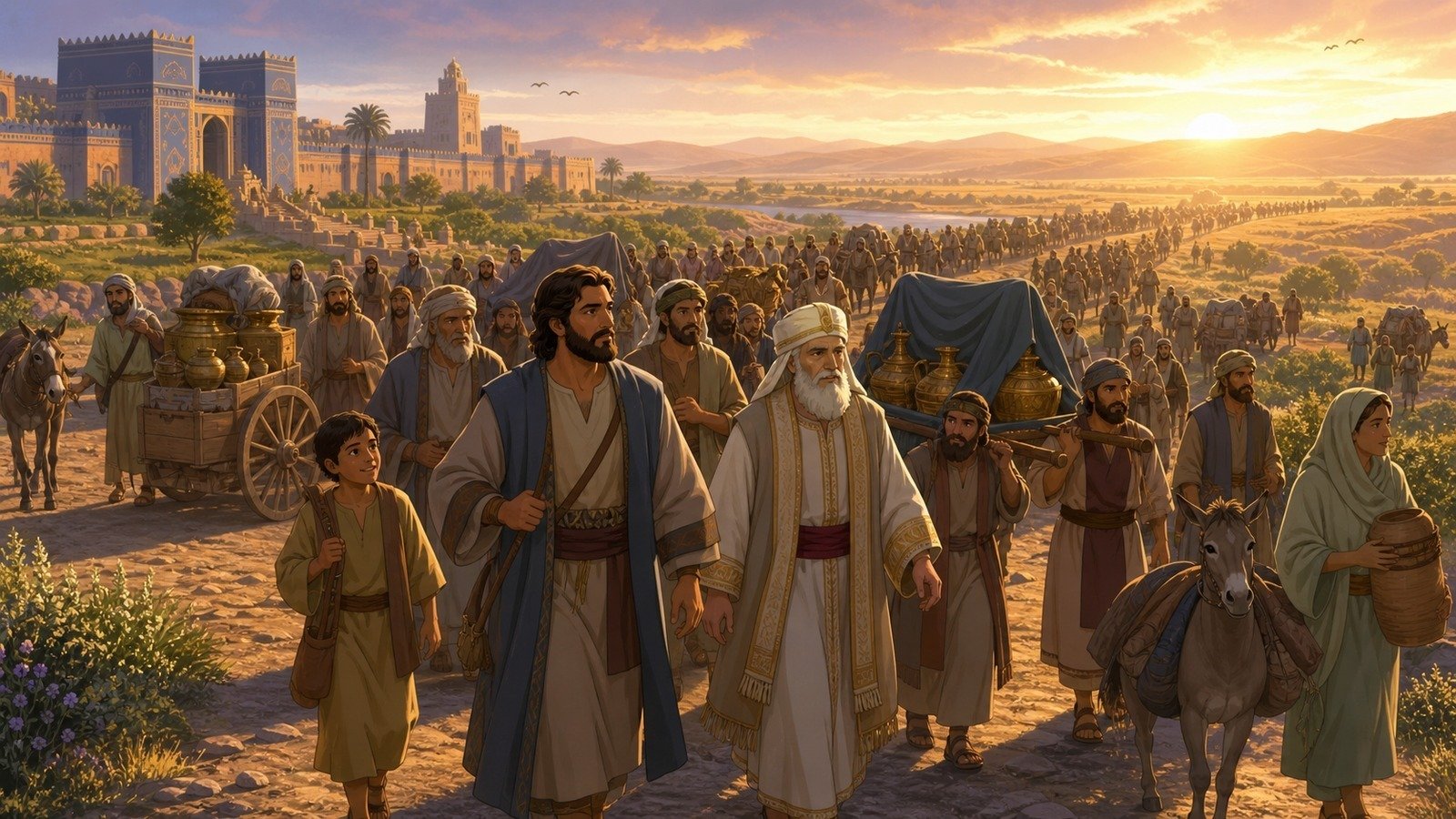
Roughly 50,000 Jews, led by the Davidic descendant Zerubbabel and the high priest Joshua, return to Judah, carrying back the Temple articles Nebuchadnezzar had taken.
Further context
3 min readThe party that goes up numbers 42,360, besides 7,337 male and female servants and 200 male and female singers, and the list of who went is preserved in full: families by name with their numbers, towns with their returnees, priests by clan, Levites, singers, gatekeepers, temple servants and the descendants of Solomon's servants.
Three details in that list are more interesting than the totals.
The livestock are counted: 736 horses, 245 mules, 435 camels and 6,720 donkeys. That is a caravan, not a march, and it is carrying property.
Some families could not show that their ancestors were Israelites and their names are recorded anyway, along with the fact that they could not prove it. Three priestly families searched for their family records and could not find them, and were excluded from the priesthood as unclean until a priest could consult the Urim and Thummim, which had not been available for generations. Nobody quietly dropped them from the list.
And the total of individuals named in the list does not add up to the total given at the end, in either of the two places the register is preserved, and the two versions disagree with each other on several figures. A copied administrative document with accumulating numerical errors is exactly what that looks like.
Two men lead them. Zerubbabel is a grandson of Jehoiachin, the king deported in 597, so the Davidic line is heading the return without holding a throne. Joshua son of Jozadak is the high priest, and his grandfather had been executed at Riblah when Jerusalem fell. The two offices that ended in 586 walk back together, one of them without a crown.
The journey is about fifteen hundred kilometres by the practicable route up the Euphrates and down through Syria, and it takes months.
What they arrive at is not a city. Jerusalem has been in ruins for fifty years, its walls broken down, its temple a burned platform. They settle in their own towns first, and the freewill offerings recorded are modest against the scale of what is needed: 61,000 darics of gold, 5,000 minas of silver and 100 priestly garments.
Sheshbazzar, who receives the temple vessels from the Persian treasurer and is called prince of Judah, is a puzzle. He appears in the imperial documents and is credited with laying the foundations, and Zerubbabel appears in the narrative doing much the same thing. Proposals include two names for one man, an older official succeeded by a younger relative, and a Persian-appointed governor working alongside a Davidic figurehead. The evidence supports the second and third about equally.
The generation that had been carried out in chains sends back its grandchildren with donkeys and a subscription list, and rather more than half of the community stays where it is.
The list of those who returned runs to about fifty thousand people including servants, and it is organised by family and by town, with the singers, gatekeepers and temple servants counted separately.
One group appears in it with a problem: three priestly families searched for their family records and could not find them, and were therefore excluded from the priesthood as unclean, pending a ruling by a priest using the Urim and Thummim, which no longer existed.
The animals are counted too: seven hundred and thirty-six horses, two hundred and forty-five mules, four hundred and thirty-five camels and six thousand seven hundred and twenty donkeys.
Sheshbazzar is named as the prince of Judah who carried the vessels, and Zerubbabel, a grandson of the exiled king Jehoiachin, leads with Joshua the high priest. A descendant of David is going back as a provincial governor rather than as a king.