

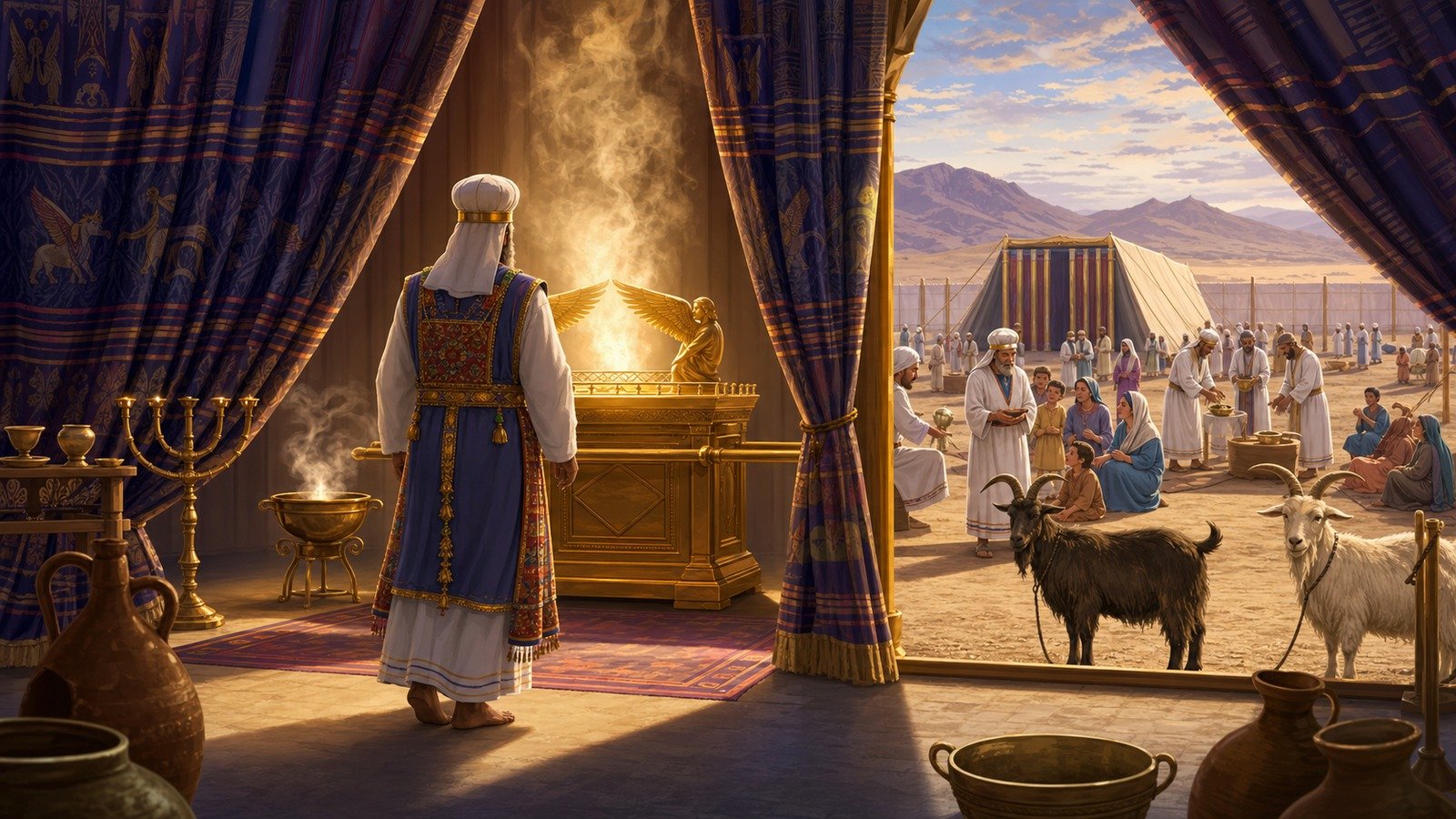
Extensive dietary and purity laws are given, along with the Day of Atonement ritual, the one day each year the high priest enters the Most Holy Place to make atonement for the nation's sin.
Further context
3 min readThe laws given to Israel at Sinai divide the animal world by criteria rather than by lists alone. Land animals must both chew the cud and have a divided hoof, which admits cattle, sheep and goats and excludes the pig, the camel and the hare, each named with the specific point on which it fails. Water creatures must have fins and scales, which excludes shellfish and eels. Birds are handled by a list, mostly of raptors and scavengers. Insects are excluded apart from certain locusts.
Explanations for the criteria have been offered for two thousand years, and none of them comes from the rules themselves. Hygiene is the most popular modern proposal and the weakest, since several permitted animals carry parasites and health is never mentioned. A symbolic reading holds that the rules exclude creatures that do not conform cleanly to their category, so that a fish without scales or a land animal moving like a reptile is anomalous. A social reading holds that their real function was to make ordinary daily life a constant marker of difference from surrounding peoples, which is demonstrably what they did. The only reason supplied is the one that closes the section: be holy, because I am holy.
One point of vocabulary prevents a good deal of confusion. Unclean here is a ritual category, not a moral or hygienic one. Childbirth makes a woman ritually unclean, and so does burying a relative, and neither is a sin. The state is temporary, has prescribed remedies, and concerns fitness to approach the sanctuary rather than the worth of the person.
The annual reset is the Day of Atonement, and it opens by dating itself after the deaths of Aaron's two sons, which supplies the reason for its severity. On one day a year, and no other, the high priest may go behind the curtain into the Most Holy Place. He removes his ornate garments, washes, and puts on plain linen. He offers a bull for himself and his own household first.
Two goats are then presented and lots are cast over them. One is for the LORD and is offered as a purification offering, and its blood is taken inside the curtain and sprinkled on the atonement cover. The other is kept alive. The high priest lays both hands on its head and confesses over it all the wickedness and rebellion of the Israelites, putting them on the goat's head, and a man appointed for the task leads it away into the wilderness.
The word attached to the second goat (Azazel) is uncertain. It has been read as a compound meaning the goat that goes away, which is the sense behind the English word scapegoat coined by William Tyndale in 1530, as the name of a desolate place, and as the name of a figure. The ancient translations already disagree and no reading has settled it.
The two goats do different things and are needed together. One deals with the sanctuary by blood; the other carries the guilt out of the camp and out of sight, and the community watches it go. The letter to the Hebrews works directly with this day, and its whole argument turns on the fact that the high priest went in once a year, and went in with blood that was not his own.