

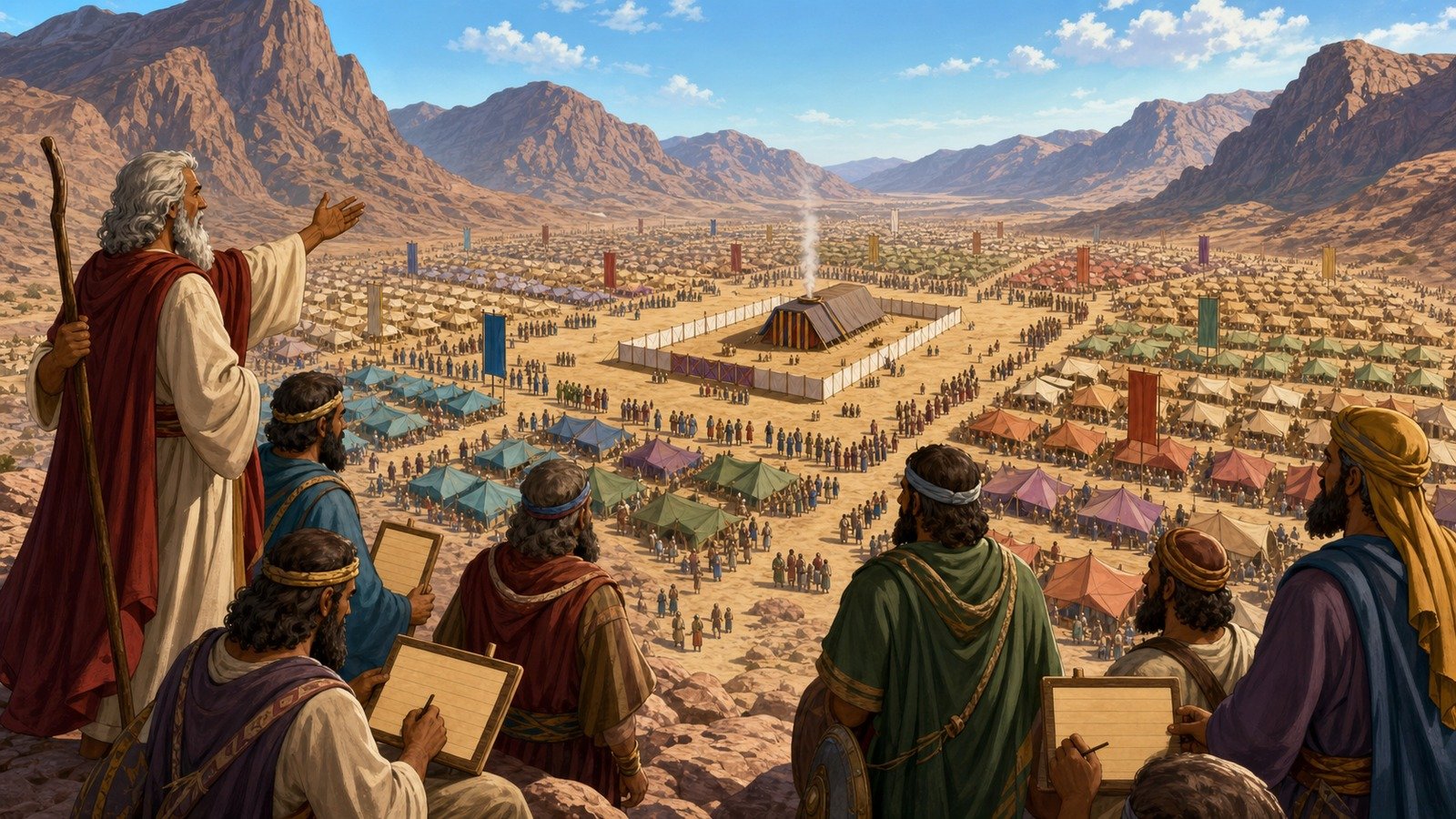
In the second year after the Exodus, Moses takes a census of Israel's fighting men by tribe and arranges the tribal encampments and marching order around the tabernacle at the centre.
Further context
3 min readThe date is given precisely: the first day of the second month of the second year after leaving Egypt, one month after the tent was set up. The English name of the book that follows comes through Greek and Latin from the two censuses it contains. Its Hebrew name is taken from the fifth word of its opening sentence, in the wilderness, which describes the contents better.
The count is of men aged twenty and over able to serve in the army, listed tribe by tribe with the name of the leader who assists. The total is 603,550, and the Levites are excluded and counted separately for a different purpose, since their responsibility is the sanctuary rather than the field.
That figure raises the same difficulties as the number given at the departure, and they are arithmetical rather than sceptical. A fighting force of six hundred thousand implies a population of around two million people in the Sinai. The tribal subtotals also sit oddly against a count of firstborn males, taken a few paragraphs later, which comes to 22,273 for the entire nation. The proposal that the Hebrew word for thousand functions here as a term for a clan or a military unit produces figures in the low thousands and resolves both problems, at the cost of having to explain totals that are added up as straightforward thousands. The question is open.
The arrangement of the camp is the more interesting part and it is usually skipped. The tent stands in the centre. The Levites camp immediately around it in a ring, which places a buffer between the sanctuary and everyone else. The twelve tribes then camp in four groups of three, one group on each side, at a stated distance.
On the east, where the entrance is, are Judah, Issachar and Zebulun, and Judah's division leads whenever the camp moves. On the south, Reuben, Simeon and Gad. On the west, Ephraim, Manasseh and Benjamin, the three descended from Rachel. On the north, Dan, Asher and Naphtali. Each group has a standard, and the order of march is specified: Judah first, then the sanctuary carried in the middle by the Levites, with the remaining divisions before and behind it.
The result is a community organised as a square with worship at the centre and a fixed order of precedence, able to strike camp and reassemble in the same configuration wherever it stops. It is also a military formation, and the census that precedes it is a muster roll.
The Levites are counted separately and by a different rule: every male from a month old rather than every man over twenty. They are not being mustered for war. Their number is then set against the number of firstborn males in the whole nation, and the difference is settled by a payment, because the firstborn of Israel had been claimed at the Passover and the tribe of Levi is being substituted for them. It is an accounting exercise with a theological purpose, and it explains why this one tribe is exempt from the census that matters militarily.
Everything is now ready. The people have a law, a priesthood, a sanctuary, a calendar, a marching order and an army, one year after walking out of a brickyard. What follows is a generation that will not reach the destination all of this was built to advance towards.