
With Haman's decree still technically in force, a second royal edict allows the Jews to defend themselves; their deliverance is commemorated ever after in the festival of Purim.
Further context
3 min readHaman is dead and the problem is not solved, and the reason is constitutional. No document written in the king's name and sealed with his ring can be revoked, and the decree ordering the destruction of the Jews on the thirteenth day of the twelfth month is already in every province in every language.
The solution is a second decree that cannot cancel the first but can neutralise it. The Jews in every city are granted the right to assemble and protect themselves, to destroy, kill and annihilate any armed force that might attack them, on that same day. Couriers riding fast horses bred for the royal service carry it out across the empire.
What follows on the day is described as self-defence, and the detail insisted on three times is that they did not lay their hands on the plunder, which distinguishes it from an ordinary massacre and is a deliberate contrast with Saul, who took the Amalekite livestock and lost his kingdom over it.
The casualty figures are large, five hundred in the citadel of Susa and seventy-five thousand in the provinces, and the ten sons of Haman are killed. A second day is granted in Susa at Esther's request, which is the hardest thing in the book to read sympathetically and is not explained.
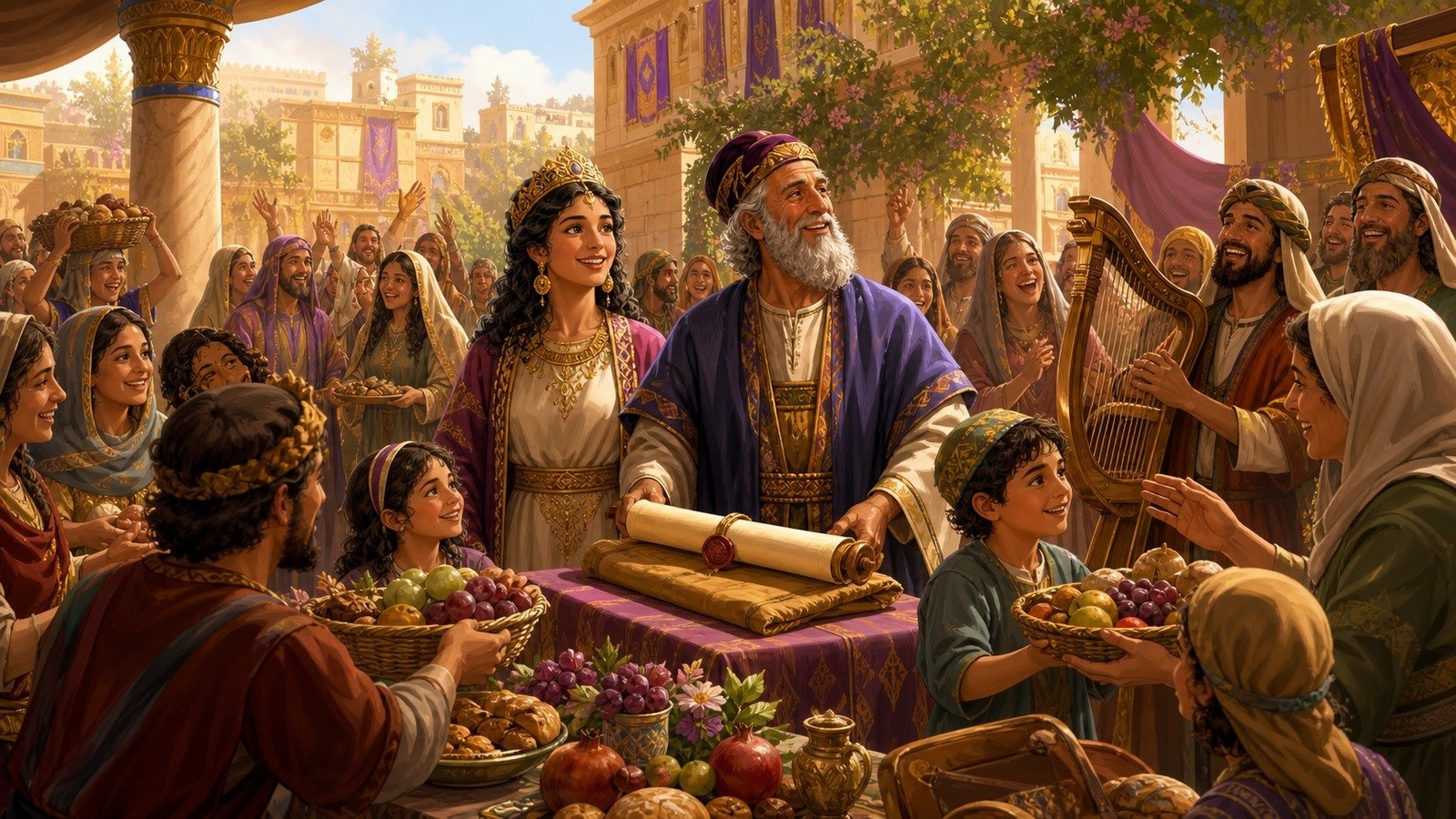
The festival is then established formally, with letters sent to all the Jews in all the provinces instructing them to keep the fourteenth and fifteenth of Adar annually as the days on which their sorrow was turned into joy and their mourning into a day of celebration, to be observed with feasting and joy, giving presents of food to one another and gifts to the poor.
The name comes from the lot Haman cast to pick the date, and the festival keeps the name of the instrument he used to choose a day for the killing.
The second day granted at Susa is the element most readers find hardest, and nothing explains it. The most that can be said is that the book is describing a community acting under a decree of extermination that could not legally be cancelled, that the killing is limited to those who attacked, and that the refusal to take plunder is insisted on three separate times. None of that makes it comfortable.
Purim is still kept. The scroll is read aloud in synagogues, the congregation makes noise whenever Haman's name is said, food parcels are exchanged and gifts are given to the poor, exactly as the letters specify.
The book has no miracle in it, no mention of God and no mention of prayer, and the only religious act anybody performs is a three-day fast whose object is never named. What it describes instead is a series of coincidences that arrive in the right order, and it leaves the reader to decide what to call that. Mordecai's sentence about relief arising from another place is the closest anyone comes to saying it out loud.
The name comes from pur, a word the book explains as meaning lot, and the lot was cast in Haman's presence to select the month and day for the massacre. Clay dice of exactly that kind, inscribed and used for selecting dates and officials, have been excavated in Mesopotamia.
The reversal is the shape of the whole book. The gallows built for Mordecai is used for Haman. The decree that could not be revoked is countered by a second decree allowing the Jews to defend themselves. The month that was to be their destruction becomes a festival.
Purim is still kept, and the customs attached to it are unusually boisterous: the whole book is read aloud in the synagogue, the congregation makes noise at every mention of Haman's name, gifts of food are exchanged, and the poor are given money.
It is the only Jewish festival that originates outside the land of Israel.