

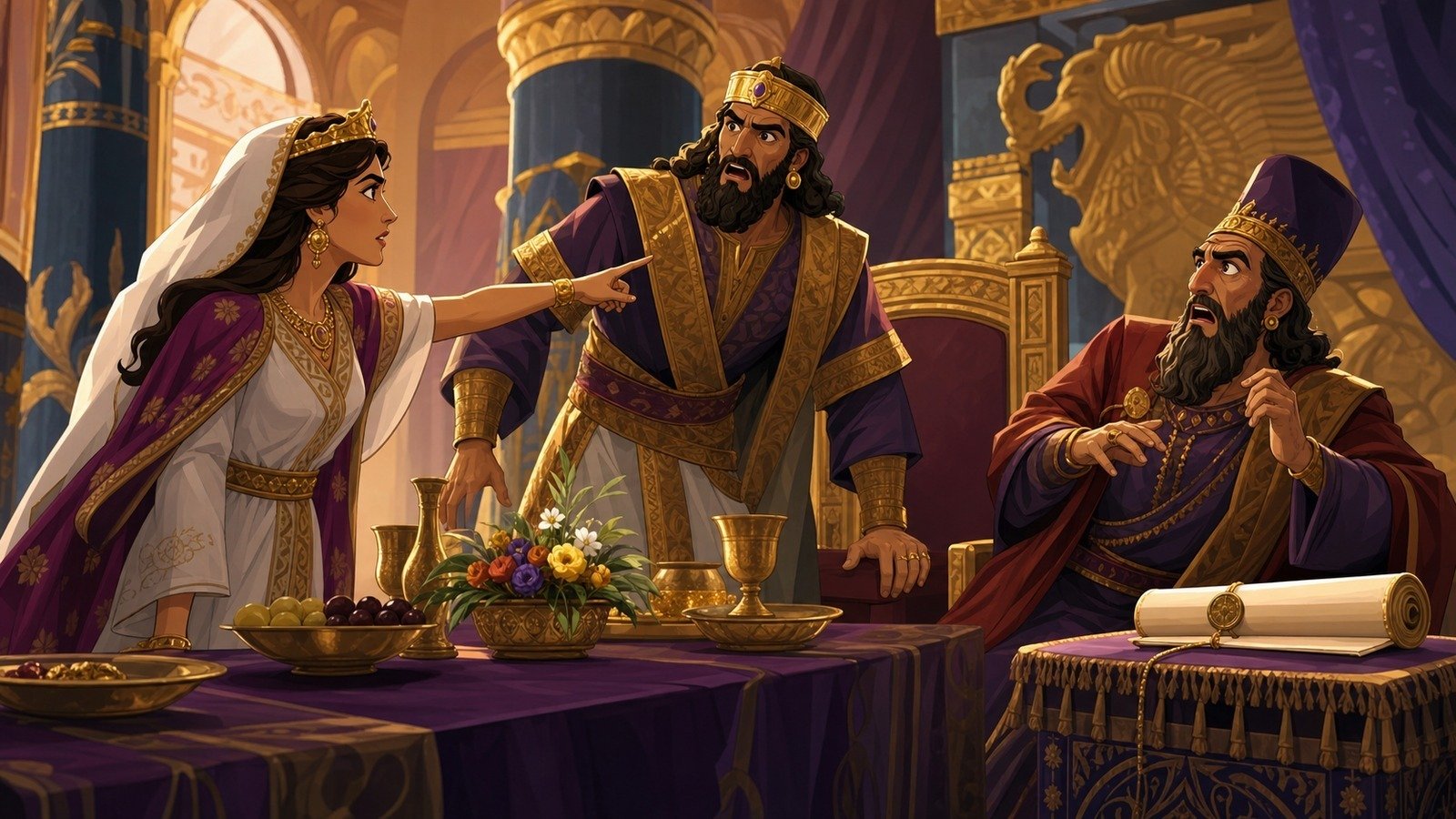
The court official Haman, enraged by Mordecai's refusal to bow to him, secures a decree to annihilate the Jews throughout the empire; Esther risks her life by approaching the king unsummoned and exposes Haman's plot at a private banquet.
Further context
3 min readHaman is promoted above all the other nobles and everyone at the king's gate kneels to him, and Mordecai will not. Asked repeatedly why, he tells them he is a Jew, and the answer is enough for Haman to decide that killing one man is beneath him.
He is introduced as an Agagite, which is not a random detail. Agag was the Amalekite king Saul spared, and Mordecai is described as a Benjamite descended from Kish, which is Saul's own line. A quarrel that started with a raid on stragglers in the Sinai is being finished in a Persian palace.
The lot is cast to choose the date, and the Persian word for that lot gives the festival its name. It falls on the twelfth month, which gives everyone eleven months' notice.
The proposal put to the king is a piece of administrative language with an enormous number attached: there is a certain people dispersed among the peoples in all the provinces of your kingdom who keep themselves separate, whose customs are different and who do not obey the king's laws. It is not in the king's best interest to tolerate them. If it pleases the king, let a decree be issued to destroy them, and I will give ten thousand talents of silver into the royal treasury. The king takes off his signet ring and hands it over without asking who the people are.
Mordecai's message to Esther is the sentence the book is remembered for. Do not think that because you are in the king's house you alone of all the Jews will escape. For if you remain silent at this time, relief and deliverance for the Jews will arise from another place, but you and your father's family will perish. And who knows but that you have come to your royal position for such a time as this.
Her reply sets the terms: fast for me, three days and nights, and I will go to the king even though it is against the law. And if I perish, I perish.
What she then does is not a plea but a manoeuvre. She invites the king and Haman to a banquet, and at the banquet invites them to a second one the following day. In the interval Haman goes home elated, has a pole set up on which to impale Mordecai, and the king cannot sleep and has the annals read to him and discovers an unrewarded service.
At the second banquet she names her request, her people and the man, and Haman is impaled on the pole he had prepared.
Haman's grievance is that one man will not bow, and his response is to plan the extermination of an entire people across a hundred and twenty-seven provinces. He offers ten thousand talents of silver to the royal treasury to cover the cost, which is a sum comparable to a substantial fraction of the empire's annual revenue.
The turning point is a night when the king cannot sleep and has the record of his reign read to him, and the entry about Mordecai uncovering an assassination plot comes up, and it emerges that nothing was ever done about it.
Haman arrives that morning intending to ask for permission to hang him, and is asked instead what should be done for the man the king delights to honour. Assuming it is himself, he specifies a robe the king has worn, a horse the king has ridden, and a procession through the city square.
He then has to lead the horse.