
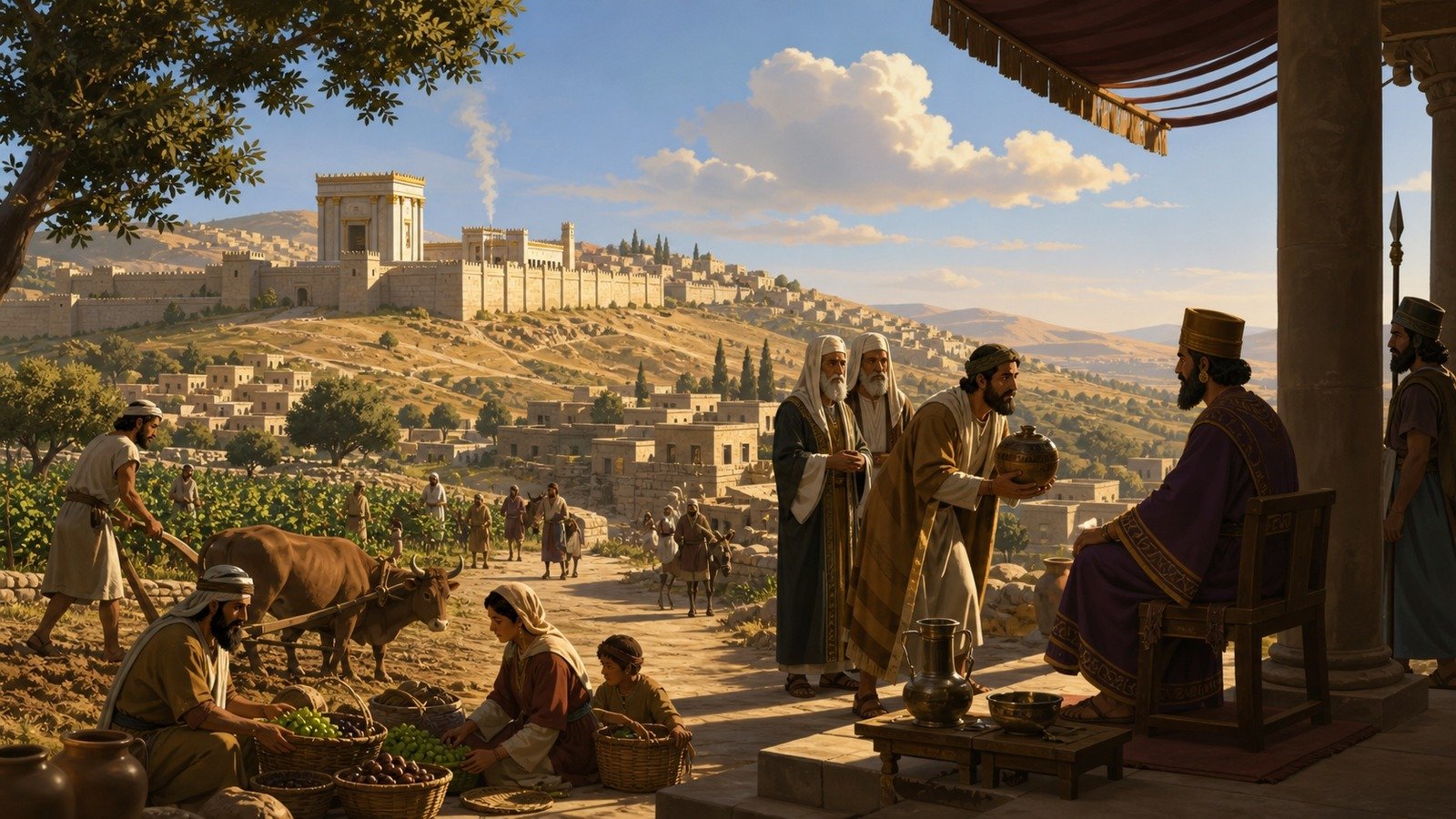
Judea remains a minor province of the Persian empire for roughly a century after Malachi, governed locally by the high priesthood under distant Persian oversight, a period from which almost no Biblical or detailed historical record survives.
No canonical Scripture reference (historical context outside the Protestant canon)
Further context
3 min readNothing in the Protestant Bible covers the century between Nehemiah and Alexander, and the label sometimes attached to it, the silent years, describes the absence of canonical text rather than an absence of history. A great deal happens, and most of it shapes the world the Gospels open in.
Judah is a small temple-state called Yehud, one district in the satrapy west of the Euphrates, and it is administered by the high priest under a Persian governor. That arrangement is the beginning of something with a long future: the high priesthood becomes a political office as much as a religious one, and by the first century it is bought, sold and appointed by whoever is in charge.
Coins minted in the province carry the name Yehud in Aramaic script, and a series of clay seal impressions from the period name governors, some of them Jewish. A Jewish military colony at Elephantine in southern Egypt has left a substantial archive of Aramaic papyri from the fifth century BC, including correspondence with the authorities in Jerusalem and Samaria about rebuilding their own temple, which shows a scattered Jewish population conducting its affairs across the empire.
Two developments in this period matter more than any political event.
The first is the consolidation of the scriptures. The five books of Moses become the settled constitutional document of the community, read publicly and interpreted, and the prophetic books are collected. The class of professional scribes and interpreters that Ezra represents becomes permanent, and it is the direct ancestor of the scribes and teachers of the law who appear in the Gospels.
The second is the shift in language. Aramaic had been the administrative language of the Assyrian and Persian empires and had become the everyday speech of the region. Hebrew survives as the language of scripture and worship and stops being what people speak at home, which is why the Levites had to explain the reading at the Water Gate, why Aramaic paraphrases eventually became standard in synagogues, and why Jesus speaks Aramaic four centuries later.
The synagogue itself probably emerges somewhere in this period, though the evidence is thin. A community scattered across an empire and unable to sacrifice anywhere except Jerusalem needed somewhere to gather, read and pray, and by the first century such buildings are everywhere.
A rival temple is also built on Mount Gerizim by the Samaritan community during these centuries, and excavation there has confirmed a substantial sanctuary. The dispute the Samaritan woman raises with Jesus about which mountain is the right place to worship goes back to it.
Almost nothing is known about Judea between Nehemiah and the arrival of the Greeks, roughly a century, and it is the emptiest stretch in the whole biblical timeline.
What can be said comes from administration. Judea was a small temple state within the Persian satrapy of Beyond the River, governed by the high priest under a provincial governor, paying tribute and left largely alone. Coins struck in the province carry the name Yehud in Hebrew script, and some of them bear a governor's name.
The Elephantine papyri, found on an island in the Nile, are the richest source. They are the archive of a Jewish military colony in Egypt in the fifth century BC, and they include letters to the high priest in Jerusalem and to the governor of Judea asking for help rebuilding their own temple, which had been destroyed by local priests of Khnum.
They also show that colony keeping the Passover and swearing by other gods alongside their own.