

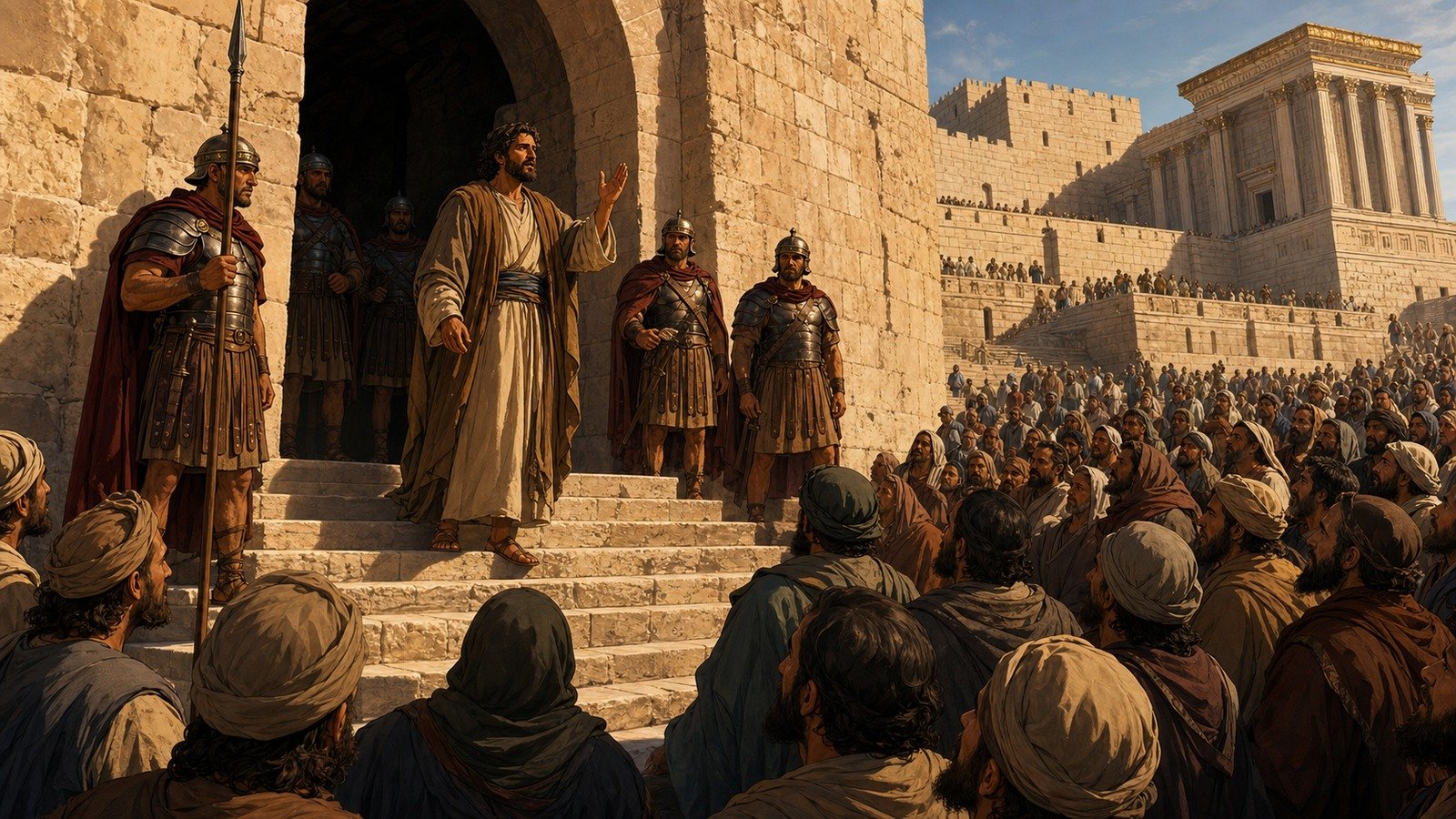
Given permission to speak, Paul addresses the hostile crowd in Aramaic, recounting his upbringing, his conversion on the Damascus road, and his commission to the Gentiles, a claim that reignites the crowd's fury the moment he mentions it.
Further context
2 min readAs the soldiers are about to take Paul into the barracks, he asks the commander whether he may say something.
The commander is astonished: do you speak Greek? Are not you the Egyptian who started a revolt and led four thousand terrorists out into the wilderness some time ago?
That is a real person. Josephus describes an Egyptian false prophet who gathered a following, led them to the Mount of Olives promising that the walls of Jerusalem would fall at his command, and was routed by the procurator Felix, escaping while his followers were killed or captured. The word used for his men is the one for the dagger-carrying assassins who operated in crowds.
The commander had assumed he was arresting a wanted terrorist.
I am a Jew, from Tarsus in Cilicia, a citizen of no ordinary city, Paul answers, and asks permission to speak to the people.
Standing on the steps, he motions to the crowd, and when they are all silent he speaks to them in Aramaic. The crowd becomes very quiet.
The speech is his own story, and its shape is a defence built entirely out of biography. I am a Jew, born in Tarsus of Cilicia, but brought up in this city. I studied under Gamaliel and was thoroughly trained in the law of our ancestors. I was just as zealous for God as any of you are today. I persecuted the followers of this Way to their death, arresting both men and women and throwing them into prison, as the high priest and all the Council can themselves testify.
Then the Damascus road, told in the first person, with the light, the voice and the blindness. Then Ananias, described carefully as a devout observer of the law and highly respected by all the Jews living there.
They listen to all of it.
The break comes at one sentence. He describes returning to Jerusalem, praying at the temple, and being told: go; I will send you far away to the Gentiles.
The crowd listened to Paul until he said this. Then they raised their voices and shouted, rid the earth of him! He is not fit to live!
Speaking in Aramaic quiets the crowd before a word of content is delivered, which tells you what the accusation about abandoning the customs had done to his standing.
The claim to be a citizen of no ordinary city was accurate. Tarsus was a centre of learning that the geographer Strabo, writing a generation earlier, rated above Athens and Alexandria for the enthusiasm of its inhabitants for philosophy.
Gamaliel is named as his teacher only here, and it explains a good deal: the man who advised the council to leave the movement alone had trained the man who tried hardest to destroy it.
The crowd throws off its cloaks and flings dust into the air while shouting, which is a recognised expression of outrage and also, incidentally, what men did before picking up stones.
What set them off was not the resurrection, the Damascus road or the claim about Jesus. It was the word Gentiles, and it had been the same word at the centre of every quarrel of the previous twenty years.