

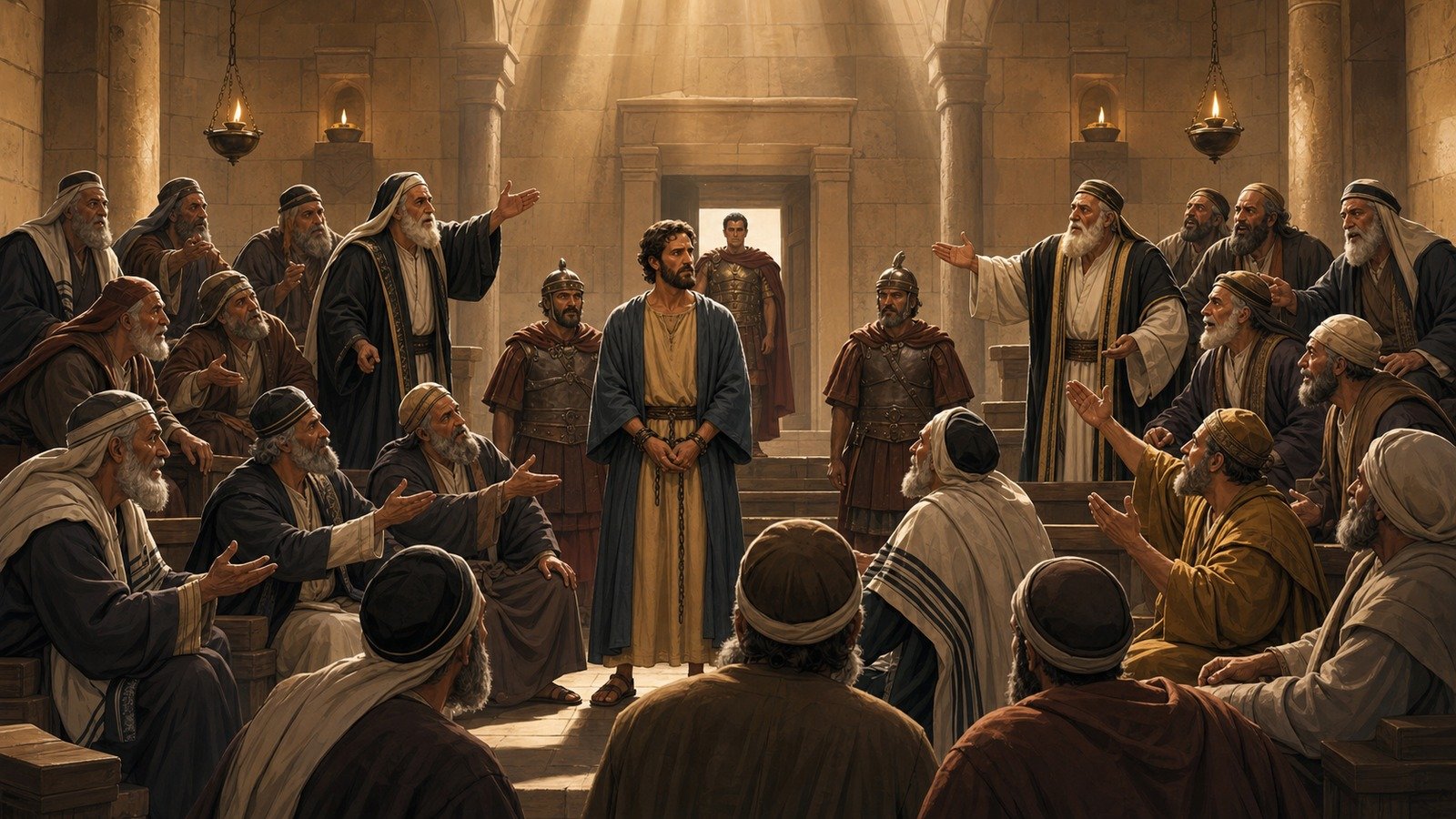
Brought before the Sanhedrin, Paul provokes a sharp dispute between Pharisees and Sadducees by declaring he is on trial over the resurrection of the dead, a claim the Pharisees present accept and the Sadducees reject, leaving the council too divided to proceed.
Further context
2 min readThe commander orders Paul taken into the barracks and directs that he be flogged and interrogated in order to find out why the people are shouting at him like this.
Flogging as an interrogation method was standard Roman practice for slaves and non-citizens, and it was not the punishment beating; it was how evidence was extracted.
As they stretch him out to flog him, Paul says to the centurion standing there: is it legal for you to flog a Roman citizen who has not even been found guilty?
That stops everything. The centurion goes to the commander: what are you going to do? This man is a Roman citizen.
The commander comes and asks him directly, and the exchange that follows is one of the sharpest social observations in the New Testament. I had to pay a lot of money for my citizenship, says the commander. But I was born a citizen, Paul replies.
Citizenship in the provinces was rare and valuable. It could be granted for service, bought through officials under a corrupt regime, or inherited, and inherited citizenship outranked purchased citizenship socially. How Paul's family acquired it is unknown.
Those about to interrogate him withdraw immediately, and the commander himself is alarmed, because he had put a citizen in chains.
The next day he releases him and orders the chief priests and the Sanhedrin to assemble, then brings Paul in.
Paul begins by saying he has fulfilled his duty to God in all good conscience, and the high priest Ananias orders those standing near him to strike him on the mouth. Paul's response is not conciliatory: God will strike you, you whitewashed wall! Told he is insulting the high priest, he says he did not realise it, and quotes the law about not speaking evil of a ruler.
Then, seeing that the assembly is made up of both parties, he says: my brothers, I am a Pharisee, descended from Pharisees. I stand on trial because of the hope of the resurrection of the dead.
The chamber divides on the spot, because the Sadducees denied the resurrection, angels and spirits, and the Pharisees affirmed all three. The Pharisees begin defending him: we find nothing wrong with this man.
The dispute becomes so violent that the commander fears Paul will be torn to pieces and orders the troops to take him by force.
Ananias son of Nedebaeus held the high priesthood from about AD 47 to 59 and appears in Josephus as wealthy, violent and widely disliked, said to have sent servants to seize tithes from the threshing floors so that poorer priests starved. He was killed by rebels at the start of the revolt in AD 66, dragged from a sewer where he had hidden.
Whitewashed wall is close to the whitewashed tombs of a much earlier denunciation, and it means a structure made presentable on the outside.
Roman citizenship carried protection from summary flogging and from crucifixion, and the right to appeal to the emperor, which Paul uses within two years. Claiming it falsely was a capital offence, so a bare assertion was generally believed.