

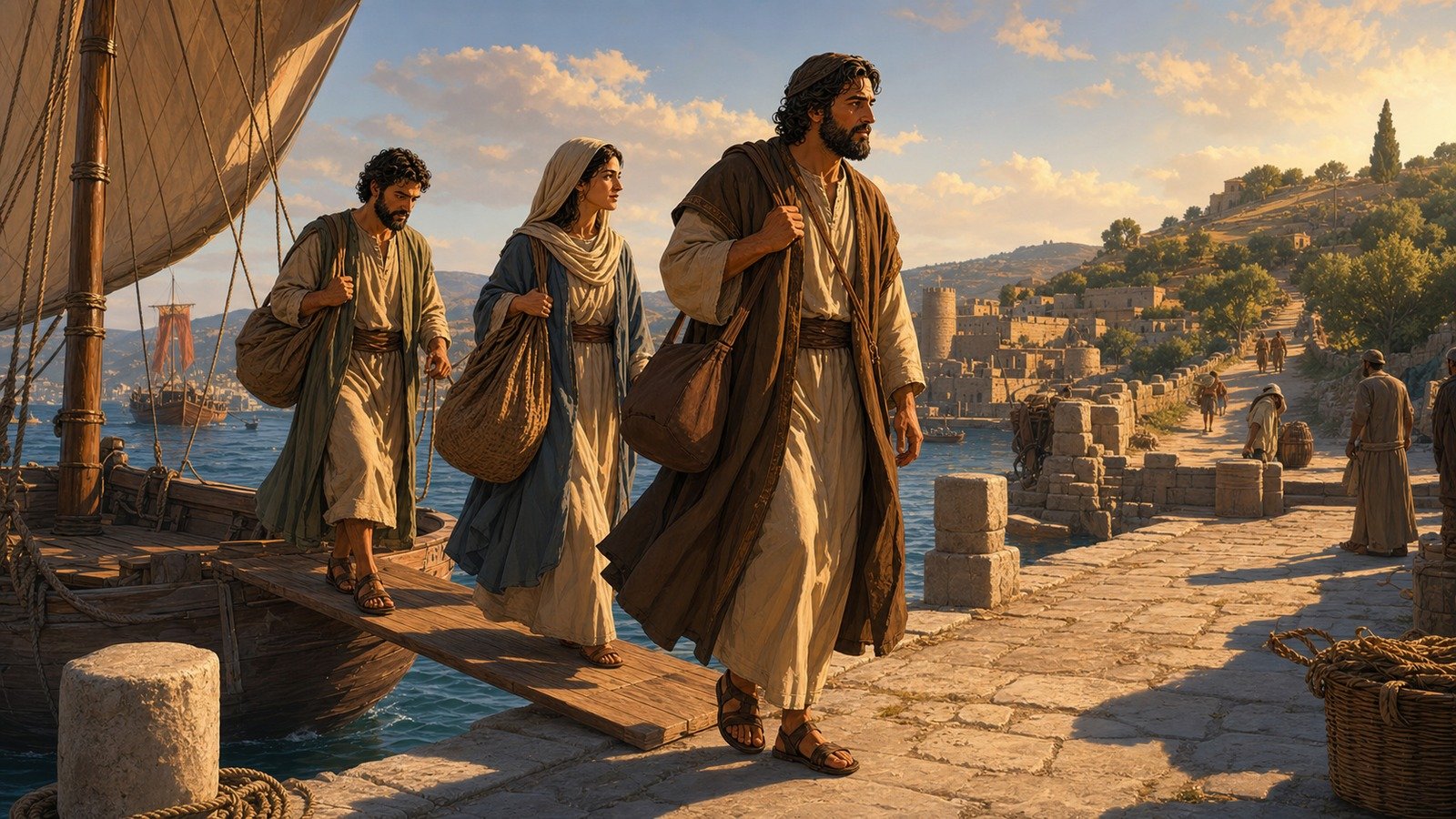
Paul sails from Corinth with Priscilla and Aquila, pauses briefly at Ephesus, then continues to Caesarea and up to Antioch, bringing the second missionary journey to a close.
Further context
2 min readPaul stays on in Corinth for some time, then says goodbye to the believers and sails for Syria, accompanied by Priscilla and Aquila.
Before he sails he has his hair cut off at Cenchreae, the eastern port of Corinth, because of a vow he had taken.
That detail is thrown in without explanation and it is one of the more revealing things in the whole account. A Nazirite vow involved abstaining from wine and from cutting the hair for a set period, and it ended with shaving the head and offering sacrifices at the temple. Here is the apostle who had just argued in Jerusalem that Gentiles need not keep the law, keeping it himself, voluntarily, in a Greek port.
Nothing is said about what the vow was for. What it demonstrates is that Paul's position was never that Jewish practice was wrong; it was that it could not be required of Gentiles as a condition of belonging.
They arrive at Ephesus, where he leaves Priscilla and Aquila. He himself goes into the synagogue and reasons with the Jews, and when they ask him to spend more time with them he declines, but promises to come back if it is God's will. Then he sails from Ephesus.
Declining an open invitation in the most important city in the province is unusual enough to be worth noticing, and he returns within a year or so and stays three years.
The couple he leaves behind are not passengers. Priscilla and Aquila are named six times in the New Testament, four of those with her name first, which in ancient usage generally indicates the more prominent of the two. They host congregations in their house in at least two cities, they instruct Apollos, and Paul says they risked their lives for him and that all the Gentile churches are grateful to them.
Paul lands at Caesarea, goes up and greets the church, presumably at Jerusalem, and then goes down to Antioch.
That closes what is traditionally called the second missionary journey, roughly three years and several thousand kilometres, during which the congregations at Philippi, Thessalonica, Berea and Corinth were founded and two letters were written to the Thessalonians, which are most probably the earliest surviving Christian documents.
After spending some time in Antioch, he sets out again.
The vow at Cenchreae has been read as Paul's, which the grammar most naturally supports, and as Aquila's, which some have preferred because it removes the awkwardness. The awkwardness is probably the point.
Cenchreae itself appears again at the end of the letter to the Romans, where Paul commends Phoebe, a deacon of the church there, who is generally taken to have carried the letter to Rome.
The second journey is the one that changed the geography of the movement, and it began with a quarrel about a young man and a route chosen by exclusion, since two provinces had been closed off before the Macedonian vision opened a third.
Cutting the hair at the end of a vow was followed by presenting the hair at the temple with the offerings, which is one reason Paul may have been in a hurry to reach Jerusalem in the first place.