

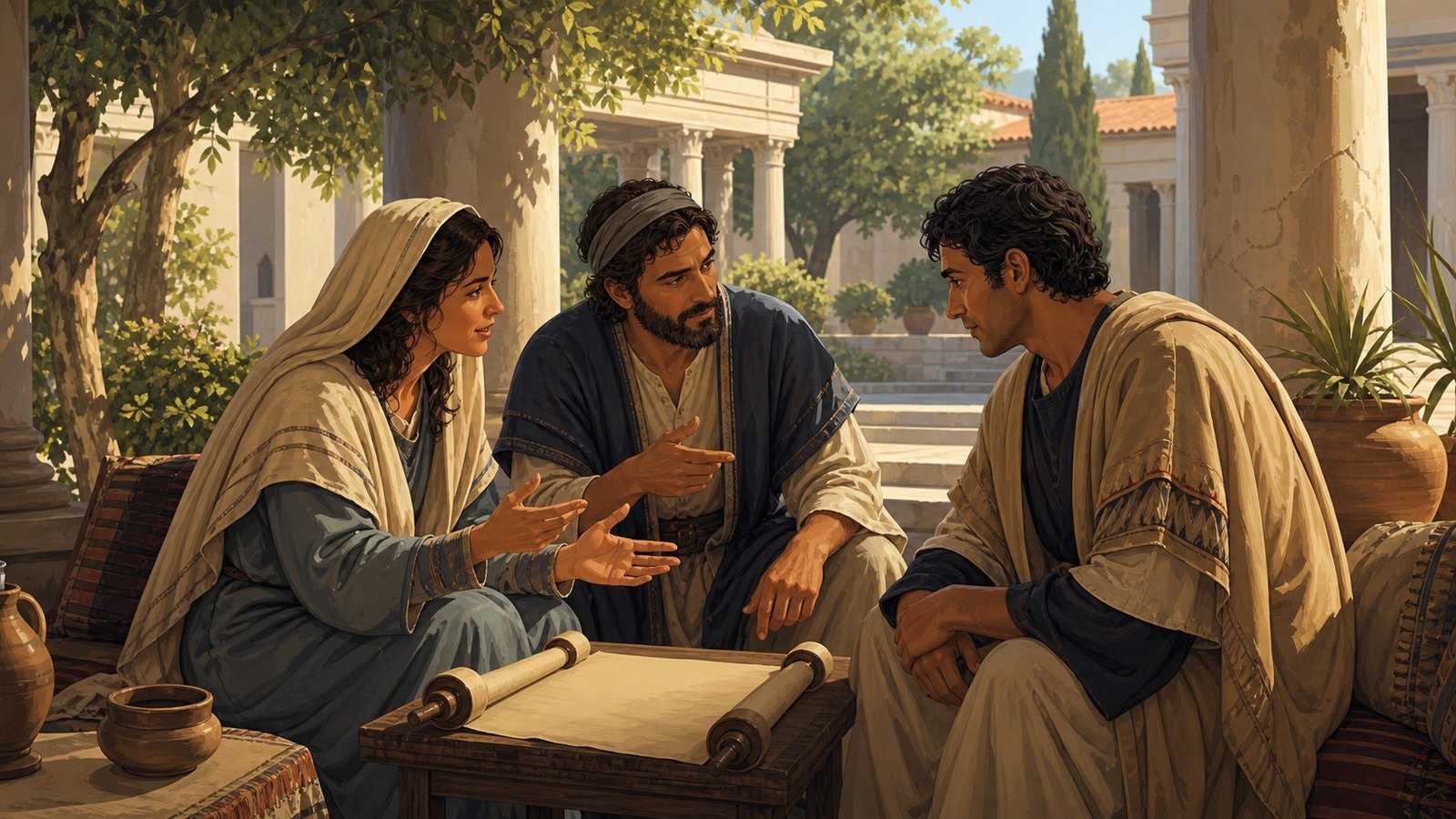
A learned Alexandrian Jew named Apollos arrives at Ephesus preaching about Jesus but knowing only the baptism of John; Priscilla and Aquila take him aside and explain "the way of God more adequately," after which he becomes an effective advocate for the gospel.
Further context
2 min readA Jew named Apollos, a native of Alexandria, came to Ephesus. He was a learned man, with a thorough knowledge of the Scriptures.
Alexandria mattered. It had the largest Jewish community outside Judea, a great library, and a tradition of scholarship that produced Philo, whose work in Greek philosophy applied to the Hebrew Scriptures survives. A learned Alexandrian Jew was a formidable thing to be, and the word used of him can mean either learned or eloquent.
He had been instructed in the way of the Lord, and he spoke with great fervour and taught about Jesus accurately, though he knew only the baptism of John.
That combination is odd and nobody has explained it fully. He knows about Jesus and teaches accurately, and his information stops somewhere before Pentecost. The likeliest reconstruction is that the message reached Alexandria early, through someone who had heard John the Baptist and the first reports and had left before the rest.
He begins to speak boldly in the synagogue at Ephesus. When Priscilla and Aquila heard him, they invited him to their home and explained to him the way of God more adequately.
Two tentmakers take aside a scholar from the greatest centre of learning in the Greek-speaking world and fill in what he is missing, in private, at home. He does not object, which says something about him, and they do it without making a public correction, which says something about them.
Priscilla is named first, as she usually is.
When Apollos wanted to go to Achaia, the believers encouraged him and wrote to the disciples there to welcome him. That is a letter of recommendation, which was the standard instrument for vouching for a traveller in the ancient world.
On arriving he was a great help to those who by grace had believed, for he vigorously refuted his Jewish opponents in public debate, proving from the Scriptures that Jesus was the Messiah.
He turns up again in Paul's first letter to Corinth, where factions in the church have formed around personalities: I follow Paul, I follow Apollos, I follow Cephas. Paul deals with it by saying he planted, Apollos watered, and God made it grow, and there is no hint of rivalry between the two men.
A learned man who accepted private correction from a tradesman and his wife, and then went on to become one of the most effective preachers of the period, is an unusual figure in any century.
Some readers have proposed Apollos as the author of the letter to the Hebrews, on the grounds of its Alexandrian style of argument and its polished Greek. Luther suggested it, and it remains a guess; the letter names no author and nobody knows.
Letters of recommendation were the standard credential for a traveller in the ancient world, and Paul refers to the practice in a letter to Corinth, saying he needs no such letter to them because they themselves are his.
Alexandria produced no church founder in the New Testament and appears only through this man, though a substantial Christian community existed there within a century and became one of the great centres of the early church.