

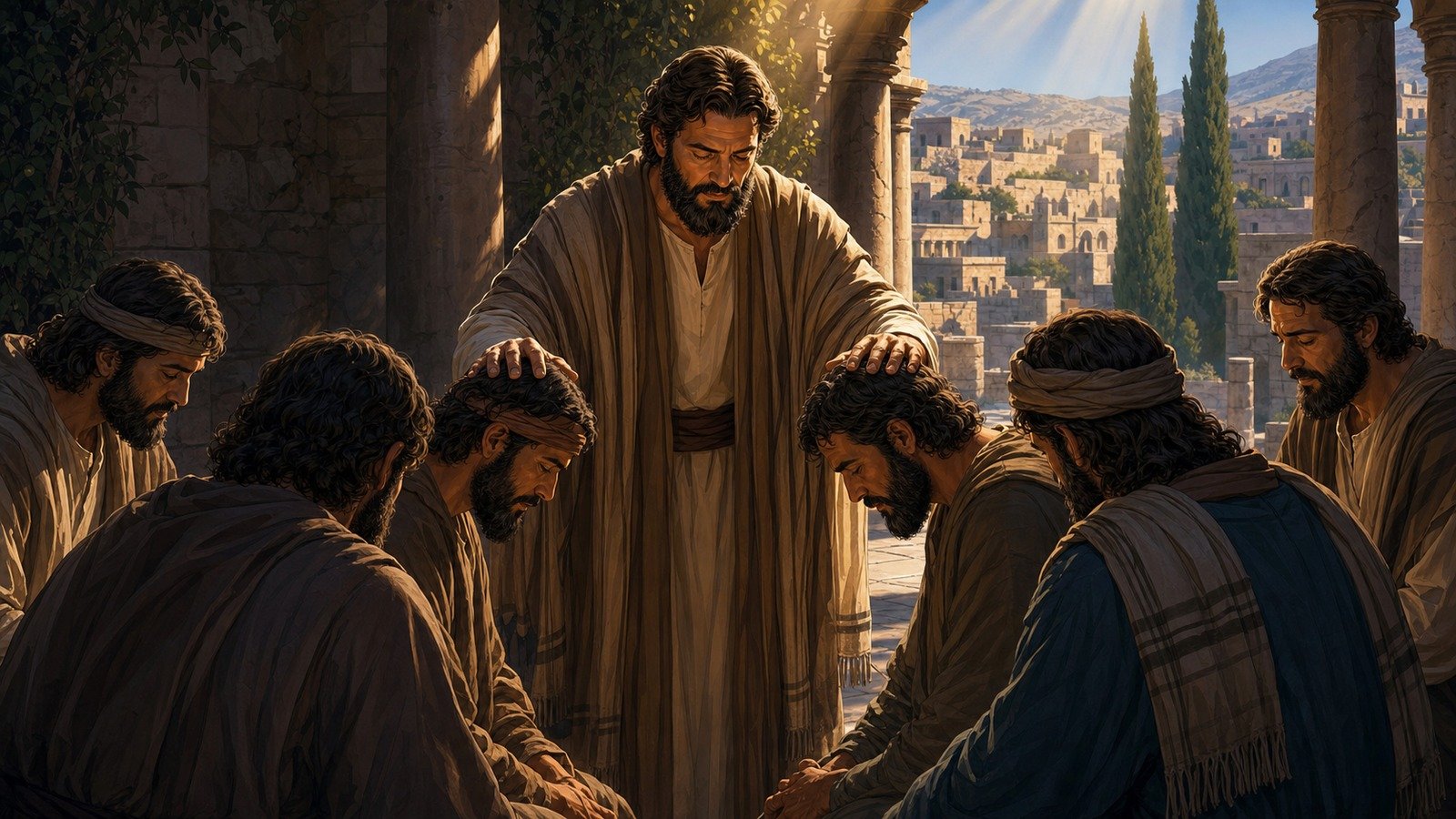
Beginning what is traditionally called his third missionary journey, Paul finds a small group at Ephesus who had received only John's baptism; he baptises them in Jesus' name, and the Holy Spirit comes on them as he lays hands on them.
Further context
2 min readWhile Apollos was at Corinth, Paul took the road through the interior and arrived at Ephesus, where he found some disciples.
His first question to them is unusual: did you receive the Holy Spirit when you believed?
Their answer is more unusual still: no, we have not even heard that there is a Holy Spirit.
Then what baptism did you receive?
John's baptism.
There are about twelve of them, and they are the same phenomenon as Apollos, arriving at the same city from a different direction: people who had received the message at an early stage, through the preaching of John the Baptist and whatever news travelled with it, and had gone no further because nothing further had reached them.
Paul explains that John's baptism was a baptism of repentance, and that he told the people to believe in the one coming after him.
On hearing this, they were baptised in the name of the Lord Jesus. When Paul placed his hands on them, the Holy Spirit came on them, and they spoke in tongues and prophesied.
This is the last of a small series of such episodes, and each one occurs at a boundary: the Samaritans, the Gentile household at Caesarea, and now a group standing at the far edge of an earlier movement. In each case something visible happens in front of witnesses, and in each case the effect is to attach a group to the main body rather than leave it as a separate stream.
That John's followers persisted as a distinct movement for some time is attested elsewhere. Later sources refer to communities holding to his baptism, and the Mandaean religion of southern Iraq and Iran, which still exists, reveres John and rejects Jesus.
Paul then enters the synagogue and speaks boldly there for three months, arguing persuasively about the kingdom of God. When some become obstinate and publicly malign the Way, he leaves and takes the disciples with him, and has discussions daily in the lecture hall of Tyrannus.
Some manuscripts add that he did so from eleven in the morning until four in the afternoon, which was the siesta period when the hall would be free and when working men were also off work.
This went on for two years, so that all the Jews and Greeks who lived in the province of Asia heard the word of the Lord.
Whether the twelve at Ephesus were Christians before Paul met them, or followers of John who had not yet heard the rest, is a question the wording leaves open. They are called disciples, which usually means believers, and their answer about the Spirit shows how partial their information was.
The lecture hall of Tyrannus is otherwise unknown, and the name appears in Ephesian inscriptions, so the hall probably belonged to a man who taught in it and rented it out.
Two years in a lecture hall, reasoning daily, is a different method from anything earlier in the account. What it produced was a base from which the whole province was covered, and congregations in towns Paul never visited.