

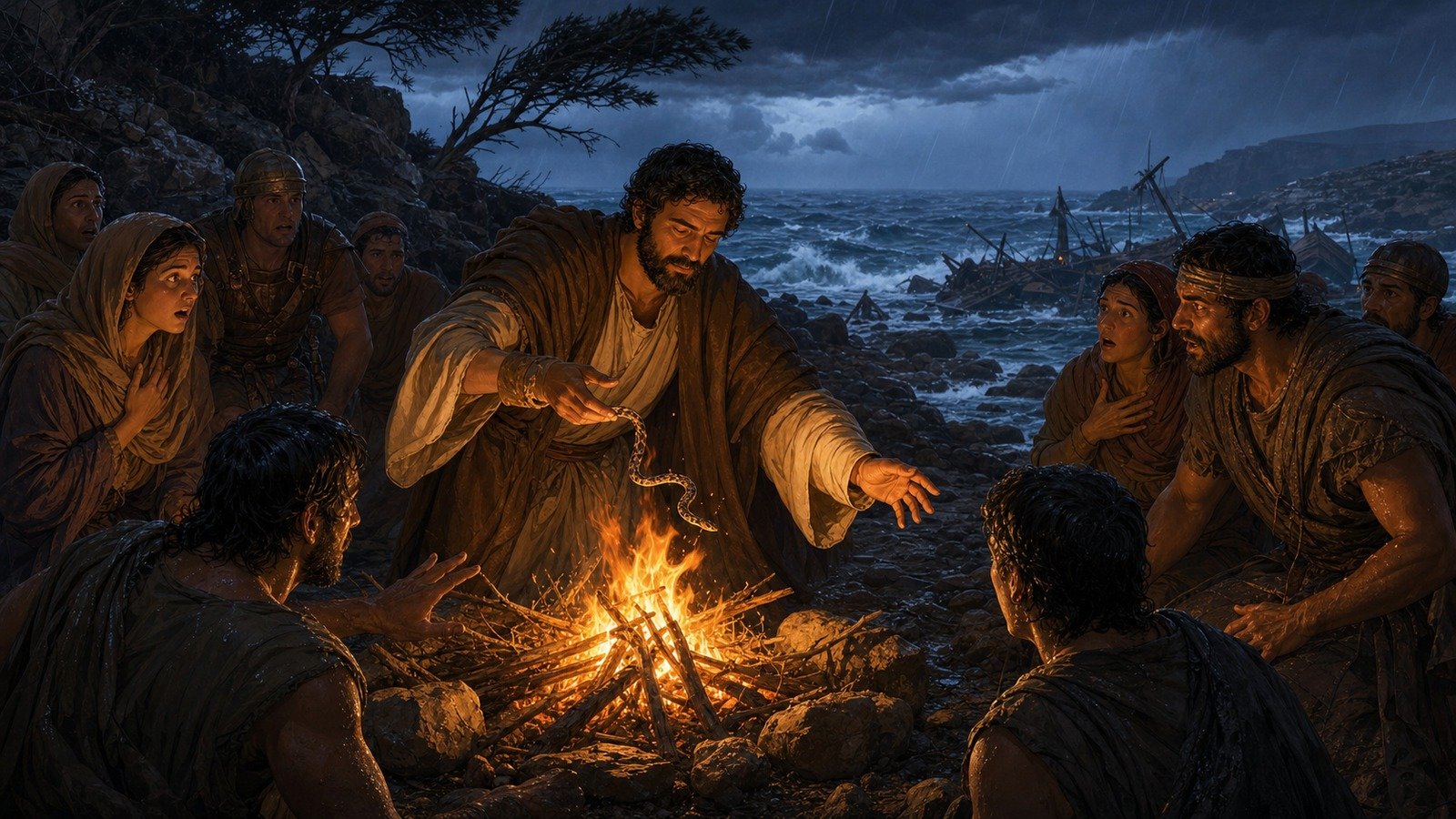
On Malta, a viper bites Paul's hand as he gathers firewood; when he suffers no harm, the islanders' assumption that he is a murderer under divine punishment shifts to thinking he is a god, and he goes on to heal the local chief official's father and others on the island.
Further context
2 min readOnce ashore they find the island is called Malta, and the islanders show them unusual kindness, building a fire and welcoming them all because it is raining and cold.
The word used for the islanders is barbaroi, which in Greek simply meant people who did not speak Greek and carried no insult of its own. Malta had been Phoenician for centuries before the Romans took it, and Punic was still spoken there.
Paul gathers a pile of brushwood and puts it on the fire, and a viper, driven out by the heat, fastens itself on his hand.
The islanders' reaction is a piece of folk theology stated aloud, and it is the reason the episode is preserved. This man must be a murderer; for though he escaped from the sea, the goddess Justice has not allowed him to live.
Justice, Dikē in Greek, was a personified deity, daughter of Zeus in Hesiod, and the reasoning is exact: a man who survives a shipwreck and is then killed by a snake is a man the gods are pursuing.
Paul shakes the snake off into the fire and suffers no ill effects. The people expect him to swell up or suddenly fall dead, but after waiting a long time and seeing nothing unusual happen to him, they change their minds and say he is a god.
That reversal, from murderer to god within an afternoon, is the same swing seen at Lystra in the opposite order, and neither crowd is given any commentary.
Whether venomous snakes exist on Malta today is an old objection, and the honest answer is that no dangerous species is now found there, though the island has been densely settled and deforested for two thousand years and a small viper could easily have been extirpated. The islanders' own reaction shows they expected a bite to kill.
Nearby are estates belonging to Publius, the chief official of the island, whose title as given, the first man of the island, appears on Maltese inscriptions in both Greek and Latin. He entertains them hospitably for three days.
His father is ill in bed, suffering from fever and dysentery. Paul goes in to see him, prays, places his hands on him and heals him. When this happens, the rest of the sick on the island come and are cured.
They stay three months and are furnished with the supplies they need when they sail.
The bay traditionally identified as the landing place is on the north-east coast and carries Paul's name, and its underwater topography includes a shoal where two seas meet, which matches the description of the place where the bow stuck fast.
Malta had been Roman since the second Punic War and was administered from Sicily, which accounts for a chief official with a Greek title on a Punic-speaking island.
Publius's father is described as suffering from fever and dysentery, and the plural form used for fever is a medical term of the period, which is one of the details cited in favour of the writer having been a physician.