

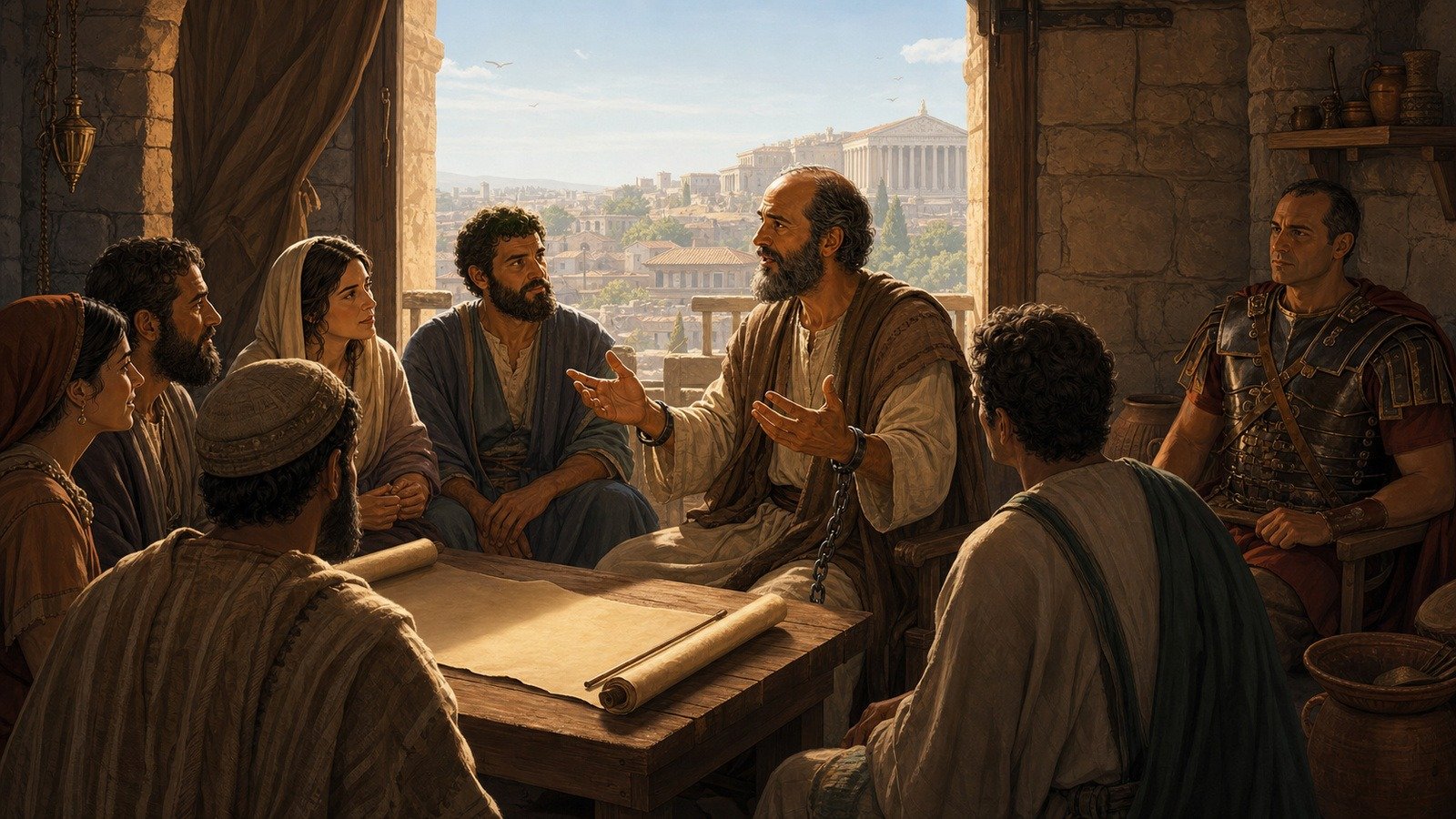
Paul finally reaches Rome, where he is allowed to live under guard in his own rented lodging; Acts closes with him there for two full years, "boldly and without hindrance," proclaiming the kingdom of God and teaching about Jesus to all who visit him.
Further context
2 min readAfter three months Paul and his escort sail in an Alexandrian ship that had wintered on the island, with the figurehead of the twin gods Castor and Pollux, patrons of sailors.
They put in at Syracuse, then Rhegium, then Puteoli on the Bay of Naples, which was the main port for the grain fleet, and where they find believers and are invited to spend a week with them.
News of their approach travels ahead, and Christians from Rome come out along the Appian Way to meet them, some as far as the Forum of Appius, about sixty-five kilometres from the city, and others to the Three Taverns, about fifteen kilometres closer. At the sight of these people Paul thanked God and was encouraged.
He had written a long letter to this church three years earlier without ever having visited it, and its final chapter greets more than twenty individuals by name.
At Rome he is allowed to live by himself, with a soldier to guard him.
Three days later he calls together the local Jewish leaders, explains his case, and says he has done nothing against his people or the customs of the ancestors. Their reply is careful: they have received no letters about him and no report from anyone, though they would like to hear his views, because people everywhere are talking against this sect.
On the appointed day large numbers come to his lodging, and from morning till evening he explains and testifies about the kingdom of God, trying to persuade them about Jesus from the Law of Moses and from the Prophets. Some are convinced and others will not believe.
The record of the church's first thirty years then ends in a way that has puzzled readers ever since: for two whole years Paul stayed there in his own rented house and welcomed all who came to see him. He proclaimed the kingdom of God and taught about the Lord Jesus Christ with all boldness and without hindrance.
No verdict. No execution. No release. The last word in the Greek is the adverb meaning unhindered, and whatever else the writer intended, he ends on it.
The ending has been explained in several ways. That the writer had reached the moment of writing and had nothing further to report. That a second volume was intended. That the outcome was well known to the first readers and needed no statement. Or that the book is not a biography of Paul at all but an account of how the message travelled from Jerusalem to Rome, in which case it ends exactly where it was always going to end.
What it does not do is describe a trial or a verdict, which a writer inventing a triumphant conclusion would surely have supplied.
Rome had a Jewish population of perhaps forty or fifty thousand, with a dozen synagogues attested by inscriptions, and the congregation Paul wrote to had grown out of it and then, after Claudius's expulsion, largely without it.
The Appian Way is still walkable south of Rome, paved with the same basalt blocks, and the Forum of Appius and Three Taverns were staging posts on it where travellers changed horses and slept.