

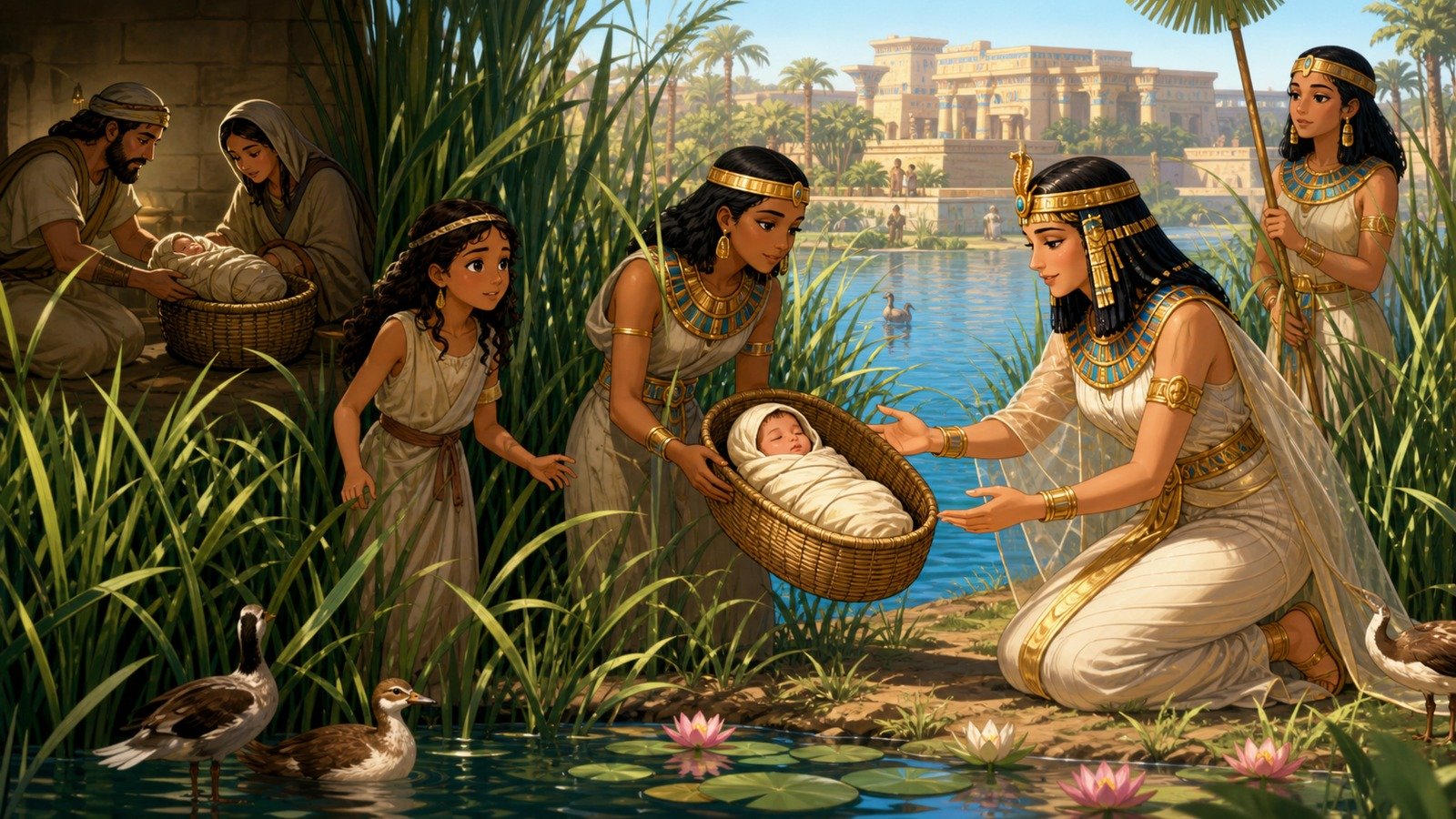
Moses is hidden as an infant to escape Pharaoh's decree, then found and adopted by Pharaoh's own daughter, who raises him within the Egyptian royal court.
Further context
3 min readA Levite man marries a Levite woman and she bears a son. Every name in that family is withheld until much later, where they are given as Amram and Jochebed. The child is hidden for three months, and then his mother does something with the royal decree rather than against it.
The order was to throw every Hebrew boy into the Nile. She puts him into the Nile, in a basket.
The vocabulary there is doing deliberate work. The Hebrew word for the basket (tevah) occurs in only two places in the entire Bible: here, and in the story of Noah, where it is the ark. Both vessels are coated with pitch, both carry their occupant through water that is killing everyone else, and both are how a line survives a general destruction. The papyrus basket is set among the reeds along the bank, and the boy's sister stands at a distance to see what will happen.
Pharaoh's daughter comes down to bathe, sees it, opens it and finds a crying baby. Her assessment is immediate and correct: this is one of the Hebrew babies. She takes him anyway, in defiance of her father's edict, and the sister steps forward with a proposal that is either quick thinking or a plan. Shall I go and get one of the Hebrew women to nurse the baby for you? The child is handed back to his own mother, who is paid a wage by the Egyptian court for raising her own son.
The name is explained by Pharaoh's daughter with a Hebrew verb meaning to draw out (mashah), because she drew him out of the water. It should also be said that Moses is a good Egyptian name in its own right. The element mose means born of or son of, and it turns up in Thutmose, Ahmose and Ramose. A child raised in the Egyptian court would plausibly carry an Egyptian name, and the Hebrew explanation is a play on it rather than a competing claim.
The daughter of Pharaoh is doing something considerable and it is easy to skim past. Her father has issued a public order that Hebrew boys are to be drowned. She finds one, identifies him correctly as Hebrew in front of her attendants, keeps him, hires a Hebrew woman to nurse him and raises him in the palace as her own. Whatever her motive, the man who will eventually confront that throne is brought up inside it by a member of the family that ordered his death.
There is a well-known parallel. A Mesopotamian text describing the birth of Sargon of Akkad has his mother place him in a reed basket sealed with bitumen and set him on a river, from which he is drawn out and raised by a gardener. The surviving copies are Neo-Assyrian, from the seventh century BC, and the direction of any influence between the two traditions is disputed and probably not recoverable.
Four women act in this scene and not one of them is named while she is acting. The mother who hides the child, the sister who watches and negotiates, the daughter of Pharaoh who takes him, and later the wife who intervenes on the road, all appear before Moses does anything at all. One of them is never named anywhere, and she is a member of the household that ordered the killings.
His age at the departure from Egypt is given as eighty, which places his birth roughly eighty years earlier under either dating scheme.