

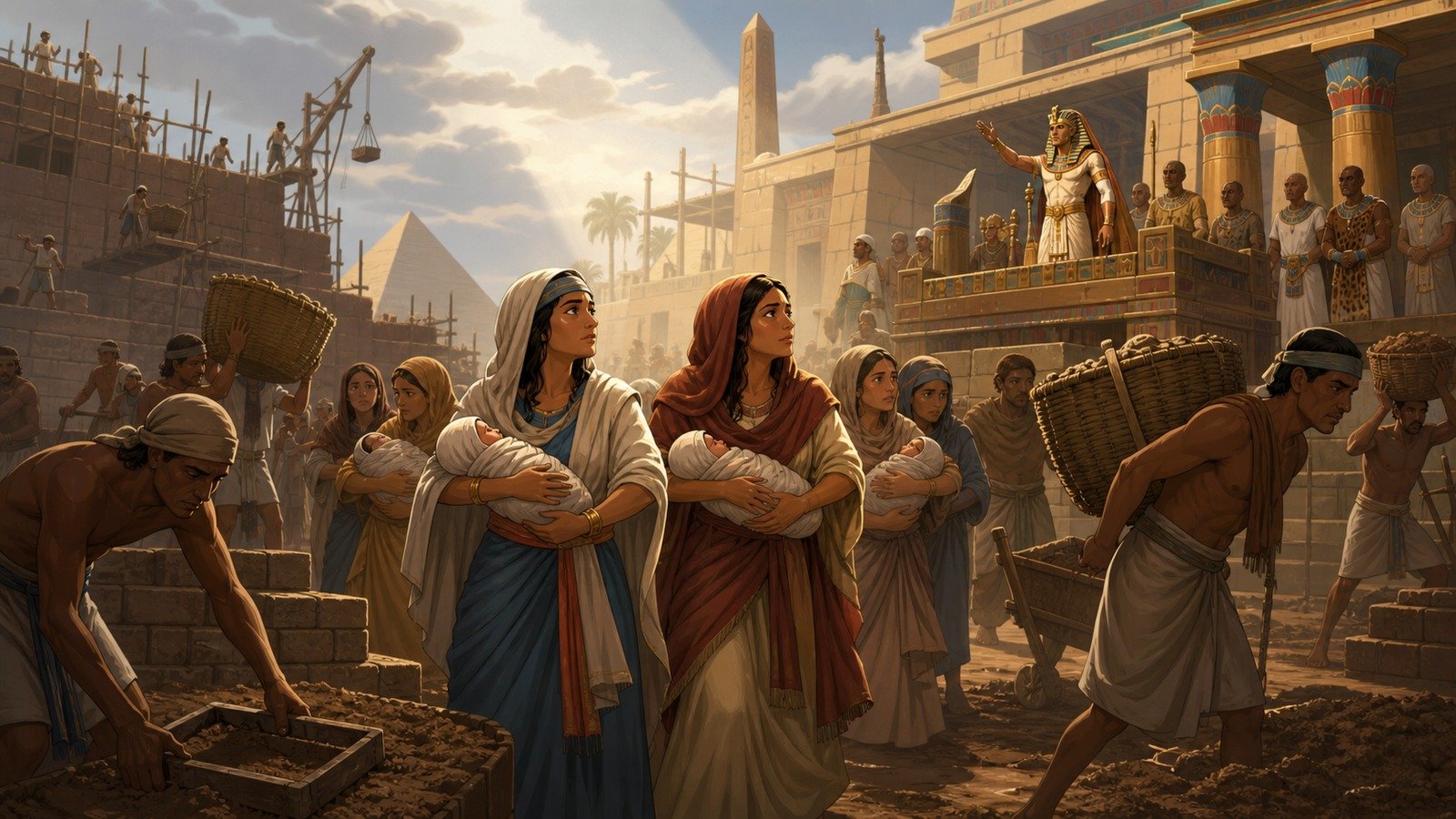
Generations after Joseph's death, a pharaoh "who did not know Joseph" grows fearful of Israel's numbers and imposes forced labour, then orders the killing of newborn Hebrew boys. Hebrew midwives Shiphrah and Puah defy the order, preserving the population God had promised to multiply.
Further context
2 min readFour centuries pass in a sentence. The Israelites were exceedingly fruitful, they multiplied greatly, and the land was filled with them. Then everything changes: a new king, to whom Joseph meant nothing, came to power in Egypt. The Hebrew says he did not know Joseph, which in this idiom means he did not acknowledge him rather than that he had never heard of him.
His argument to his people is the standard logic of a frontier population under suspicion. The Israelites have become too numerous, and if war breaks out they will join the enemy, fight against us and leave the country. Goshen sits on the north-eastern approach, which is the direction invasions came from, and the concern is stated in military terms.
The response is forced labour under slave masters, and two projects are named: the store cities of Pithom and Rameses. That second name is the single most important piece of evidence in the argument over when the Exodus happened, and both positions should be stated with their reasoning.
The case for a thirteenth-century date rests on it directly. Pi-Ramesses, the Delta capital built by Ramesses II, has been excavated at Qantir, and it was constructed during his reign in the thirteenth century BC. A city named after that king cannot have been built before him, so on this reading the oppression belongs to his reign and the departure follows around 1260 BC.
The case for a fifteenth-century date rests on a number. The temple in Jerusalem is said to have been begun in the four hundred and eightieth year after Israel came out of Egypt, in the fourth year of Solomon's reign. That year is fixed near 966 BC by Assyrian synchronisms, which produces an Exodus around 1446 BC. On this reading the place name Rameses is a later updating, and replacing an obsolete name with the current one is common practice elsewhere in the Hebrew scriptures, which does exactly that with Bethel and Hebron. The counter-argument is that 480 may be schematic, twelve generations of forty years, and that generations of forty years are an idealisation.
Neither side has produced a decisive argument, which is why the date is marked as disputed.
The story then narrows to two women. Pharaoh orders the Hebrew midwives to kill every boy at birth, and their names are given, Shiphrah and Puah, while the king of Egypt is left unnamed throughout the whole book. They feared God and did not do what the king had told them, and when questioned they answer that Hebrew women are vigorous and give birth before the midwives arrive. It is the first recorded act of civil disobedience anywhere in the Bible, and God is said to have been kind to them because of it.
Both their names are attested as ordinary West Semitic personal names in second-millennium Egyptian documents, one of them appearing in a list of servants on a papyrus from the eighteenth century BC.
The final order removes the intermediaries. Every Hebrew boy that is born must be thrown into the Nile.