

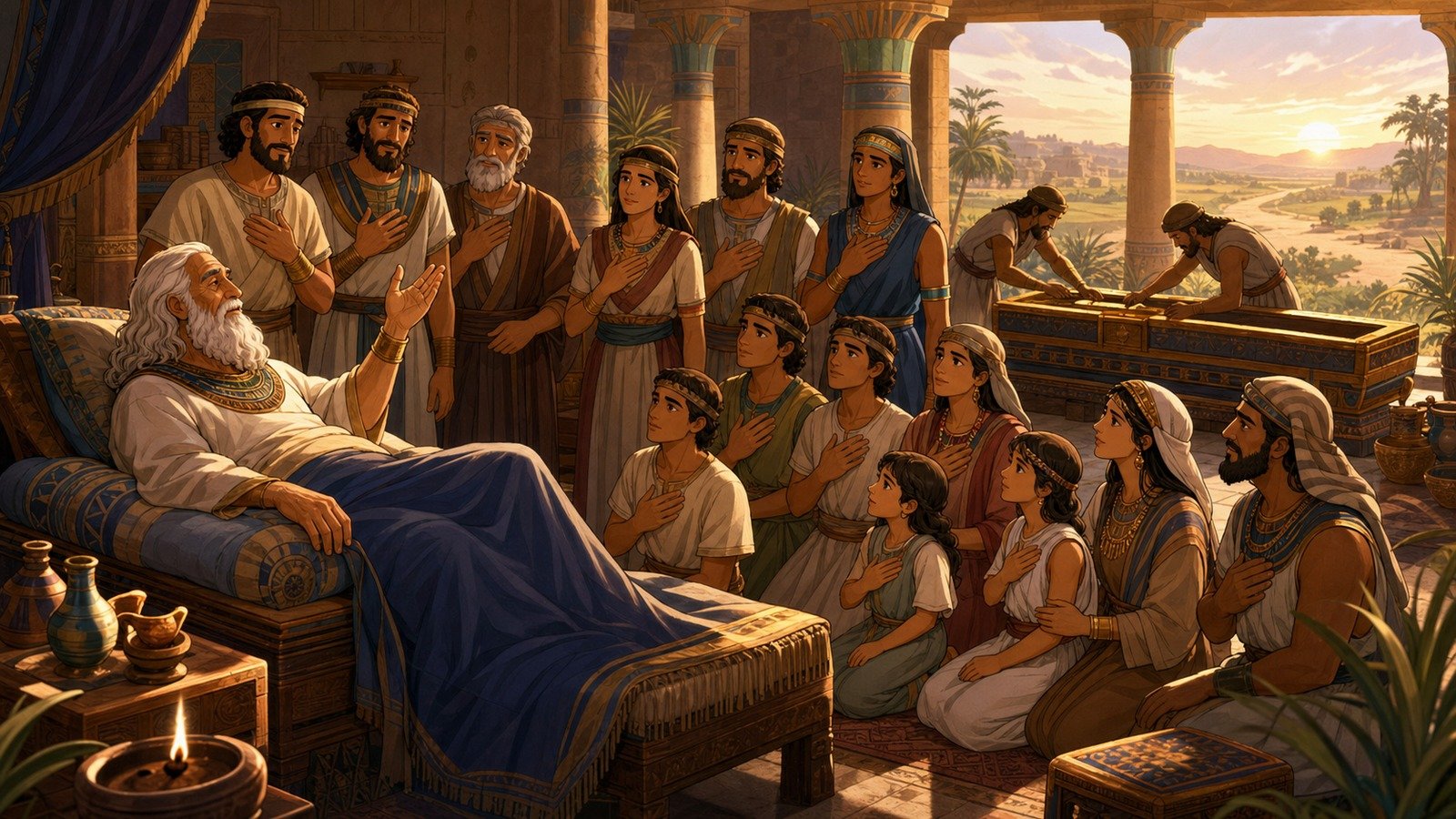
Joseph dies at 110, having seen his great-grandchildren, and, anticipating Israel's eventual return to Canaan, makes his family swear to carry his bones out of Egypt when God brings them back. His death closes the book of Genesis.
Further context
2 min readJoseph lived to a hundred and ten, and the figure is not an accident of arithmetic. A hundred and ten was the ideal lifespan in Egyptian thought, appearing repeatedly in Egyptian wisdom texts and funerary inscriptions as the mark of a complete and blessed life. The Egyptian official of this family gets the Egyptian ideal, in a story where his ancestors live for a hundred and seventy-five, a hundred and eighty and a hundred and forty-seven years.
He lives to see Ephraim's children to the third generation, and the children of Makir son of Manasseh are placed at birth on his knees, which is the adoption gesture used earlier when Rachel received Bilhah's sons.
His last recorded words concern something that will not happen for centuries. I am about to die, but God will surely come to your aid and take you up out of this land to the land he promised on oath to Abraham, Isaac and Jacob. He then makes the sons of Israel swear an oath, and the terms are precise: when God comes to your aid, you must carry my bones up from this place.
He does not ask to be taken home now, as his father did, and the difference is deliberate. Jacob's body went back at once with a state escort and a hundred chariots. Joseph's stays in Egypt, in a coffin, as a standing claim on a future nobody can yet see. A sealed coffin that nobody is permitted to bury permanently is an awkward thing to keep, and it is meant to be.
The last sentence of the whole book reports it: so Joseph died at the age of a hundred and ten, and after they embalmed him, he was placed in a coffin in Egypt. In Hebrew the final word is Egypt. A story that began with the creation of the heavens and the earth and narrowed to one family ends with that family outside the country it was promised, holding an oath and a body.
The oath is kept, and both stages of it are recorded. Moses takes the bones with him on the night of the departure. They are buried, generations later, at Shechem, in the plot of ground Jacob had bought from the sons of Hamor for a hundred pieces of silver. The bones travel through the whole of the Exodus and the whole of the conquest and end up in the second piece of land the family ever owned.
The letter to the Hebrews singles out that instruction rather than anything else in his long career: by faith Joseph, when his end was near, spoke about the exodus of the Israelites from Egypt and gave instructions concerning the burial of his bones.
Everything promised to Abraham has by now been partly kept and none of it completely. There are descendants but not a nation, wealth but not a land, and a burial cave and a field at Shechem instead of a territory. The story closes on an unfinished undertaking, and the next book opens by counting the same seventy names.