

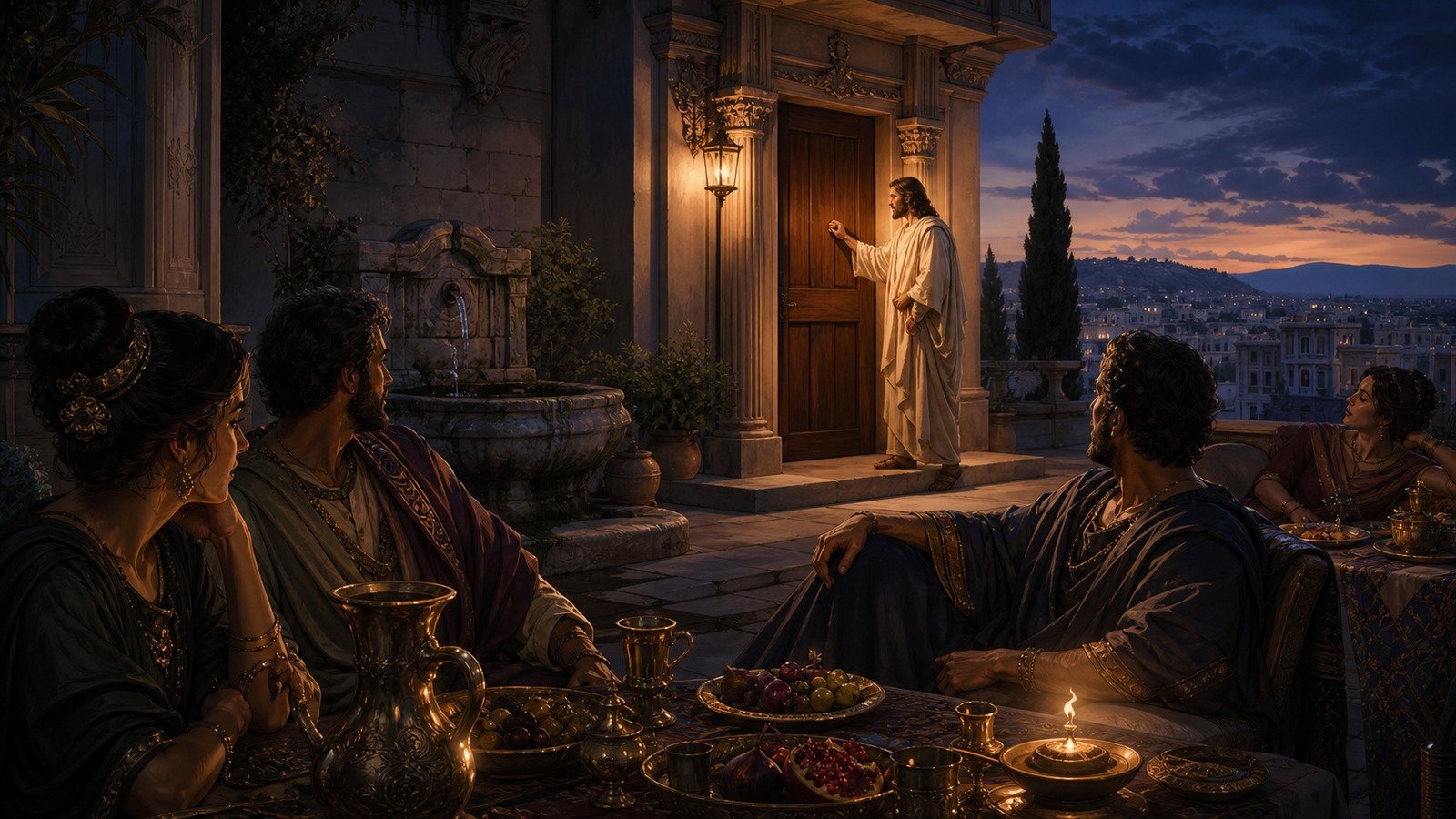
Christ rebukes the wealthy but complacent Laodicean church as "lukewarm," neither cold nor hot, and famously stands "at the door and knocks," inviting a response from anyone willing to listen.
Further context
2 min readLaodicea was the wealthiest of the seven cities: a banking centre, a producer of a glossy black wool that was famous across the empire, and the site of a medical school known for an eye ointment.
When an earthquake levelled it in AD 60, the city refused imperial assistance and rebuilt itself out of its own resources, which Tacitus records with some admiration.
Its one weakness was water. It had none of its own, and it was supplied through a stone pipeline several kilometres long from springs to the south. Hierapolis, six miles north across the valley, had hot mineral springs whose white terraces are still one of the sights of Turkey. Colossae, ten miles east, had cold fresh water from the mountains. Laodicea's water arrived tepid and heavy with minerals, and it was known to make visitors sick.
I know your deeds, that you are neither cold nor hot. I wish you were either one or the other! So, because you are lukewarm, neither hot nor cold, I am about to spit you out of my mouth.
The image is not about enthusiasm. Hot water heals, cold water refreshes, and the city's own supply did neither, and a stranger drinking it spat it out.
You say, I am rich; I have acquired wealth and do not need a thing. But you do not realise that you are wretched, pitiful, poor, blind and naked.
Each item in that list is aimed. A banking centre is told it is poor. A city that produced fine black cloth is told it is naked. A place with a famous eye salve is told it is blind.
The counsel follows the same lines: buy from me gold refined in the fire, and white clothes to wear, and salve to put on your eyes so you can see.
Then the sentence that softens the whole message: those whom I love I rebuke and discipline. So be earnest and repent.
And the last image, which has been reproduced in more paintings and stained glass than almost any other: here I am! I stand at the door and knock. If anyone hears my voice and opens the door, I will come in and eat with that person, and they with me.
The door has no handle on the outside, and it is a church being asked to open it.
Laodicea's ruins include two theatres, a stadium, and the remains of the aqueduct with pipes so encrusted with calcium that the bore is almost closed. The water problem is not an inference from the message; it is visible on the ground.
The city was also the recipient of a letter from Paul that no longer survives, mentioned in the letter to Colossae.
Laodicea is the last of the seven and the harshest, and it is followed immediately by the door opening into heaven, which is a change of scene as abrupt as any in the book.
Laodicea is the only one of the seven congregations that is offered nothing it already has, and the three things it is told to buy are gold, clothing and eye salve, which are precisely the three trades that made the city rich.