

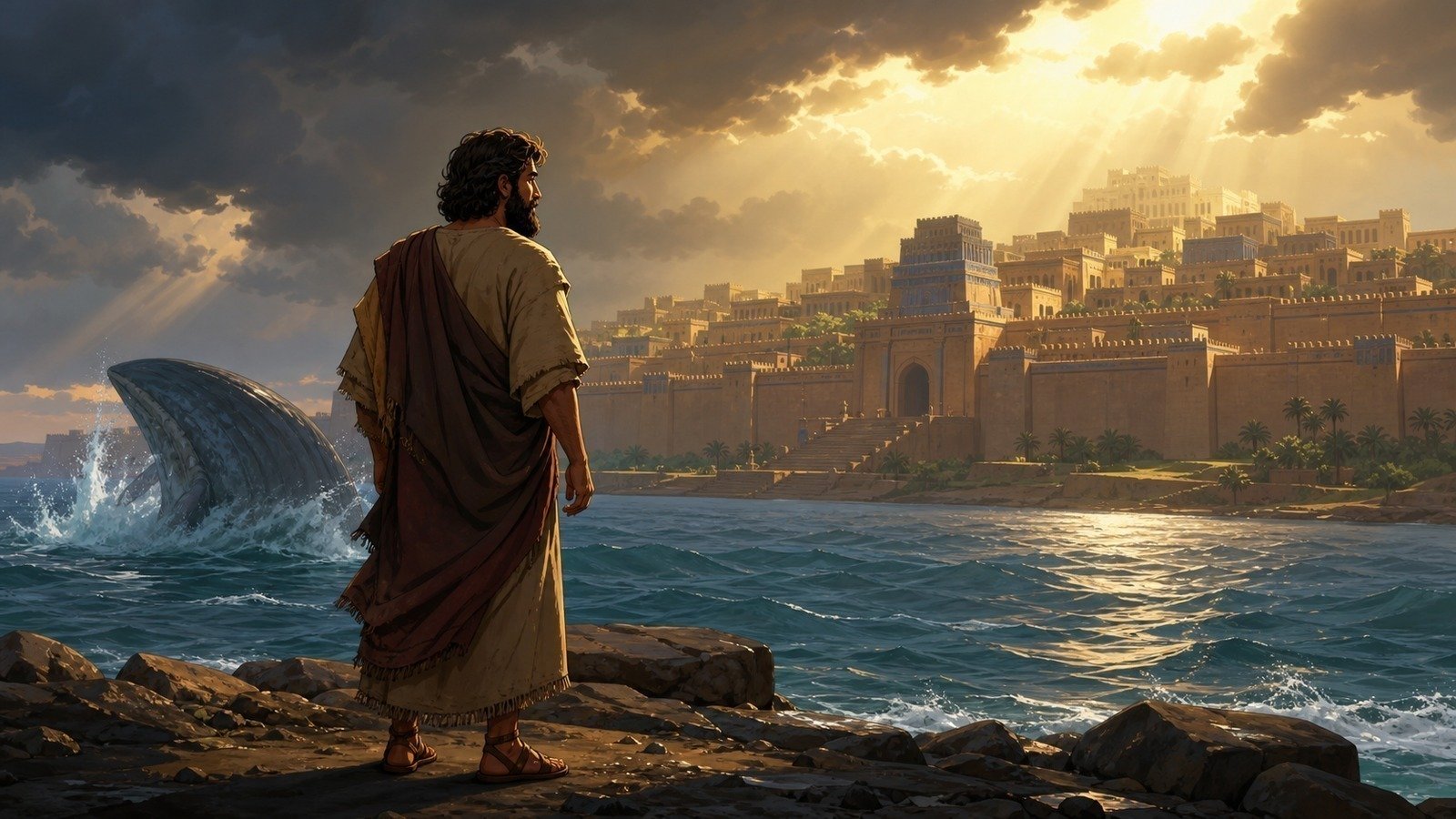
Jonah, a prophet named in 2 Kings as active under Jeroboam II, flees God's call to preach against Nineveh, is swallowed by a great fish after being thrown overboard, and eventually delivers a message that leads the entire city to repent, provoking Jonah's own resentment at God's mercy toward Israel's enemies.
Further context
3 min readJonah is a real prophet from a real place, mentioned in passing in the histories as having predicted the restoration of Israel's borders under Jeroboam II, which places him in the north in the early eighth century BC.
The commission is to go to Nineveh, the great city, and preach against it. Nineveh is the Assyrian capital on the Tigris, and Assyria is the power that will destroy his country within a lifetime. What he does is get up and run in the opposite direction, taking ship at Joppa for Tarshish, which is somewhere in the far west and about as far from Nineveh as a Mediterranean vessel could go.
The storm, the sailors casting lots, and the moment when the pagan crew turn out to behave better than the prophet are the shape of the first part. They row hard to get back to land rather than throw him overboard, and only do it when there is nothing else left, and they pray to a God they do not worship before they do.
He is swallowed by a large fish and stays inside it three days and three nights. Nothing in the Hebrew identifies the animal, and the whale of popular retelling comes from later translation. The prayer he prays from inside it is composed almost entirely of lines from the Psalms.
Nineveh repents. The king rises from his throne, takes off his royal robes, covers himself with sackcloth and sits in the dust, and orders that people and animals be covered with sackcloth and that everyone give up their evil ways and violence. The whole city is spared.
Then the last section, which is the reason the book exists. He is furious, and he finally admits why he ran: I knew that you are a gracious and compassionate God, slow to anger and abounding in love, a God who relents from sending calamity. He is quoting, almost word for word, the description of God given to Moses at Sinai, and using it as an accusation.
He goes east of the city, builds a shelter and waits to see what will happen to it. A plant grows up and shades him and he is very happy about it, and then a worm eats it and a scorching east wind comes and he asks to die.
The book ends on a question and does not answer it. God points out that Jonah cared about a plant he did not tend or make grow, which sprang up overnight and died overnight, and asks whether he should not have concern for the great city of Nineveh, where there are more than a hundred and twenty thousand people who cannot tell their right hand from their left, and also many animals.
Nobody replies.
Jonah is the only prophetic book that is a story about a prophet rather than a collection of his messages, and almost nothing in it is a sermon. His entire recorded preaching is eight words in Hebrew: forty more days and Nineveh will be overthrown.
Nineveh was the Assyrian capital under Sennacherib, on the east bank of the Tigris opposite modern Mosul, and its walls enclosed about seven hundred hectares. Assyrian methods, recorded with pride in their own inscriptions and reliefs, included flaying prisoners alive and stacking heads outside captured cities.
That is the city he is sent to, and his stated reason for running is not fear: I knew that you are a gracious and compassionate God, slow to anger and abounding in love, a God who relents from sending calamity.
He would rather die than watch them be forgiven, and the book ends with a question about a plant and a hundred and twenty thousand people who cannot tell their right hand from their left.