

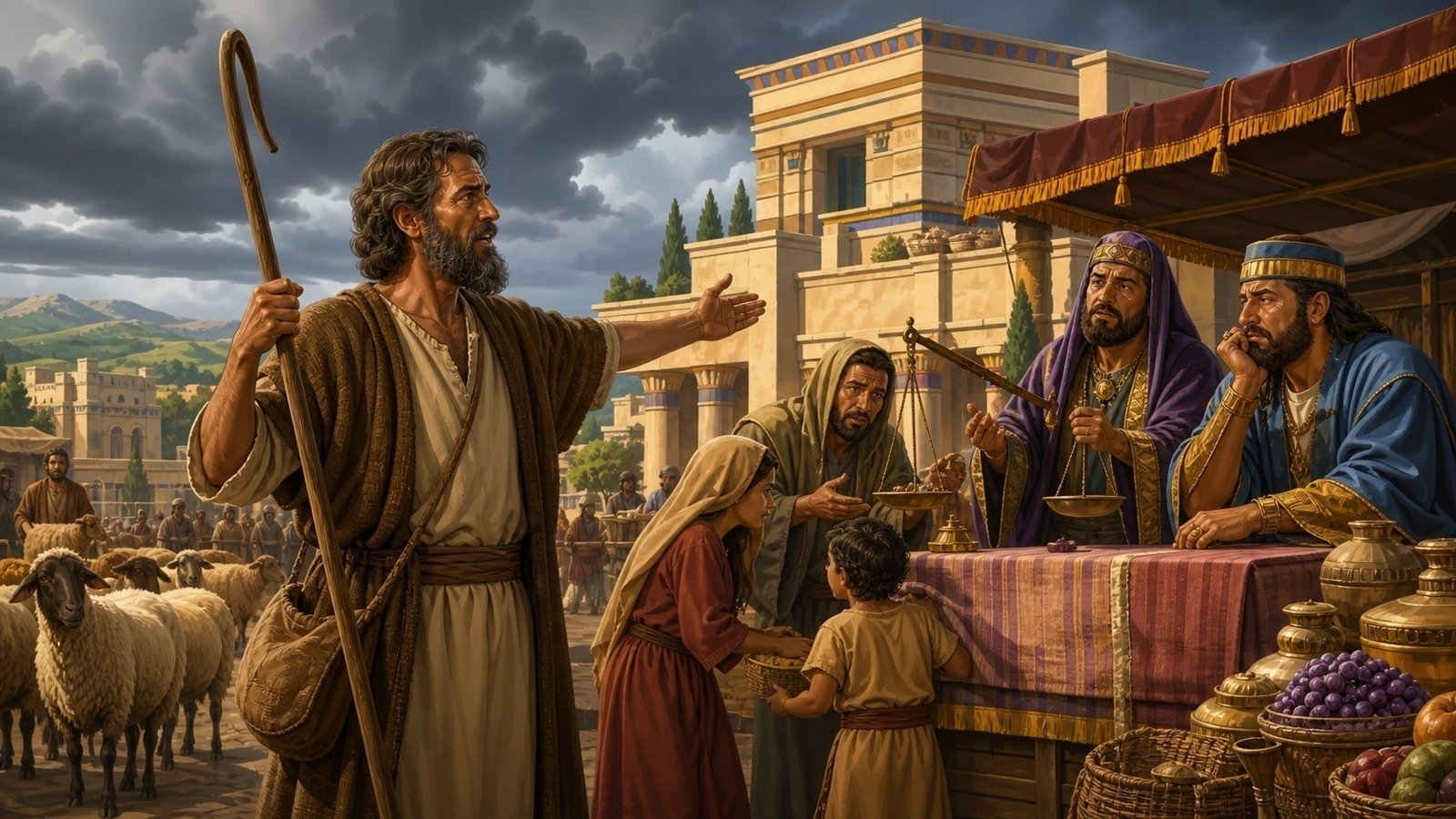
A shepherd from Judah, Amos prophesies against Israel's social injustice and religious hypocrisy during the outwardly prosperous reign of Jeroboam II, warning of coming judgement despite the kingdom's apparent strength.
Further context
3 min readAmos is a shepherd and a tender of sycamore-fig trees from Tekoa, a town in the Judean hills about sixteen kilometres south of Jerusalem, and he goes north to Bethel, which is the royal sanctuary of the other kingdom. He has no prophetic training and says so, and his own summary of his position is that he was taken from tending the flock and told to go.
The date is fixed by an unusual marker: two years before the earthquake. That event is otherwise unrecorded, though a substantial destruction layer at Hazor from around the middle of the eighth century BC has been proposed as evidence of it, and a prophet writing two centuries later still refers to fleeing from the earthquake in the days of Uzziah.
The opening of his message is a piece of rhetorical entrapment. He pronounces judgement on Damascus, then Gaza, then Tyre, then Edom, Ammon and Moab, each with a specific war crime attached: threshing Gilead with sledges having iron teeth, selling whole communities into slavery, ripping open pregnant women. An Israelite crowd hearing a foreigner condemn its enemies one after another would agree with every word. Then he condemns Judah. Then, in the same form and at greater length, Israel.
The charges against Israel are not religious in the ordinary sense. They sell the innocent for silver and the needy for a pair of sandals. They trample on the heads of the poor as on the dust of the ground. They lie down beside every altar on garments taken in pledge, which the law required to be returned before sunset. In court they hate the one who upholds justice and detest the one who tells the truth, they take bribes and they deprive the poor of justice at the gate.
The prosperity is real and it is the problem. He describes people who lie on beds inlaid with ivory, dine on choice lambs and fattened calves, and drink wine by the bowlful, and are not grieved over the ruin of Joseph. Hundreds of carved ivory furniture inlays have been excavated at Samaria from this period.
The religion is flourishing too, which is why his sharpest passage is about worship rather than idolatry: I hate, I despise your religious festivals. Your assemblies are a stench to me. Away with the noise of your songs. But let justice roll on like a river, righteousness like a never-failing stream.
The priest of Bethel reports him to the king for conspiracy and tells him to go home to Judah and earn his bread there.
Sycamore-fig trees are worth a word, because the detail places him socially. The fruit had to be pierced or scratched a few days before ripening to be edible, which was hot seasonal work done in the valleys rather than in the hill country where he lived. He is describing himself as a man who did two unglamorous jobs in two different climates, and who had no standing whatever to be lecturing a royal sanctuary.
Amos is the earliest of the writing prophets and the sequence with which his book opens is a piece of rhetorical engineering.
He begins with oracles against Israel's neighbours, one after another: Damascus, Gaza, Tyre, Edom, Ammon, Moab. Each follows the same formula, for three sins and for four, and each names an atrocity: ripping open pregnant women, selling whole communities into slavery, burning a king's bones to lime.
An Israelite audience would have enjoyed every one of them. Then Judah, which is closer to home. Then Israel, in the same formula, and the list of sins is domestic rather than military: they sell the innocent for silver and the needy for a pair of sandals, they trample on the heads of the poor, and father and son use the same girl.
Let justice roll on like a river, righteousness like a never-failing stream, is his, and so is the sentence about hating and despising religious festivals.