

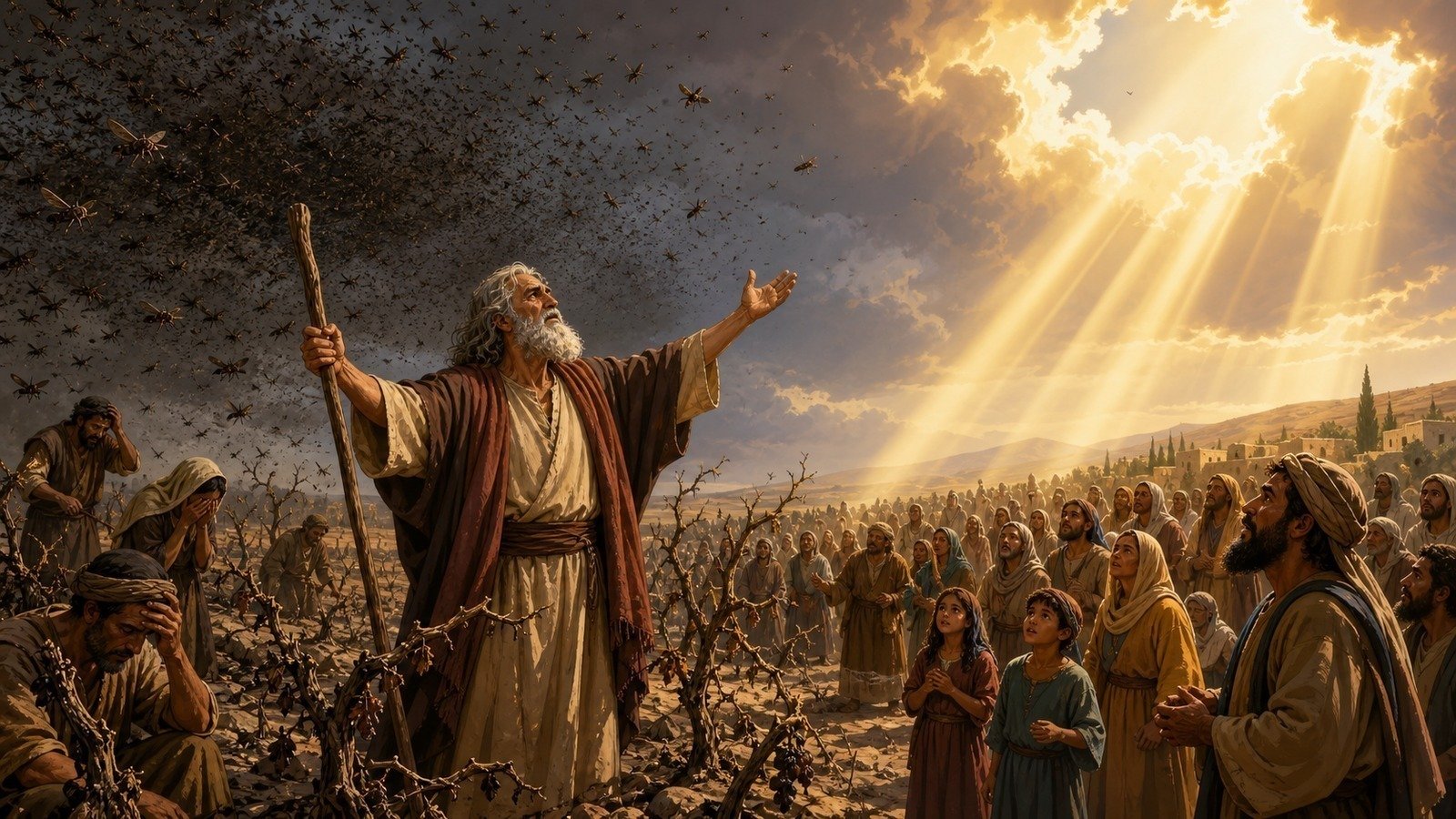
Joel uses a devastating locust plague as the springboard for a wider warning of the coming day of the Lord, and promises a future outpouring of God's Spirit "on all people," a passage Peter quotes at Pentecost.
Further context
3 min readNobody knows when he wrote. The book names no king, no foreign empire and no datable event, and estimates run across four centuries.
The early case puts him in the ninth century BC under Joash, on the grounds that the enemies mentioned are Philistines, Phoenicians, Egyptians and Edomites rather than Assyria or Babylon, and that the country appears to be governed by priests and elders rather than a king, which would fit a boy on the throne with a priest as regent. The late case puts him after the exile, in the fifth century, on the grounds that the temple is functioning, the walls are standing, the people are described as scattered among the nations and the land divided up, and there is no mention of a northern kingdom at all. Neither case is decisive and the division among scholars is genuinely even.
What the book describes is a locust plague, and the description is entomologically precise. Four terms are used for the insects, most plausibly stages of the same creature rather than four species. What the locust swarm has left the great locusts have eaten; what the great locusts have left the young locusts have eaten. The vines are dried up, the fig tree is withered, the grain is destroyed, the seeds shrivel beneath the clods, the cattle moan because they have no pasture, and even the flocks of sheep are suffering. Desert locusts in that region can strip a landscape in hours and a swarm can cover hundreds of square kilometres.
The response called for is a national fast, and the instruction is one of the sharpest in these books: rend your heart and not your garments. Tearing clothing was the standard public sign of grief, and the point is that the sign is easy and the thing it stands for is not.
Then the material that made the book matter far beyond its own crisis. The disaster is read as a preview of the day of the LORD, described as a day of darkness and gloom, with an army like nothing ever seen. And then a promise that reverses it: I will repay you for the years the locusts have eaten.
The lines everybody knows come at the end. I will pour out my Spirit on all people. Your sons and daughters will prophesy, your old men will dream dreams, your young men will see visions. Even on my servants, both men and women, I will pour out my Spirit in those days.
Peter quotes those lines in full on the morning of Pentecost, standing in front of a crowd in Jerusalem, and uses it to explain what has just happened. It is the first sermon of the Christian church and its text is a book nobody can date.
The date of Joel is the loosest of any prophetic book. It names no king, no foreign empire and no datable event, and proposals for when it was written range across roughly five centuries.
The occasion is a locust plague described in four waves, each stripping what the previous one left, and the description is agricultural and exact: the vine is dried up, the fig tree is withered, the pomegranate, the palm and the apple tree are dried up, and the seeds shrivel beneath the clods.
Locust swarms in that region are real and periodic. A plague in 1915 stripped Palestine and Syria and was photographed and documented in detail, and the eyewitness accounts read very like the book.
What he does with it is turn a natural disaster into a summons: return to me with all your heart, with fasting and weeping and mourning. Rend your heart and not your garments.