

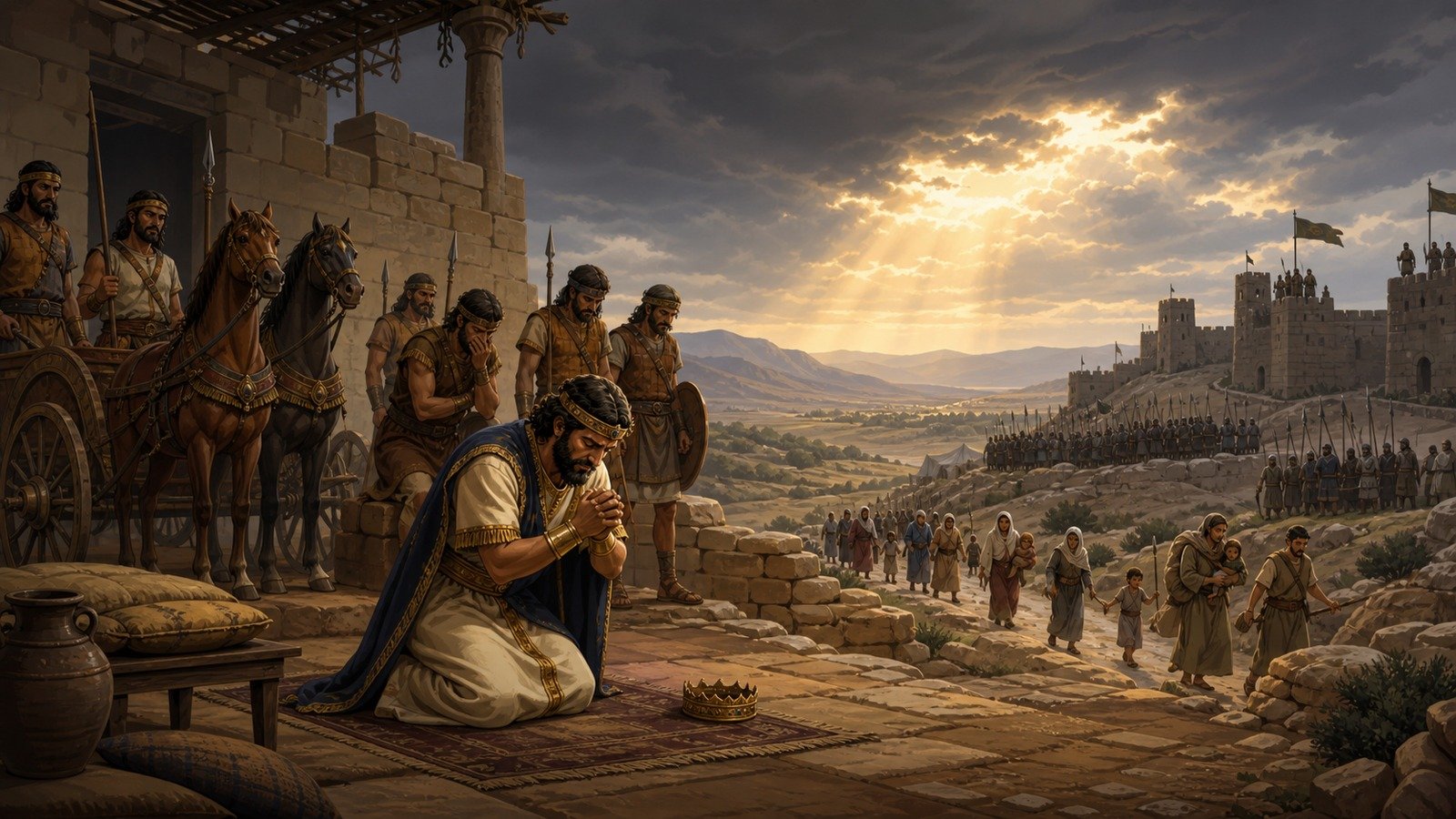
Jehu's son Jehoahaz sees Israel's military reduced almost to nothing by Hazael of Aram; only when he pleads with God does relief eventually come, though Kings does not say exactly how.
Further context
3 min readSeventeen years, and the reign is the low point of the northern kingdom's military history. Hazael of Aram and his son Ben-Hadad oppress Israel throughout it, and the state of the army is given in a single devastating inventory: nothing remained of the army of Jehoahaz except fifty horsemen, ten chariots and ten thousand foot soldiers, for the king of Aram had destroyed the rest and made them like the dust at threshing time.
Fifty horsemen and ten chariots, in a kingdom whose founder's grandfather had put two thousand chariots into the field at Qarqar. The reduction is almost total.
What happens in the middle of that is unexpected and is reported without any softening of what surrounds it. Jehoahaz seeks the LORD's favour, and he is heard, because he saw how severely the king of Aram was oppressing Israel. A deliverer is provided and the Israelites escape from the power of Aram and live in their own homes as they had before.
Who that deliverer was is unknown and several proposals have been made, including his own son and grandson, and, more plausibly on the timing, the Assyrian king Adad-nirari III, whose campaign against Damascus around 796 BC broke Aramean power and whose inscriptions record receiving tribute from the region. If that is right, the answer to an Israelite king's prayer arrived in the form of an Assyrian army that neither he nor anyone else had any control over.
The word used for the deliverer is deliberately vague, and the same term is used of the figures who rescued Israel repeatedly in the era before the monarchy. Applying it here, in a reign assessed as evil, to a rescue that produced no reform at all, is either a deliberate echo or a very dry one.
Nothing changes afterwards. They did not turn away from the sins of the house of Jeroboam, and the Asherah pole remained standing in Samaria.
That last clause is worth noticing because it is the same object his grandfather Jehu had left in place while demolishing the temple of Baal. A dynasty founded on the destruction of one foreign cult keeps another one standing in its capital for three generations.
Fifty horsemen is worth setting against a number from a century earlier. At the battle of Qarqar in 853 BC, an Assyrian inscription credits Ahab of Israel with two thousand chariots, the largest contingent in the coalition. Three generations later his successor has ten.
The reign is a compressed version of the pattern the whole northern kingdom runs on: pressure, distress, an appeal, relief, and no change of any kind once the pressure lifts. What distinguishes it from the earlier cycles is that the relief comes from imperial politics rather than from a deliverer raised up inside the country, and that the empire in question is about to arrive properly and remove the kingdom altogether.
Seventeen years, and the picture given of the army at the end of them is the most concrete measure of the collapse: nothing was left of the army of Jehoahaz except fifty horsemen, ten chariots and ten thousand foot soldiers, for the king of Aram had destroyed the rest and made them like the dust at threshing time.
Ahab had put two thousand chariots into the field at Qarqar two generations earlier. Ten is what is left.
The relief that comes is credited to a deliverer who is not named, and the likeliest candidate is the Assyrian king Adad-nirari III, whose campaign against Damascus around 796 BC broke Aramean power and took the pressure off Israel entirely by accident.