

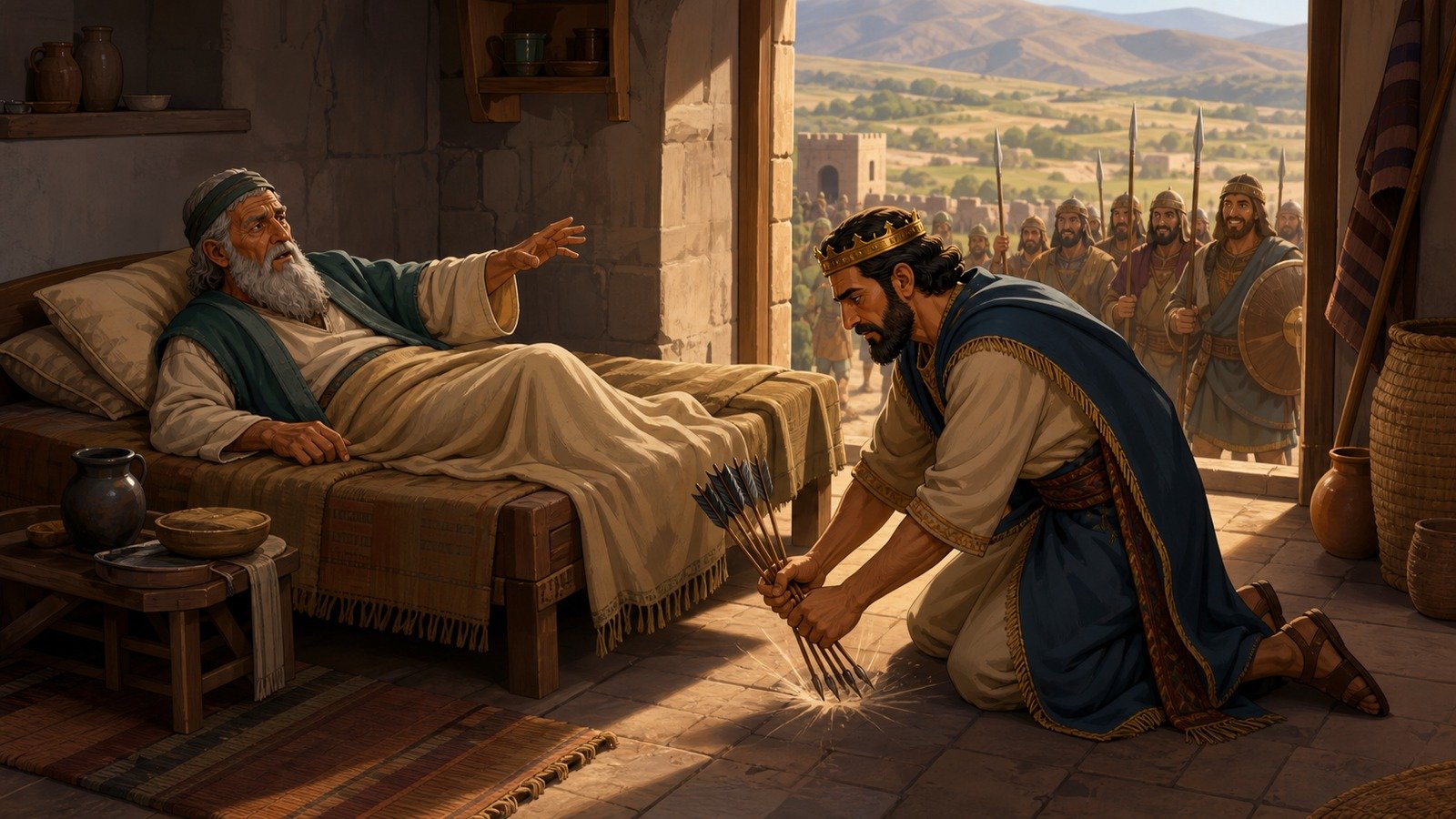
Jehoash visits the dying Elisha, who promises limited victories over Aram symbolised by striking arrows on the ground; Jehoash also defeats Judah's Amaziah in battle, beginning a recovery of Israel's fortunes.
Further context
3 min readJehoash of Israel reigns sixteen years, receives the standard bad verdict, and presides over a military recovery that reverses a generation of losses.
The scene that defines him is a deathbed. Elisha, who has been active since Ahab's reign and is now dying, is visited by the king, who weeps over him and says the words Elisha himself had shouted when Elijah was taken: my father, my father, the chariots and horsemen of Israel. A king of the northern kingdom, whose whole dynasty is assessed as evil, weeps at the bedside of the prophet who had anointed its founder.
What follows is a piece of prophetic theatre with a sting in it. Elisha tells him to take a bow and arrows, puts his own hands over the king's hands, has the east window opened and tells him to shoot, and calls it the LORD's arrow of victory over Aram. Then he tells him to take the arrows and strike the ground. He strikes three times and stops.
Elisha is angry. You should have struck the ground five or six times; then you would have defeated Aram and completely destroyed it. But now you will defeat it only three times.
Nothing explains why three was insufficient, and the point appears to be that the king stopped when he had done enough to comply rather than continuing until he was told to stop. A man handed an open-ended promise settles for the minimum gesture.
He defeats Aram three times and recovers the towns his father had lost, and no more than that.
One further episode belongs to his reign and it is the last recorded of Elisha. After the prophet's death and burial, a body is being buried hurriedly during a raiding season, and when it touches Elisha's bones the man comes to life and stands up. Nothing whatever is made of it; it takes two sentences and is the closing note on a fifty-year career.
He also fights Judah and wins decisively. Amaziah of Judah, fresh from a victory over Edom, challenges him to meet face to face, and the reply is a fable of the kind used in the north for two centuries. A thistle in Lebanon sent a message to a cedar in Lebanon asking for his daughter in marriage for his son, and a wild beast came along and trampled the thistle underfoot. He advises him to stay at home and enjoy his victory, and asks why he should ask for trouble.
Amaziah insists. The armies meet at Beth Shemesh, Judah is routed, the king is captured, and Jehoash marches on Jerusalem and breaks down about two hundred metres of the city wall, from the Ephraim Gate to the Corner Gate. He takes the gold, silver and articles from the temple and the palace treasuries, along with hostages, and goes back to Samaria.
That is the only occasion in two centuries when an Israelite army takes Jerusalem, and it happens because a southern king who had just won a war went looking for another one.
The deathbed scene with Elisha is the strangest thing in the reign. The dying prophet tells the king to shoot an arrow out of the east window, calls it the arrow of victory over Aram, and then tells him to strike the ground with the remaining arrows. He strikes three times and stops, and Elisha is angry with him: you should have struck five or six times; then you would have defeated Aram completely. Now you will defeat it only three times.
Nothing explains why the number mattered or why the king was not told in advance, and interpreters have been uncomfortable with it for centuries.
He does defeat Aram three times and recovers the towns his father had lost, which is the beginning of the recovery that peaks under his son.