

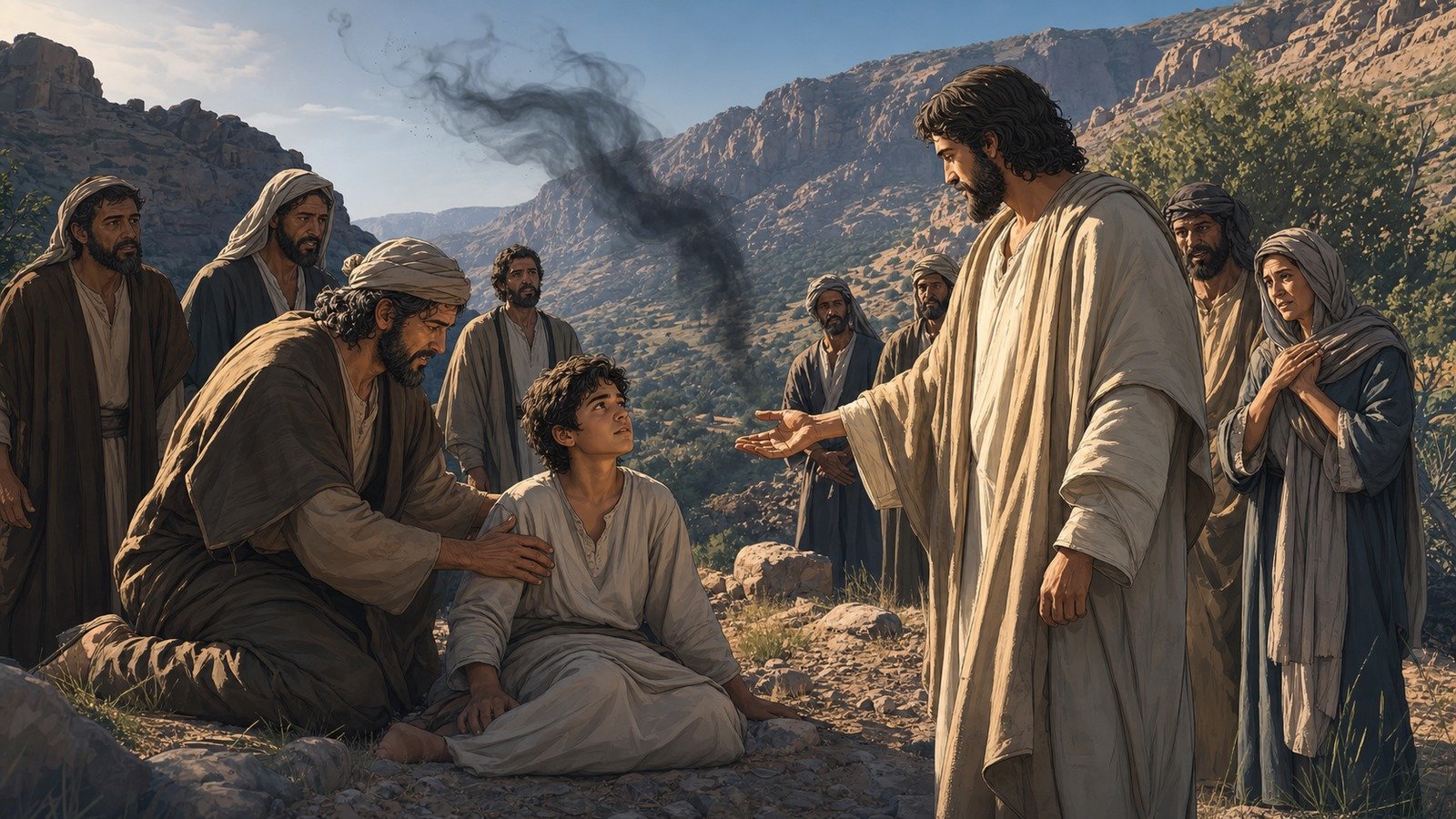
Coming down from the mountain, Jesus heals a boy with a violent, convulsive spirit that the disciples had been unable to cast out themselves, attributing their failure to insufficient faith and, in Mark's account, to a need for prayer.
Further context
2 min readJesus comes down from the mountain with Peter, James and John into a scene that is going badly. A large crowd, teachers of the law arguing with the disciples, and when the people see him they are overwhelmed with wonder and run to greet him.
He asks what the argument is about, and a man in the crowd answers.
His account of his son's condition is unusually detailed. A spirit robs him of speech, and whenever it seizes him it throws him to the ground, he foams at the mouth, gnashes his teeth and becomes rigid. It has often thrown him into fire and into water to kill him. This has been happening since childhood. Luke, whose vocabulary elsewhere suggests medical interest, adds that the boy scarcely ever leaves him and that he is the man's only child.
The symptoms described match epilepsy closely, and the Greek word used in one account means moonstruck, which was the ordinary term for the condition and lies behind the old English lunatic. How that maps onto the spiritual diagnosis offered here has been argued over for centuries and remains unsettled.
I asked your disciples to drive it out, the father says, but they could not.
The reply is a cry of exhaustion. You unbelieving generation, how long shall I stay with you? How long shall I put up with you? Bring the boy to me.
When the boy is brought, the spirit throws him into a convulsion in front of everyone. He asks the father how long this has been happening, which is the only time he asks for a case history, and the man says from childhood, and then makes his request: if you can do anything, take pity on us and help us.
If you can? repeats back. Everything is possible for one who believes.
The father's answer is the most quoted sentence in the episode, and it is honest about its own limits: I do believe; help me overcome my unbelief.
The spirit is rebuked and comes out with a shriek and a violent convulsion, leaving the boy looking so much like a corpse that many say he is dead. He is taken by the hand and lifted to his feet, and stands.
Indoors, the disciples ask privately why they failed. The answer given is that this kind can come out only by prayer, and some early copies add fasting. Elsewhere the failure is put down to their little faith, followed by the remark about a mustard seed moving a mountain.
Luke sets the descent from the mountain on the next day, which places this scene the morning after the three had seen his face change. The contrast is heavy and deliberate: brightness, a voice from the cloud and two prophets on the summit, and at the bottom a crowd, an argument, a convulsing child and nine men who cannot do anything.
The father's request is also the only one in the Gospels phrased as a doubt about capacity rather than willingness. A leper had said, if you are willing, you can make me clean. This man says, if you can do anything, and the words are picked up and handed back to him before anything else is dealt with.