

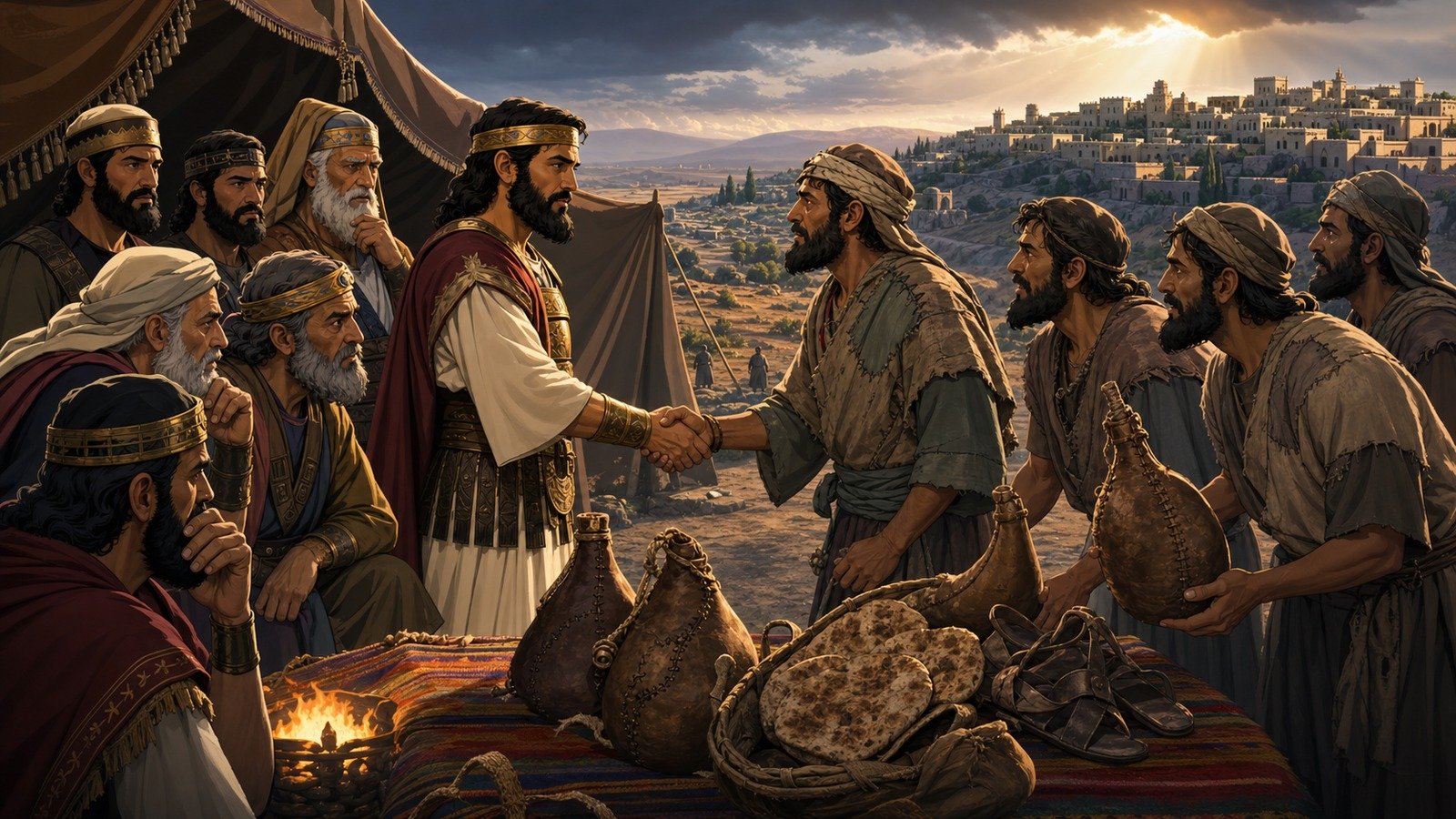
The Gibeonites disguise themselves as distant travellers to trick Israel into a peace treaty without consulting God first. Once the deception is discovered, Israel honours the oath but reduces the Gibeonites to servitude.
Further context
2 min readThe Gibeonites do the arithmetic and reach a different answer from everybody else. Jericho and Ai have fallen and the local kings are forming a coalition to fight. Gibeon, a substantial town about ten kilometres north of Jerusalem, decides not to join it.
Their delegation arrives in worn-out clothes and patched sandals, with cracked and mended wineskins, and carrying bread that is dry and mouldy. We have come from a distant country, they say. This bread was warm when we packed it. Look at these wineskins, new when we filled them. They name what they have heard about, and the list is careful: Egypt, and Sihon and Og east of the Jordan. They do not mention Jericho or Ai, which have only just happened and would give away how close they live.
The Israelites sample their provisions and do not enquire of the LORD. That one clause is the hinge of the whole episode. A treaty is sworn, and three days later the truth comes out.
The oath is honoured anyway. The leaders say they have sworn by the LORD, the God of Israel, and cannot touch them now, and the community grumbles against the leaders for it. The Gibeonites are made woodcutters and water carriers for the community and for the altar, which is servitude rather than destruction, and their explanation when challenged is disarming: your servants were clearly told that the LORD your God had commanded you to give you the whole land and wipe out all its inhabitants, so we feared for our lives and did this.
What the episode demonstrates is that a sworn oath binds even when it was obtained by fraud. Centuries later, when Saul breaks it and kills Gibeonites in a burst of zeal, the consequence lands on his successor: a three-year famine in David's reign is traced directly to that broken treaty, and restitution has to be made.
The Gibeonites also remain a fixed part of the landscape. Their town becomes an important sanctuary site, the tent of meeting stands there in David's time, and Solomon goes to Gibeon to sacrifice at the start of his reign, where he asks for wisdom.
The failure identified is precise and it is worth naming, because it recurs. The Israelites sampled the provisions and did not enquire of the LORD. They investigated. They examined the evidence in front of them, drew the obvious conclusion from mouldy bread and worn sandals, and never asked the one question that would have settled it. Competent scrutiny of the wrong things is what defeats them, and the same failure with a different subject brought down an army at Ai a few weeks earlier.
A people who survived by lying about where they came from end up carrying water for the altar for centuries, and the arrangement holds because somebody kept an oath he wished he had not sworn.