

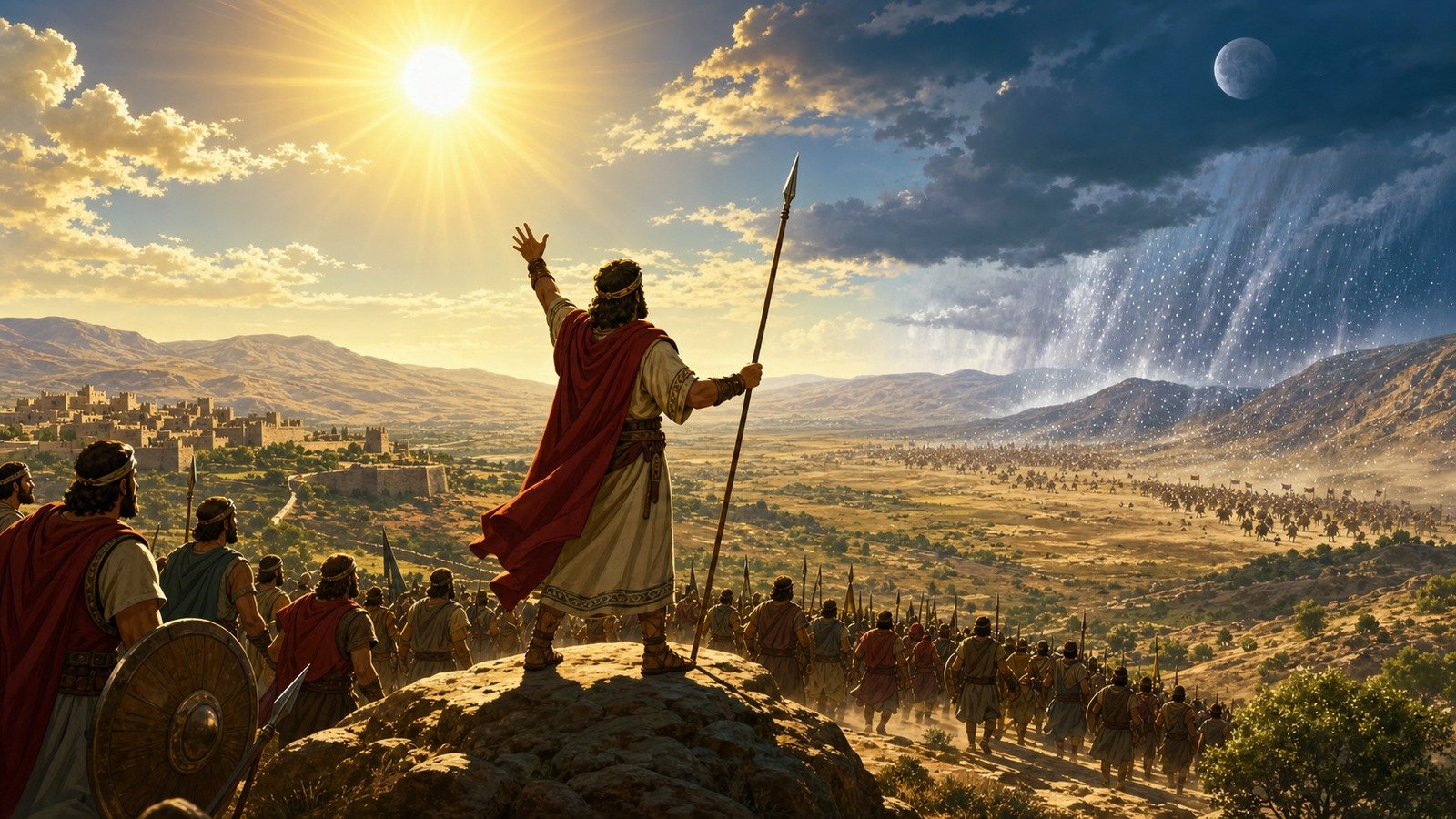
A coalition of five Amorite kings attacks Gibeon for its treaty with Israel; Joshua marches through the night to relieve it, and, in a passage long debated by interpreters, the sun and moon are said to stand still to extend the day of battle.
Further context
2 min readGibeon's defection is what triggers the war. Five Amorite kings, led by Adoni-Zedek of Jerusalem, combine not against Israel but against Gibeon, for making peace. The Gibeonites send an urgent message and Joshua marches all night from Gilgal, roughly thirty kilometres uphill, and attacks at dawn after a forced march.
The coalition breaks and is pursued down the descent of Beth Horon, a steep and narrow pass that was the main route between the hill country and the coastal plain and the scene of several later battles for the same reason. Large hailstones kill more of them on the road than the Israelites kill with the sword.
Then the strangest lines in the whole conquest. Joshua speaks to the LORD in the presence of Israel and says, sun, stand still over Gibeon, and you, moon, over the Valley of Aijalon. The sun stopped and the moon halted until the nation avenged itself on its enemies, and the sun stopped in the middle of the sky and delayed going down about a full day.
That is quoted from a work called the Book of Jashar, which is named twice in the Hebrew scriptures and has not survived, so what is being reproduced here is poetry from an older collection.
Three readings are current. The first takes it as a literal extension of daylight. The second treats it as an optical or atmospheric phenomenon, with the hailstorm and cloud producing unusual light. A third, argued in detail in recent decades, notes that the Hebrew verbs can carry the sense of ceasing to shine rather than ceasing to move, which would make it a prayer for the sun to stop beating down on exhausted men, or alternatively a reference to an eclipse; one such proposal ties it to an annular eclipse visible in Canaan on 30 October 1207 BC. A fourth simply reads it as poetry doing what victory poetry does, and notes that the surrounding prose is the frame around a quoted song.
Nothing settles it, and the poetic source is the reason. Habakkuk later uses the same image of sun and moon standing still in their heavenly dwellings, in a passage that is unambiguously poetry.
The campaign that follows is summarised with brutal efficiency. The five kings are found hiding in a cave at Makkedah, sealed in with stones while the battle finishes, and then executed. Town after town in the southern hill country is taken, and the summary sentence says that Joshua subdued the whole region because the LORD, the God of Israel, fought for Israel.
That summary sits awkwardly against the opening chapters of Judges, which describe large areas still unconquered and Canaanite towns holding out for generations. The two are usually reconciled by reading the conquest account as describing decisive victories in the field rather than permanent occupation of every site, which is how ancient military summaries generally work.