

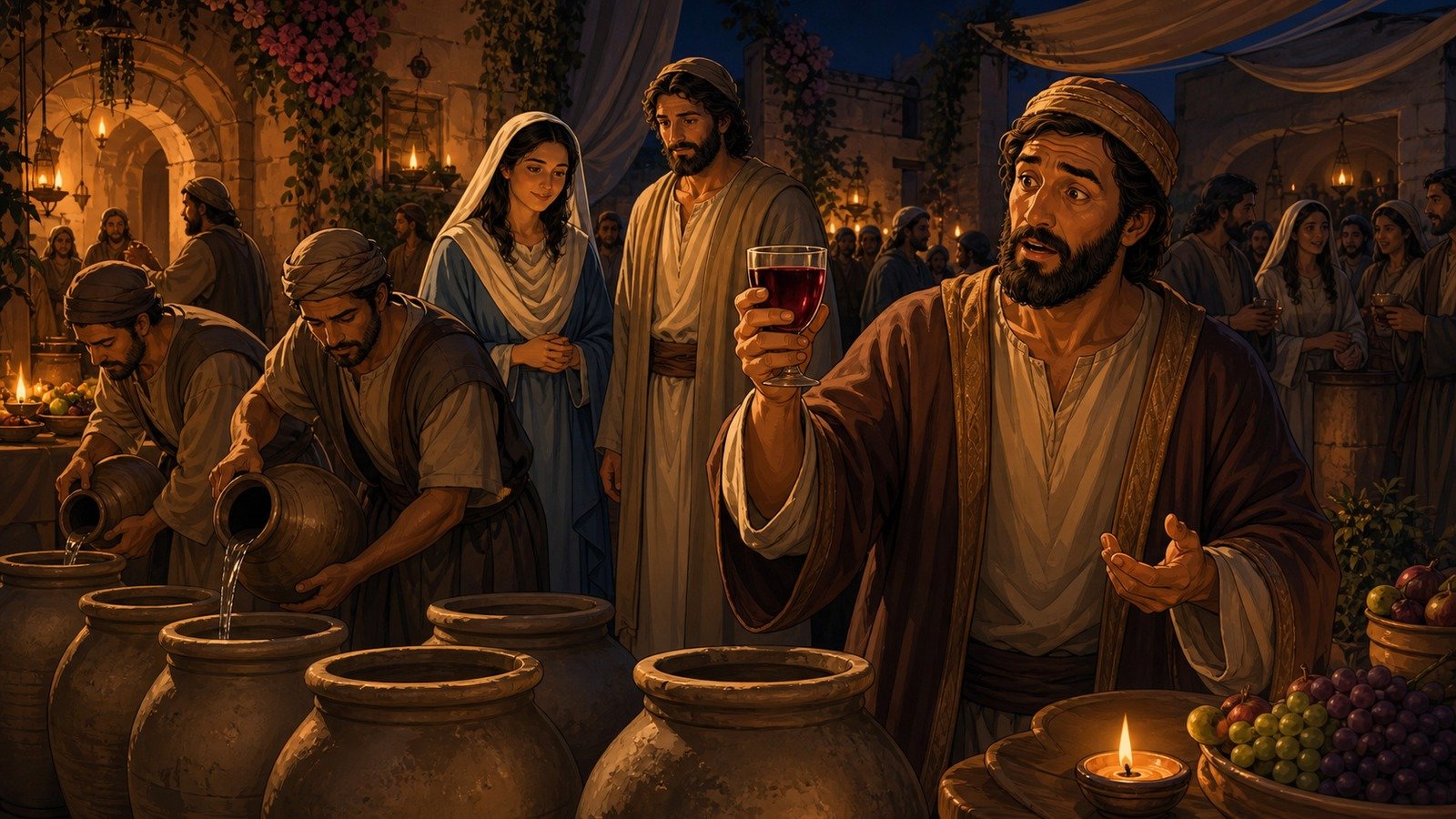
At a wedding in Cana, Jesus turns water into wine at his mother's prompting after the wine runs out, "the first of the signs through which he revealed his glory," strengthening his disciples' fledgling belief in him.
Further context
3 min readA village wedding in Galilee, on the third day, with Jesus, his mother and the disciples among the guests. Weddings in that world lasted about a week, the guests were the whole village and anyone connected to it, and providing for them was the groom's family's responsibility and a matter of honour.
The wine runs out, which is a social catastrophe rather than an inconvenience. In a culture built on hospitality it would be remembered for years and could in principle expose the family to a legal claim.
His mother tells him, without asking for anything: they have no more wine. His answer is not the one a reader expects. Woman, why do you involve me? My hour has not yet come. The address is not rude in Greek, and is closer to madam than to anything sharp, but the refusal is real. Her response is to ignore it entirely and tell the servants, do whatever he tells you, which are the last recorded words she speaks anywhere.
Six stone water jars are standing nearby, the kind used for ceremonial washing, each holding twenty to thirty gallons. Stone was used rather than pottery because stone vessels did not contract ritual impurity, and large numbers of them have been excavated in Galilee and Jerusalem. The total capacity is somewhere between five hundred and seven hundred litres.
He tells the servants to fill them to the brim, and then to draw some out and take it to the master of the banquet. Nothing is said, no gesture is made and no announcement follows. The only people who know what has happened are the servants who carried the water.
The master of the banquet tastes it, does not know where it came from, and calls the bridegroom over to compliment him on his cellar management: everyone brings out the choice wine first and then the cheaper wine after the guests have had too much, but you have saved the best till now. He is praising a man who has no idea what he is talking about.
The quantity is the detail that has struck most readers. Several hundred litres of good wine, at the end of a wedding, is far beyond what anyone needed and it is left with the family. What was solved was an embarrassment.
Cana has not been located with certainty. Two sites in Galilee compete for it, one about six kilometres north of Nazareth and one about thirteen kilometres further on, and excavation at the second has produced first-century remains including fragments of stone vessels of exactly the kind described. Neither identification is settled.
The jars themselves carry the point. Vessels for ritual purification are filled to the brim with water and what comes out is wine at a party.
The quantity is the detail people miss. Six stone jars holding between twenty and thirty gallons each comes to something between five and seven hundred litres of wine, delivered to a village wedding that had already run out.
The exchange with his mother is abrupt in every translation. Woman, why do you involve me? My hour has not yet come. She ignores it entirely and tells the servants to do whatever he tells them, which is the last recorded thing she says anywhere.
The master of the banquet, who does not know where the wine came from, delivers the verdict as a compliment to the bridegroom: everyone brings out the choice wine first and then the cheaper wine after the guests have had too much; but you have saved the best till now.
Stone jars were used for purification water specifically because stone, unlike pottery, could not contract ritual uncleanness, and fragments of them turn up regularly in first-century excavation.