

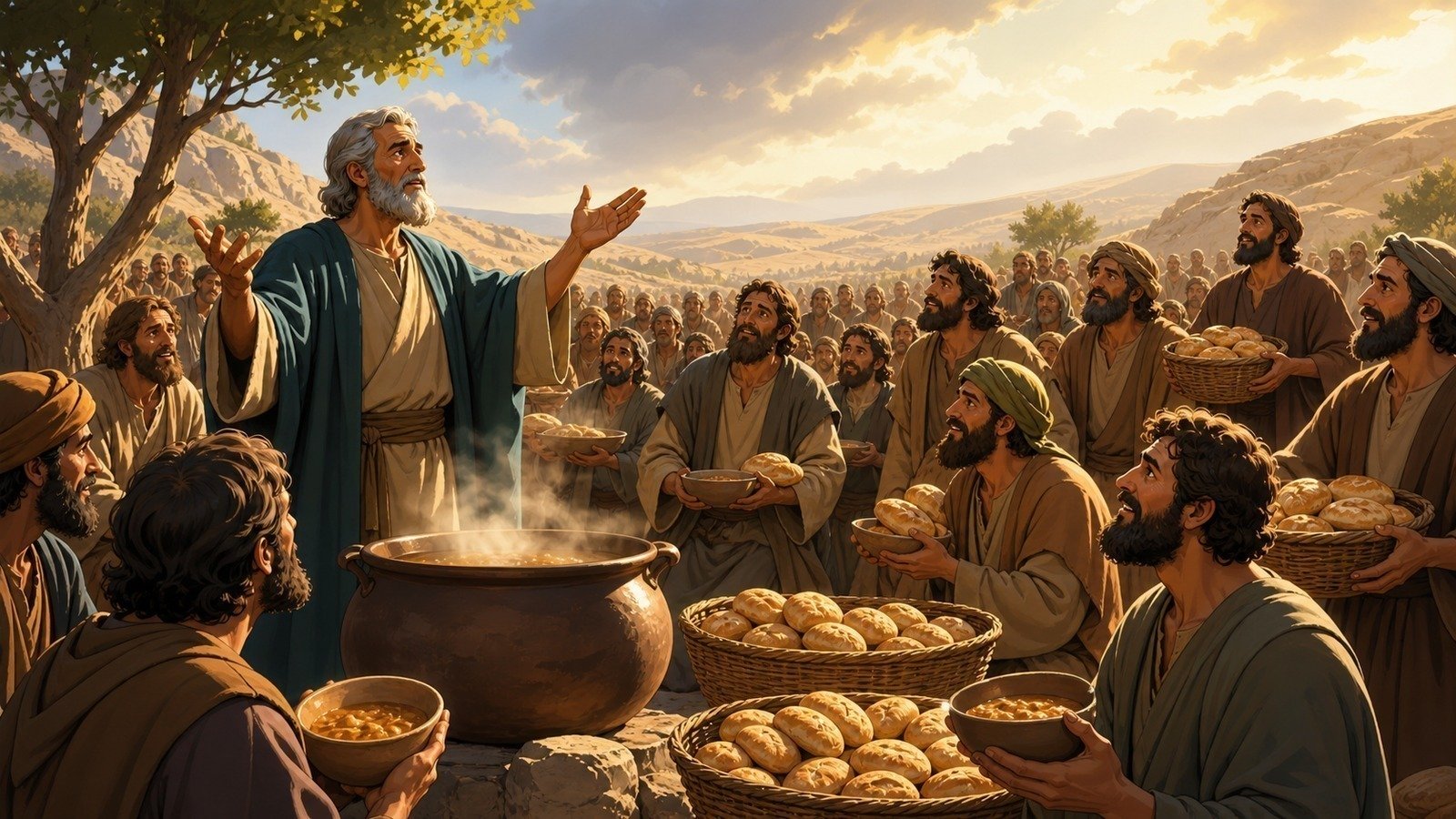
During a famine, Elisha neutralises a pot of stew accidentally poisoned with wild gourds, then feeds a hundred men from twenty loaves of bread with food left over, foreshadowing Jesus' later feeding miracles.
Further context
3 min readTwo short episodes, both about food, both during a famine, and both involving the company of prophets, which appears to be a resident community of men associated with Elisha at Gilgal.
In the first, a large pot is put on to boil for the whole group and one of them goes out into the fields to gather herbs. He finds a wild vine, fills his cloak with its gourds, comes back and cuts them into the pot without knowing what they are. As they begin to eat they cry out, there is death in the pot.
Which plant that was is unknown. The colocynth, a wild gourd of the region whose fruit looks edible and is violently purgative, is the usual identification, and it grows in exactly that terrain.
The remedy is flour thrown into the pot, and then the instruction to serve it, and there is nothing harmful in it. Flour does not neutralise a purgative, and the ordinary domestic character of what is used is a feature of most of these episodes: salt into a spring, flour into a stew, a stick thrown into water to float an axe head.
In the second, a man comes from Baal Shalishah bringing twenty loaves of barley bread baked from the first ripe grain, along with some heads of new grain. Bringing the first of a harvest to a religious figure is what the law prescribed for the priests, so a farmer during a famine is handing over his firstfruits to a prophet rather than to the sanctuary at Bethel, which says something about where he thought the legitimate priesthood was.
Elisha tells his servant to give it to the people to eat, and the objection is arithmetical: how can I set this before a hundred men? The reply is that they will eat and have some left over, and they do.
The parallels with two later feedings are close enough that they are generally taken as deliberate. A crowd, a small quantity of barley loaves, an assistant who points out that it is not enough, an instruction to distribute it anyway, and leftovers. When Jesus feeds a crowd with five barley loaves and two fish and twelve baskets are collected afterwards, the pattern is recognisable, and the Gospel writers knew this story.
Baal Shalishah, where the loaves come from, is otherwise unknown, and Gilgal, where the community lives, is in the Jordan valley. What the two episodes share besides food is the setting: a famine in the land, which is mentioned in the first line of the first one and is the background to both.
Both episodes together take twelve sentences and neither involves a king, an army or a public. A community of men eats a meal that would have poisoned them and then a hundred people are fed from one man's harvest offering, in the middle of a famine, and nothing further is made of either.
The famine mentioned is the seven-year one Elisha had told the Shunammite woman about, telling her to leave the country and stay wherever she could, which is why her land had to be recovered when she came back.
In the first episode a servant gathers herbs from the open country and finds a wild vine, whose gourds he shreds into the pot without knowing what they are. The company of prophets taste it and cry out, there is death in the pot. Elisha calls for flour, throws it in, and tells them to serve it. The plant was most probably a colocynth, a bitter wild gourd that grows in that region and is a violent purgative.
In the second, a man brings twenty loaves of barley bread from the firstfruits, and Elisha tells the servant to set it before a hundred men. The objection and the answer are both preserved, and they are almost word for word what is said on a hillside in Galilee nine centuries later.