

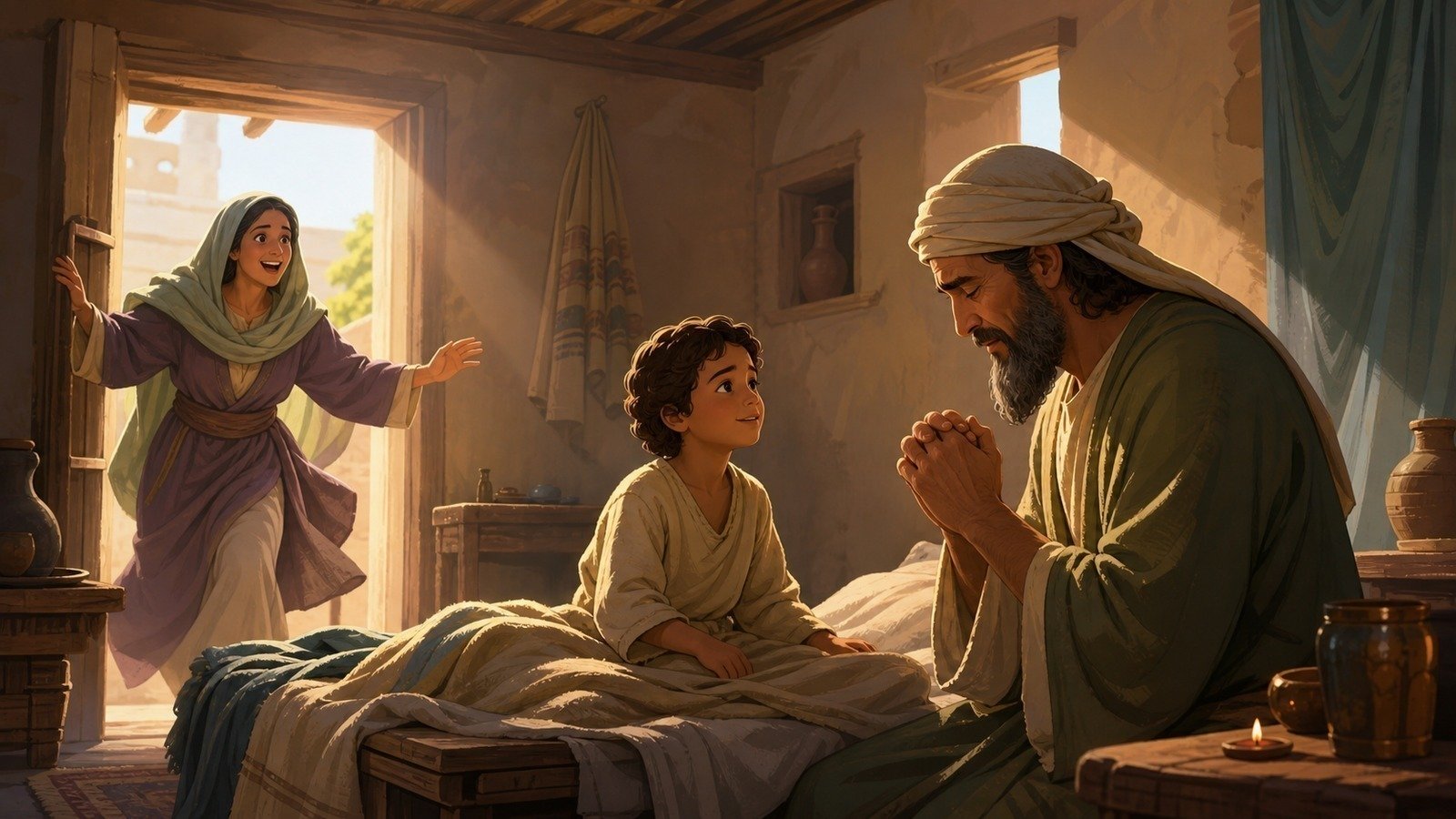
A wealthy Shunammite woman who had shown Elisha regular hospitality is promised, and bears, a son; when the boy later dies suddenly, Elisha stretches himself over the body in prayer and revives him.
Further context
3 min readA well-to-do woman in Shunem, in the Jezreel valley, notices that Elisha keeps passing through and urges him to stay for a meal, and after a while suggests to her husband that they build a small room on the roof and put a bed, a table, a chair and a lamp in it, so that he can stay whenever he comes.
The care is unusually specific and it is entirely her idea. She identifies him correctly as a holy man of God, arranges the accommodation and pays for it, and asks for nothing.
When he tries to repay her by offering to speak on her behalf to the king or the commander of the army, her answer is one of the most self-possessed lines anywhere: I have a home among my own people. She is not looking for patronage.
His servant Gehazi points out that she has no son and her husband is old, and she is told that about this time next year she will hold a son in her arms. Her reaction is not joy but something closer to fear: no, my lord, do not mislead your servant. She has evidently stopped hoping and does not want it started again.
The child is born, and some years later he goes out to his father among the harvesters, complains of his head, is carried home to his mother, sits on her lap until noon and dies.
What she does then is remarkable at every step. She carries him up to the prophet's room, lays him on the bed, shuts the door, and goes out. She asks her husband for a servant and a donkey without telling him anything, and when he asks why she is going today, since it is neither the new moon nor the Sabbath, she says it is all right. She rides to Carmel, ignores Gehazi's polite enquiries with the same two words, and takes hold of the prophet's feet.
His comment when he sees her is honest about his own limits: she is in bitter distress, but the LORD has hidden it from me and has not told me why.
He sends Gehazi ahead with his staff to lay on the boy's face and she refuses to leave without him, and the staff produces nothing. He goes in himself, shuts the door on the two of them, prays, and then lies on the boy, mouth to mouth, eyes to eyes, hands to hands, and the body grows warm. He gets up, walks back and forth in the room, stretches out on him again, and the boy sneezes seven times and opens his eyes.
The room she builds is described in a list of four objects, a bed, a table, a chair and a lamp, which is the only piece of interior furnishing described anywhere in these books.
When Elisha asks what can be done for her and offers to speak to the king or the commander of the army on her behalf, her answer is a refusal that says a great deal about her position: I have a home among my own people.
The child's death is described in a way that suggests sunstroke: he goes out to his father among the harvesters, says my head, my head, is carried to his mother and dies on her lap at noon.
She saddles a donkey, tells her husband nothing, rides to Carmel and takes hold of the prophet's feet, and when Gehazi tries to push her away Elisha stops him: she is in bitter distress, and the LORD has hidden it from me and has not told me why.