

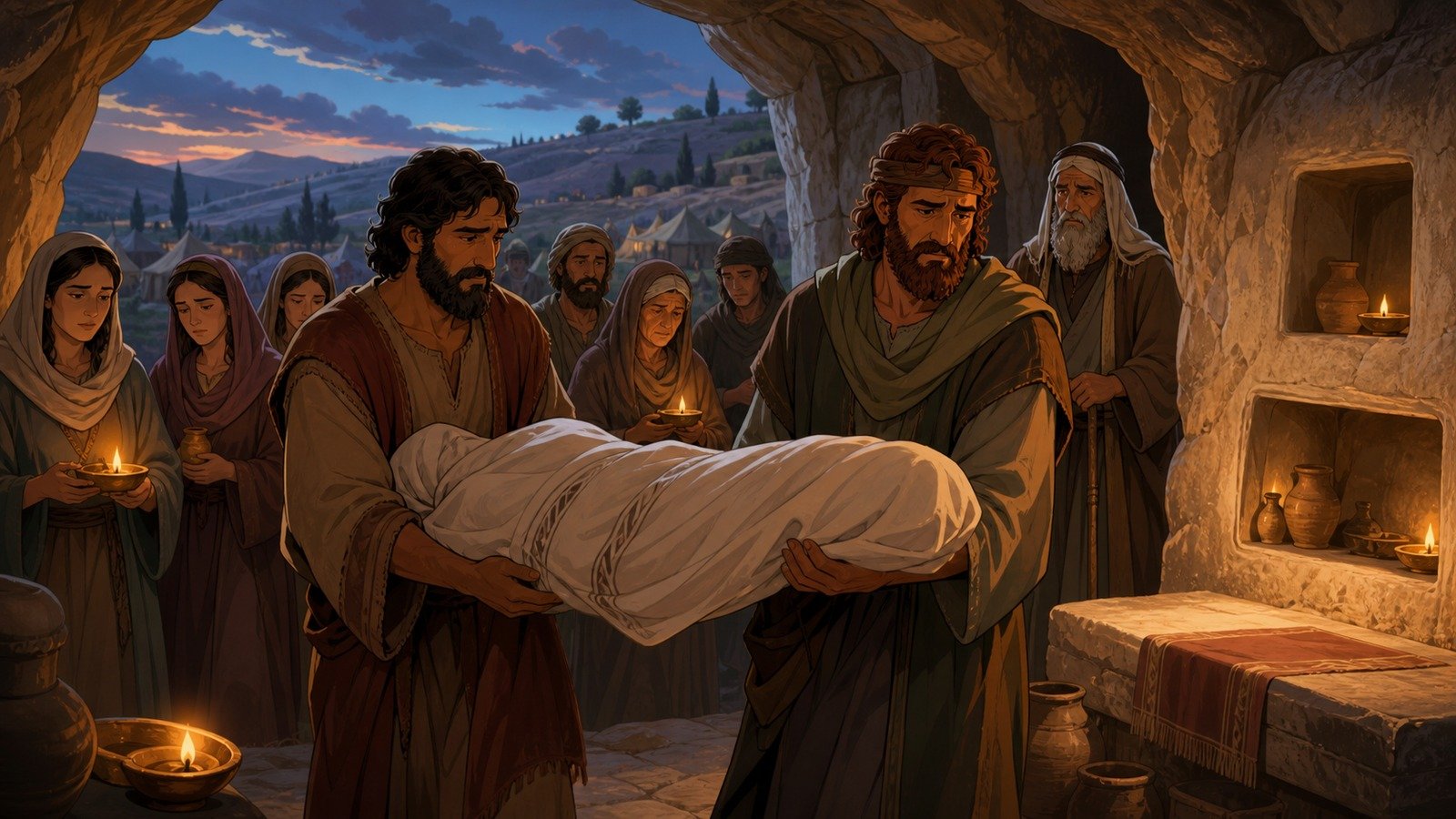
Isaac dies at 180 in Hebron, and both Jacob and Esau bury him beside Abraham and Sarah at Machpelah, one of the rare moments the estranged brothers appear together again.
Further context
3 min readTwo brothers stand at a graveside for the second time in three generations. Jacob comes home to his father at Mamre near Hebron, where Abraham and Isaac had both lived, and Isaac dies at a hundred and eighty, old and full of years, and his sons Esau and Jacob bury him.
The last time these two appeared in the same scene, one had just stolen the other's blessing and fled the country. The time before that, they had wept on each other's necks on a road in Transjordan. Nothing is said here about their relationship at all. Each patriarch's life closes with two estranged sons standing at the same burial and no dialogue between them.
The placement of this is not chronological, and the arithmetic supplied elsewhere makes that clear. Isaac was sixty when the twins were born, so he died when Jacob was a hundred and twenty. Jacob tells Pharaoh he is a hundred and thirty when the family arrives in Egypt. Joseph was thirty when he entered Pharaoh's service, and the family came down after seven years of plenty and two of famine, so Joseph was thirty-nine at the reunion and was therefore born when his father was ninety-one.
Putting those figures together changes how the following chapters read. Isaac died when Joseph was twenty-nine, a year before Joseph stood in front of Pharaoh and roughly twelve years after he was sold. Isaac was alive throughout the slavery in Potiphar's house and throughout the years in prison. He lived a decade beyond the point where his death is reported, and he died believing his grandson had been killed by an animal.
Hebrew storytelling regularly closes off one figure's life in full before returning to pick up a thread that runs behind it, and this is a clear instance. Isaac is finished with first, and then the story turns to Joseph and starts again from a point years earlier.
One consequence of that overlap is worth drawing out. For roughly a decade, an old blind man at Hebron and a slave in an Egyptian prison were alive at the same time, and neither knew anything about the other. Jacob spent those years believing his favourite son had been torn apart by an animal, and his father spent them believing the same, because the family told him so. The grief in that household ran for twenty-two years on a lie sustained by ten men who saw each other every day.
Isaac's life is the least eventful of the three. He is the son on the altar, the husband whose wife was found for him, the father who was deceived, and the herdsman who moved on twice rather than fight over a well. He is also the only one of the three who never leaves Canaan, and the only one whose death is recorded with both sons present and no dispute over what he left behind. The estate is never itemised, and neither brother is said to have claimed anything.
The phrase used, that he was gathered to his people, is applied to Abraham, Ishmael, Isaac, Jacob, Aaron and Moses, and always as something separate from the burial that follows it. The Hebrew scriptures say remarkably little about what happens after death, and this expression is one of the few indications that their writers thought of something beyond the grave, though it stops well short of a description.
Esau's descendants and their settlement in Seir take up the whole of the next section, after which the story turns to Joseph and does not come back to that line.