

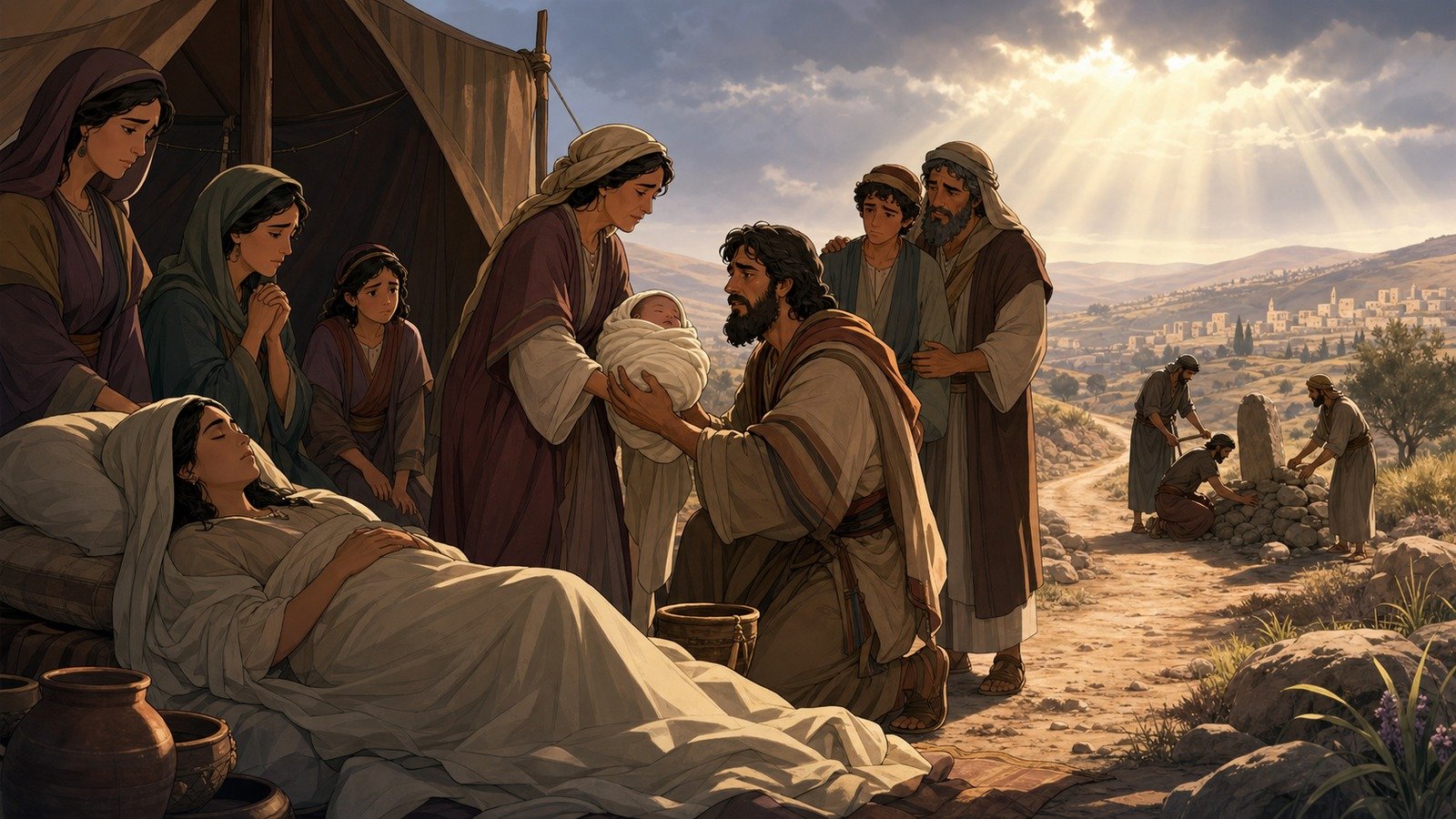
Rachel dies giving birth to Benjamin, Jacob's twelfth son, near Bethlehem, and is buried there rather than in the family tomb at Machpelah.
Further context
2 min readThe labour was hard and she was still on the road, some distance short of Ephrath, which is Bethlehem. Everything about the scene is improvised: no house, no women of the household around her, no time.
The midwife says the sentence that would ordinarily be good news: do not despair, for you have another son. It is the answer to the prayer Rachel made when Joseph was born, when she asked that the LORD would add to her another son. The request is granted and it kills her, and the two sentences are placed close enough together that the connection cannot be avoided.
As she is dying she names the child Ben-Oni, son of my trouble, or son of my sorrow. His father calls him Benjamin instead, son of the right hand, which in Hebrew idiom carries the sense of favour and strength and can also mean son of the south. This is the only occasion anywhere where a father overturns a name a mother has given, and the effect is to spare the boy a lifelong reminder of how he arrived.
She is buried where she died, on the road, and Jacob sets up a pillar over the grave. The pillar was still standing and still known when this was written down.
Where that tomb was is not straightforward, and the difficulty is better stated than smoothed over. Here it is on the road to Ephrath, identified as Bethlehem, which lies south of Jerusalem. Samuel later places Rachel's tomb at Zelzah on the border of Benjamin, which is north of Jerusalem, and Jeremiah has Rachel weeping for her children at Ramah, also north. Three explanations circulate: that the Bethlehem identification is a later gloss attached to an older northern tradition, that Benjamin's territory reached further than usually mapped, or that two sites were venerated. The structure shown as her tomb on the northern edge of Bethlehem today is attested from the Byzantine period onwards.
Jeremiah's verse has an afterlife of its own. Matthew quotes it in connection with the killing of the children around Bethlehem, using the image of the matriarch weeping for descendants who are gone.
Her death completes the twelve sons. Benjamin is the only one born in Canaan; the other eleven were born in Paddan Aram. He is also the only full brother of Joseph, which is why the tests set in Egypt years later all turn on him specifically.
The tribe descended from him carries an odd double character through the later histories, and both sides of it are visible from the start. It is the smallest of the tribes and the one nearly wiped out in the civil war at the end of Judges. It also produces Ehud, Saul the first king, and the apostle Paul, who identifies himself by it in his letters. Jacob's oracle over him calls him a ravenous wolf who devours the prey in the morning and divides the plunder in the evening, which is not the language anyone expects for a youngest son born beside a road.