

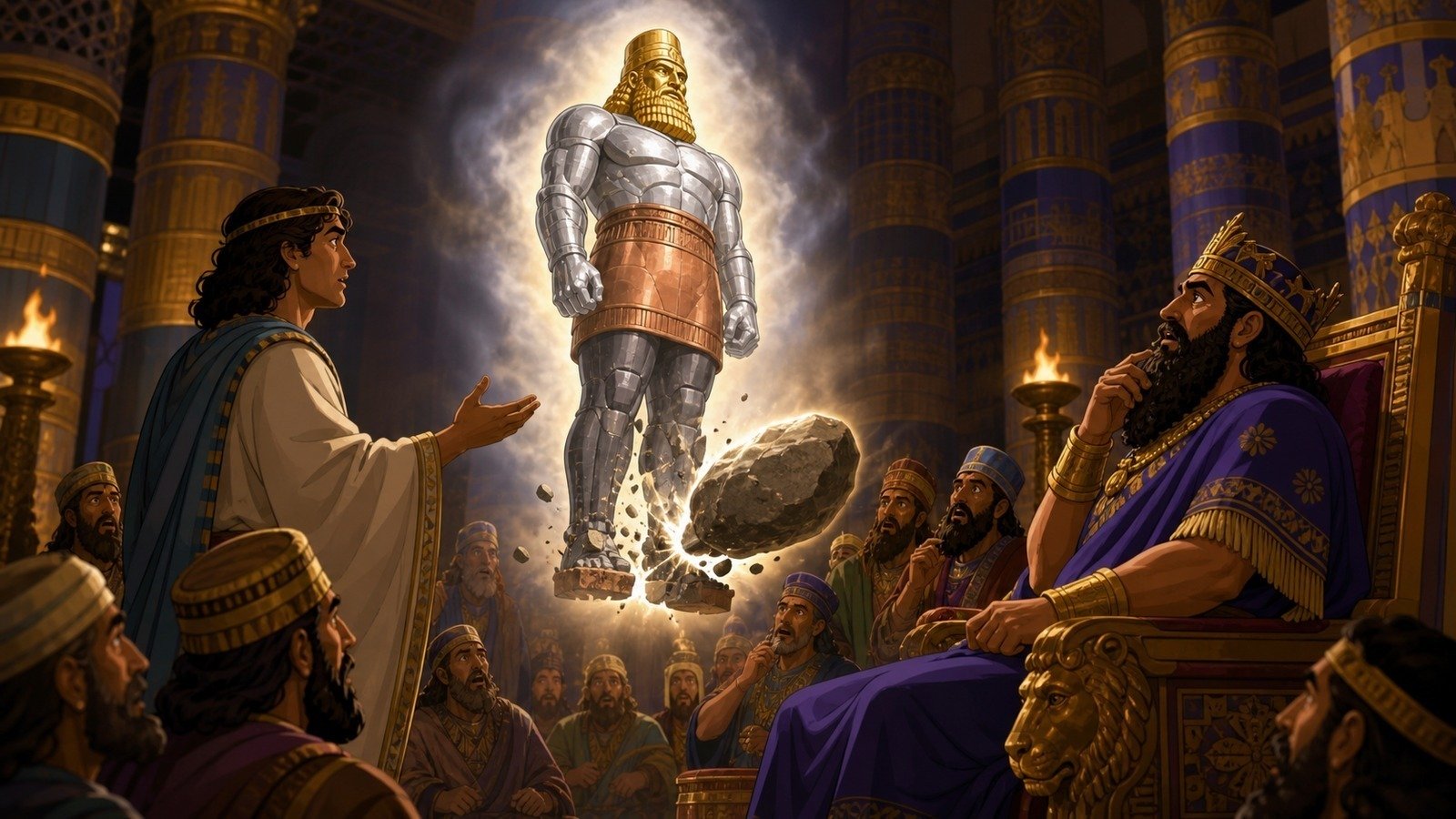
Daniel succeeds where Babylon's own diviners fail, both recounting and interpreting Nebuchadnezzar's dream of a statue made of four metals struck down by an uncut stone, read as a succession of kingdoms ultimately superseded by God's own indestructible kingdom.
Further context
3 min readNebuchadnezzar has a dream that troubles him and makes it impossible to sleep, and the demand he makes of his advisers is impossible. Tell me what I dreamed and then interpret it. Their protest is entirely reasonable: there is no one on earth who can do what the king asks, and no king has ever asked such a thing of any magician or enchanter or astrologer. What the king asks is too difficult; no one can reveal it except the gods, and they do not live among humans.
He orders the execution of all the wise men of Babylon, which includes the four young Judaeans, and the decree is already being carried out when Daniel asks the commander for time.
He and his three friends spend the night asking for mercy, and the mystery is shown to him in a vision. His response before he goes to the king is a poem of thanks that includes a line about the situation he is in: he changes times and seasons; he deposes kings and raises up others.
The dream is an enormous statue. Its head is of pure gold, its chest and arms of silver, its belly and thighs of bronze, its legs of iron, its feet partly iron and partly baked clay. A rock is cut out, but not by human hands, strikes the statue on its feet and smashes them, and the whole thing is broken to pieces and becomes like chaff on a threshing floor, blown away without a trace. The rock becomes a huge mountain and fills the whole earth.
The interpretation identifies the head directly: you, Nebuchadnezzar, are that head of gold. After you another kingdom will rise, inferior to yours. Then a third, of bronze, and a fourth, strong as iron, breaking and smashing everything. The feet of mixed iron and clay are a divided kingdom, partly strong and partly brittle, and the attempt to hold it together by intermarriage will not work, just as iron does not mix with clay.
Which empires those are has been argued for two thousand years. The traditional identification runs Babylon, Medo-Persia, Greece and Rome. An alternative separates the Medes from the Persians, which produces Babylon, Media, Persia and Greece and is the reading generally preferred by scholars who date the book to the second century BC. The choice between them is bound up with the question of when the book was written, which is one of the sharpest disputes in Old Testament studies.
What everything agrees on is the rock. In the time of those kings the God of heaven will set up a kingdom that will never be destroyed, and it will crush all the others and endure for ever. A stone cut without hands, which grows until it fills the earth.
Nebuchadnezzar falls prostrate before a foreign captive and promotes him to rule over the entire province of Babylon.
The demand that the wise men produce the dream as well as the interpretation is not a whim. It is a test designed to expose them, and their protest states the position exactly: there is no one on earth who can do what the king asks. No king, however great and mighty, has ever asked such a thing of any magician or enchanter or astrologer.
When the decree goes out to execute all of them, Daniel asks for time and goes home, and what he does with it is recorded: he urges his three friends to plead for mercy from the God of heaven concerning this mystery.
The statue in the dream has a head of gold, chest and arms of silver, belly and thighs of bronze, legs of iron, and feet of iron mixed with clay. A rock cut out but not by human hands strikes the feet and the whole thing collapses, and the rock becomes a mountain that fills the earth.
Which empires the metals stand for has been argued for two thousand years.