

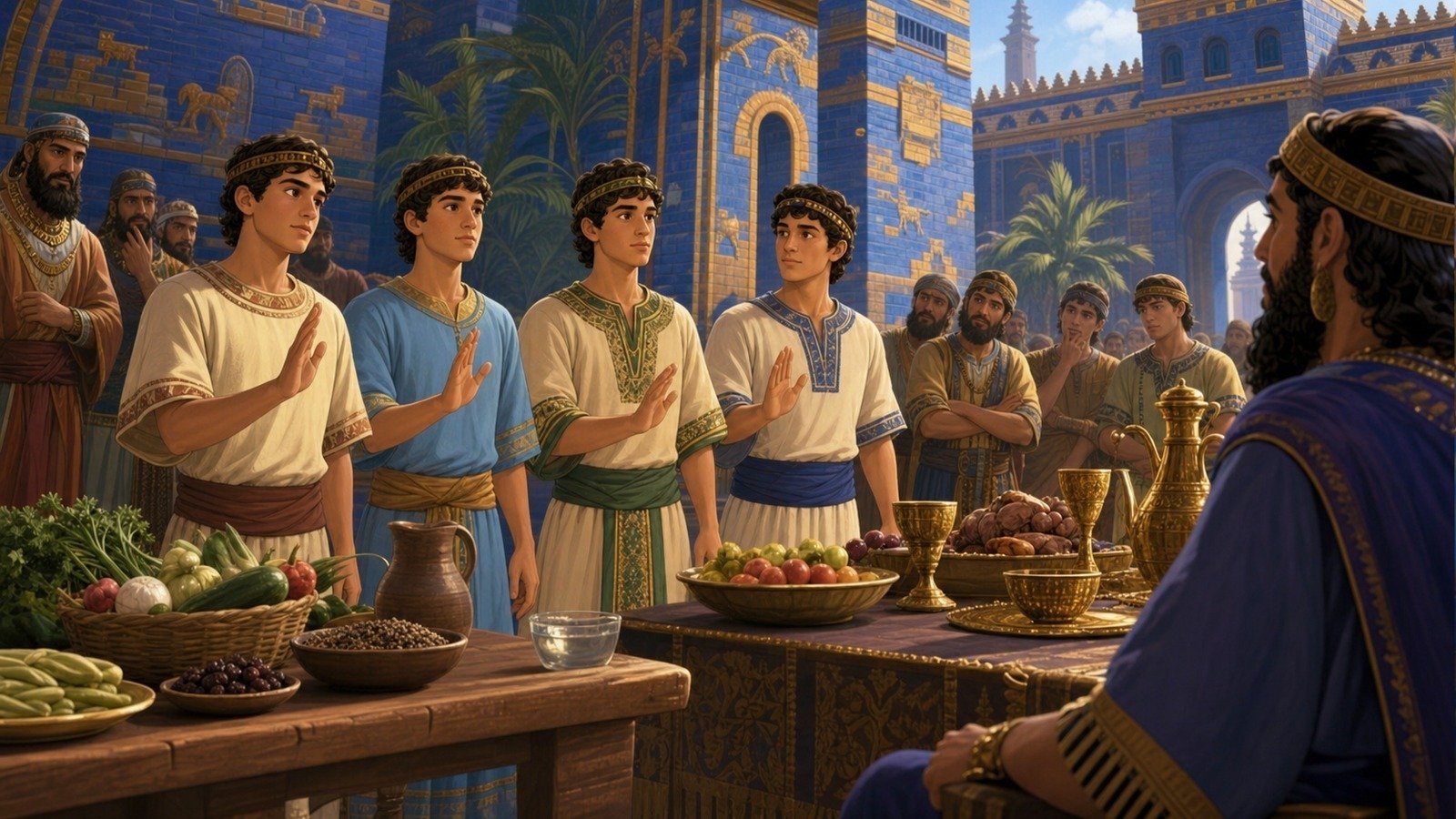
Following Nebuchadnezzar's first campaign against Jerusalem, Daniel and three companions are among the young nobility deported to Babylon for training in the royal court; they resolve not to defile themselves with the king's food, and are found ten times wiser than all the royal magicians.
Further context
3 min readIn the third year of Jehoiakim, which is 605 BC, Nebuchadnezzar comes to Jerusalem and besieges it. This is the first of three deportations, nearly two decades before the city is destroyed, and what is taken is not a population but a selection.
The instruction given to the chief court official is precise about the type: young men from the royal family and the nobility, without any physical defect, handsome, showing aptitude for every kind of learning, well informed, quick to understand and qualified to serve in the king's palace. They are to be taught the language and literature of the Babylonians, given a daily amount of food and wine from the king's table, and trained for three years.
That is an imperial civil service programme. The empire is taking the ablest young men of a subject kingdom, cutting them off from home at the age when loyalties form, and training them to administer the empire that took them. It is a more effective instrument than deportation and it was standard practice.
The renaming is part of it. Daniel, Hananiah, Mishael and Azariah all carry Hebrew names containing elements of their own God's name, and they are given Babylonian ones containing the names of Babylonian gods: Belteshazzar, Shadrach, Meshach and Abednego.
What they refuse is the food. Daniel resolves not to defile himself with the royal food and wine and asks permission to abstain. Why exactly it was objectionable is not spelled out, and the usual explanations, that it was not slaughtered properly or had been offered to idols, both work, though the same objections would apply to the vegetables. What is clear is that eating at a king's table created an obligation, and refusing it while accepting the education and the career is a very precise piece of resistance.
The official is afraid for his own head, so Daniel proposes a controlled trial: ten days on vegetables and water, and then compare us with the young men who eat the royal food. At the end of ten days they look healthier and better nourished, and the arrangement is made permanent.
At the end of the training the king examines all of them and finds none equal to these four, and in every matter of wisdom and understanding he finds them ten times better than all the magicians and enchanters in his whole kingdom.
The date of the book is the sharpest dispute attached to it. The traditional position takes it as a sixth-century work by the man it names. The majority scholarly position dates its final form to the 160s BC, during the persecution under Antiochus IV, on the grounds of its Persian and Greek loanwords, the character of its Aramaic, its position among the Writings rather than the Prophets in the Hebrew canon, and the precision of its account of the second-century crisis compared with its looser handling of Babylonian and Persian history. Both positions have serious work behind them.
Daniel remains there until the first year of Cyrus, which is around sixty-six years later.
The four young men are selected on stated criteria: from the royal family and the nobility, without any physical defect, handsome, showing aptitude for every kind of learning, well informed, quick to understand and qualified to serve in the king's palace.
They are put through a three-year course in the language and literature of the Babylonians, which meant cuneiform, and that in turn meant astrology, divination and the mythology, since those were the literature.
Their names are changed, and each new one carries a Babylonian god: Belteshazzar, Shadrach, Meshach and Abednego. Daniel's own name means God is my judge, and the substitution is deliberate.
The one thing they refuse is the food, and they propose a ten-day trial on vegetables and water. Why food and not the education or the names is a fair question, and the usual answer is that the royal table involved meat offered in temple ritual and consumption at the king's table implied a bond of loyalty.