

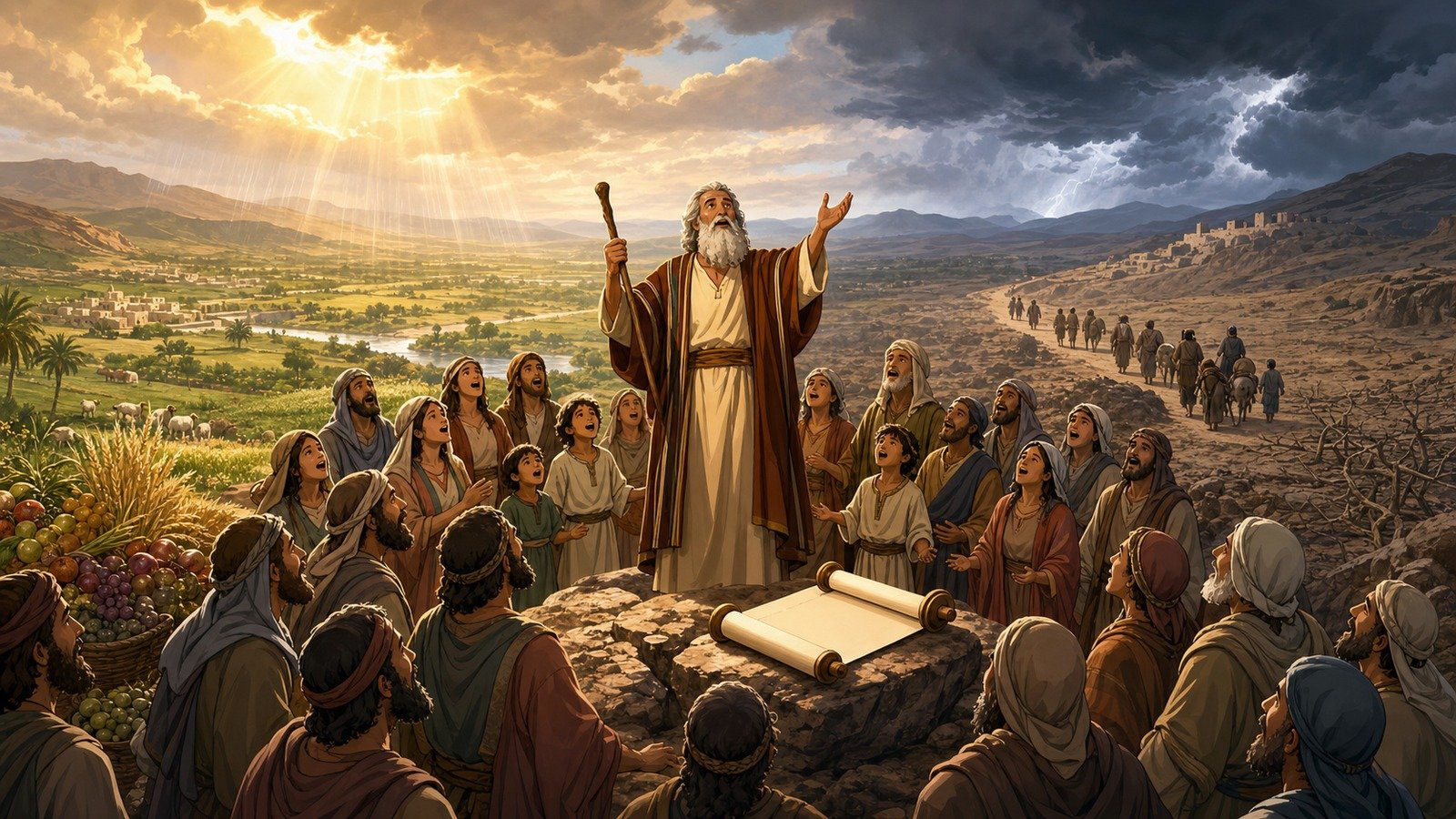
Moses sets out in detail the blessings that will follow covenant faithfulness and the curses that will follow rebellion, and teaches Israel a song intended to stand as a witness against them in future generations.
Further context
3 min readThe covenant is sealed with a list of consequences, and the imbalance between the two halves is the first thing anyone notices. Fourteen verses describe what follows obedience: rain in season, full storehouses, children, livestock, victory, standing among the nations. Fifty-four describe what follows the opposite, and they get progressively worse. Disease, drought, defeat, madness and blindness, a wife taken by another man, a house built and not lived in, sons and daughters given to another nation, a siege so severe that people eat their own children, and finally deportation and dispersal among peoples where no rest can be found and life hangs in doubt day and night.
The form is not unique to Israel. Assyrian vassal treaties of the seventh century BC end with blessing and curse sections of exactly this kind, and some of the individual curses are close enough in wording to suggest a shared legal culture rather than a coincidence. What differs is who the parties are and what the terms concern.
Anyone reading the later histories with these lists in mind will recognise where they are going. Siege, famine, deportation and dispersal are what actually happened, first to the northern kingdom under Assyria and then to Judah under Babylon, and the writers of those histories clearly had this material in front of them.
The song that follows is poetry of a very old kind, and it is given as something to be memorised and taught to the children, on the explicit grounds that it will function as a witness against the nation when things go wrong. It is a national anthem written in advance to be used as evidence for the prosecution.
Its argument is compressed and unsentimental. God found this people in a barren land, guarded them as the apple of his eye, carried them like an eagle carrying its young on its wings. Then they grew fat and kicked, abandoned the God who made them and sacrificed to gods they had never known, new gods that had recently appeared, which their ancestors did not fear. The judgement that follows is described as provocation answered in kind: they made me jealous by what is no god, so I will make them envious by those who are not a people.
The closing section turns again. Vengeance belongs to God, the nations will be called to rejoice with his people, and he will make atonement for his land and people.
One provision inside the curses is easy to miss and it shaped Jewish history. Deportation is described not as annihilation but as scattering: you will be uprooted from the land and scattered among all nations, from one end of the earth to the other, and among those nations you will find no repose. Alongside it sits an equally explicit promise of return, conditional on the people turning back wherever they have been driven. Both halves were taken seriously by the exiles in Babylon, and the second half is what they organised their lives around.
Moses is a hundred and twenty when he recites it, in front of the whole assembly, with Joshua standing beside him. He has been told he will not cross the river, and what he leaves behind is a legal document with the penalties spelled out and a poem designed to be remembered when the penalties arrive.