

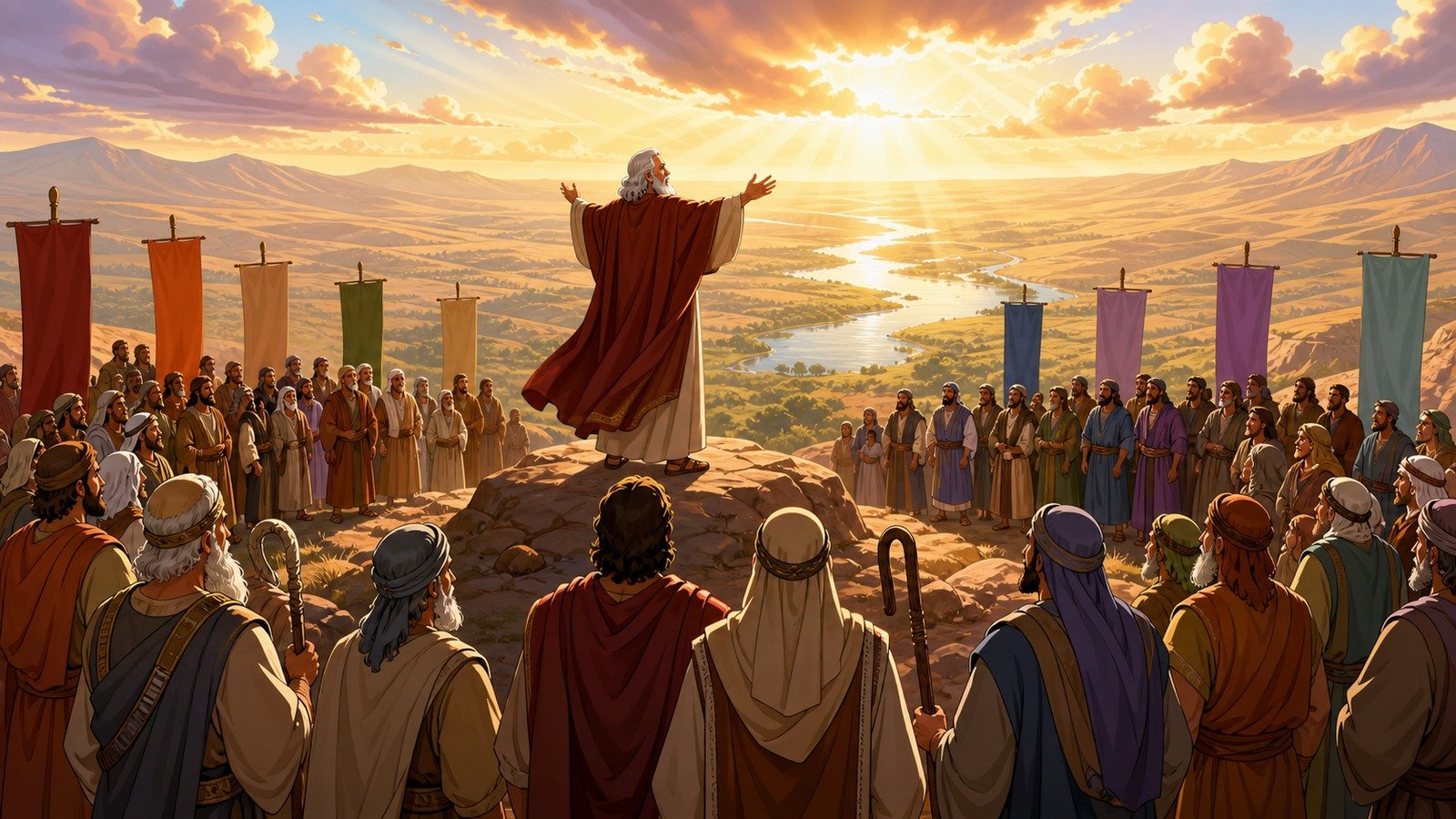
Shortly before his death, Moses pronounces an individual blessing over each of the twelve tribes, echoing Jacob's blessing on his sons in Genesis 49.
Further context
3 min readThe last recorded words of Moses are a poem addressed to the twelve tribes one by one, and setting it beside the one Jacob delivered on his deathbed in Egypt shows how much has changed in four centuries.
Jacob's poem was about his sons, and several of them were condemned in it. Reuben lost his standing, Simeon and Levi had their anger cursed. This one is about tribes with territory, armies and functions, and its tone is almost entirely favourable.
Levi is the clearest reversal. Cursed for violence at Shechem in the earlier poem and told his descendants would be scattered, Levi here receives the longest section after Joseph and is praised for exactly the quality that produced the earlier condemnation: a willingness to act against his own family for the sake of a duty. The scattering has become a posting. The tribe with no land of its own is given the Urim and Thummim, the teaching of the law and the offering of incense, and is distributed among the others as a result rather than as a punishment.
Judah gets a short and urgent plea rather than a promise of dominance: hear, LORD, the cry of Judah, bring him to his people, with his own hands he defends his cause.
Joseph receives the longest section, full of agricultural abundance, the best gifts of the earth and its fullness, the choicest gifts of the sun and the finest the moon can yield. Benjamin is described as the beloved of the LORD who rests between his shoulders. Asher dips his foot in oil. Naphtali is abounding with the favour of the LORD.
Simeon is missing entirely. The tribe is not mentioned in the whole poem, and by the time the land is divided its territory is enclosed inside Judah's, so the omission matches what happened.
The poem opens and closes with the whole nation rather than its parts. It begins with God coming from Sinai and shining forth, with the peoples in his hand, and it ends with a line that has outlived its context: the eternal God is your refuge, and underneath are the everlasting arms.
One tribe is treated in a way that repays attention. Levi's earlier condemnation and this later commendation are about the same trait. At Shechem the sons of Levi acted violently against their own family's interest, and at Sinai they were the ones who rallied to Moses after the golden calf, against their own relatives. Willingness to put a duty above kinship is what got the tribe cursed in one generation and given the priesthood in another, and nothing is done to soften the discomfort of that.
Simeon's absence has been explained in two ways. Either the tribe had already been absorbed into Judah by the time the poem reached its final form, so there was nothing left to bless, or a line has dropped out of the manuscript tradition; the Greek version inserts Simeon into Judah's section, which looks like an ancient attempt to fix the gap. Either way, a tribe that walked out of Egypt with the rest of them has effectively ceased to exist as a separate entity within a few generations.
The last words are about the nation's position rather than any individual's: blessed are you, Israel. Who is like you, a people saved by the LORD? Then he goes up the mountain.