

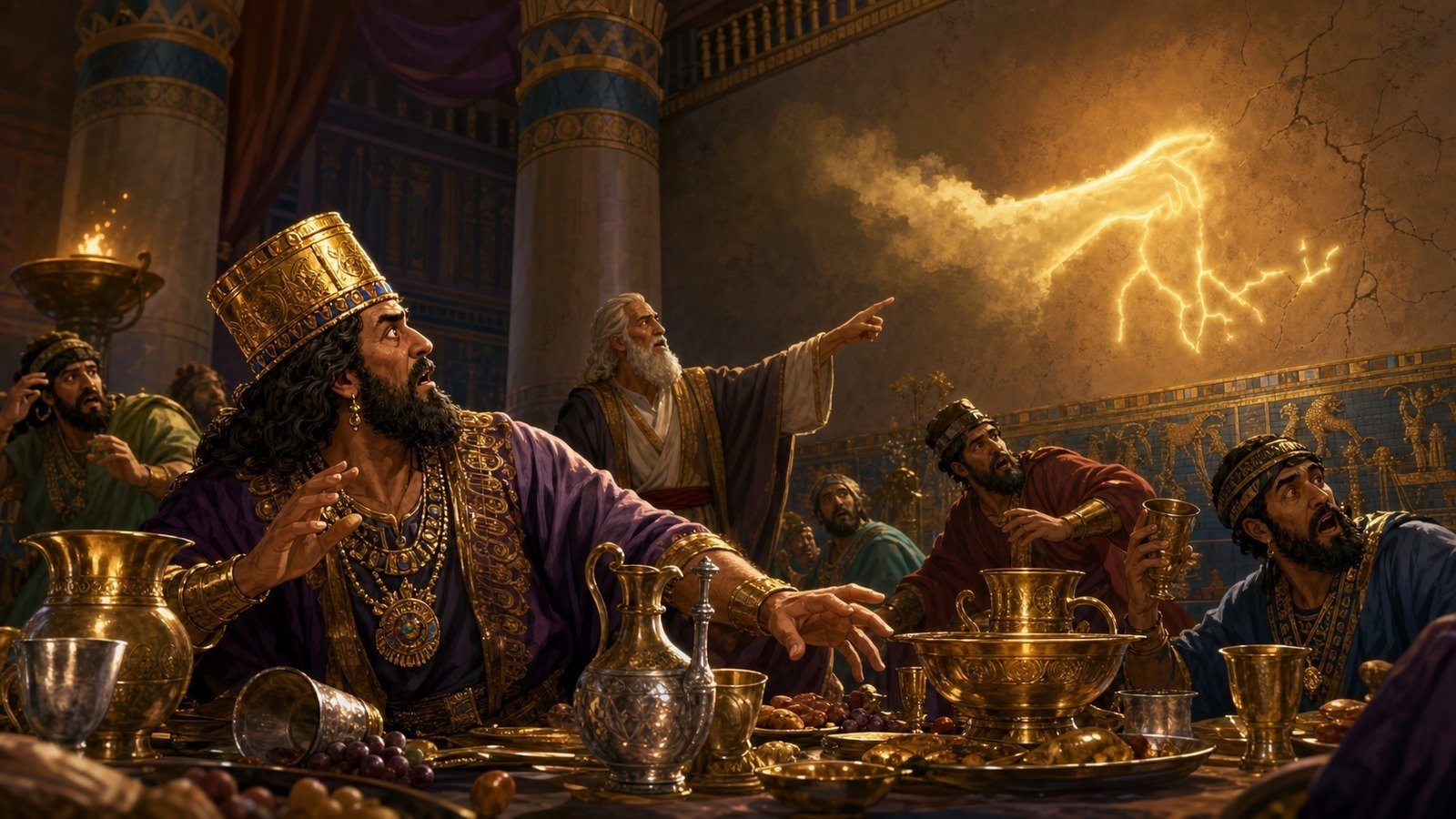
During a drunken feast using vessels looted from Jerusalem's Temple, a disembodied hand writes a cryptic judgement on the palace wall; Daniel interprets it as the end of Belshazzar's kingdom, fulfilled that same night.
Further context
3 min readBelshazzar gives a banquet for a thousand of his nobles, and while drinking his wine he orders the gold and silver goblets that Nebuchadnezzar had taken from the temple in Jerusalem to be brought in, so that he and his nobles, his wives and his concubines can drink from them. They drink from them and praise the gods of gold and silver, bronze, iron, wood and stone.
That is not carelessness. Using captured temple vessels at a state banquet is a public statement about whose god won, made with the actual property.
Then the fingers of a human hand appear and write on the plaster of the wall near the lampstand, and the king watches the hand as it writes. His face turns pale, his legs give way and his knees knock together. The reward offered to anyone who can read it is purple robes, a gold chain and the position of third highest ruler in the kingdom.
That detail about third place was for a long time treated as an error. Belshazzar appears in no king list and was thought to be an invention, and third rather than second made no sense for a monarch's gift. Both objections were resolved by cuneiform evidence recovered in the nineteenth and twentieth centuries. Nabonidus was the last king of Babylon, spent about a decade at the oasis of Tayma in Arabia, and left his son Belshazzar in charge of the capital as co-regent. A man who is himself the second ruler can only offer third place. The book was right on a point of constitutional detail that nobody could have guessed and that no other surviving source preserved.
The queen, most plausibly the queen mother, remembers Daniel, who is by now an old man and out of favour.
He refuses the gifts, delivers a short history lesson about the previous king's humbling, and states the charge: you have set yourself up against the Lord of heaven, you have not honoured the God who holds in his hand your life and all your ways.
The writing is three or four Aramaic words that are also weights and measures: mene, mene, tekel, parsin. A mina, a mina, a shekel and half-shekels. The interpretation turns each into a verb. Numbered: God has numbered the days of your reign and brought it to an end. Weighed: you have been weighed on the scales and found wanting. Divided: your kingdom is divided and given to the Medes and Persians.
That very night Belshazzar is killed, and Babylon falls to Cyrus in October 539 BC.
The plaster wall is a detail worth noticing. Excavation of the throne room of Nebuchadnezzar's southern palace found a large hall with a niche opposite the entrance where a king would have sat, and the walls were plastered and whitewashed. Anyone writing at a distance would have said stone.
Belshazzar was long treated as a fabrication, since no Babylonian king list contains him. Cuneiform documents recovered in the nineteenth century established that Nabonidus, the last king, spent about a decade at Tayma in Arabia and left his son Belshazzar in charge at Babylon as co-regent.
That solves a second puzzle in the story. Daniel is offered the third highest position in the kingdom rather than the second, which is exactly what a co-regent had available to give.
The vessels are the point of the offence. They had been taken from the temple in Jerusalem by his predecessor and stored, and bringing them out for a drinking party while praising gods of gold, silver, bronze, iron, wood and stone is a deliberate act.
The words on the wall are three Aramaic terms that are also units of weight: a mina, a shekel and half-shekels. Daniel reads them as verbs. Numbered, weighed, divided.