

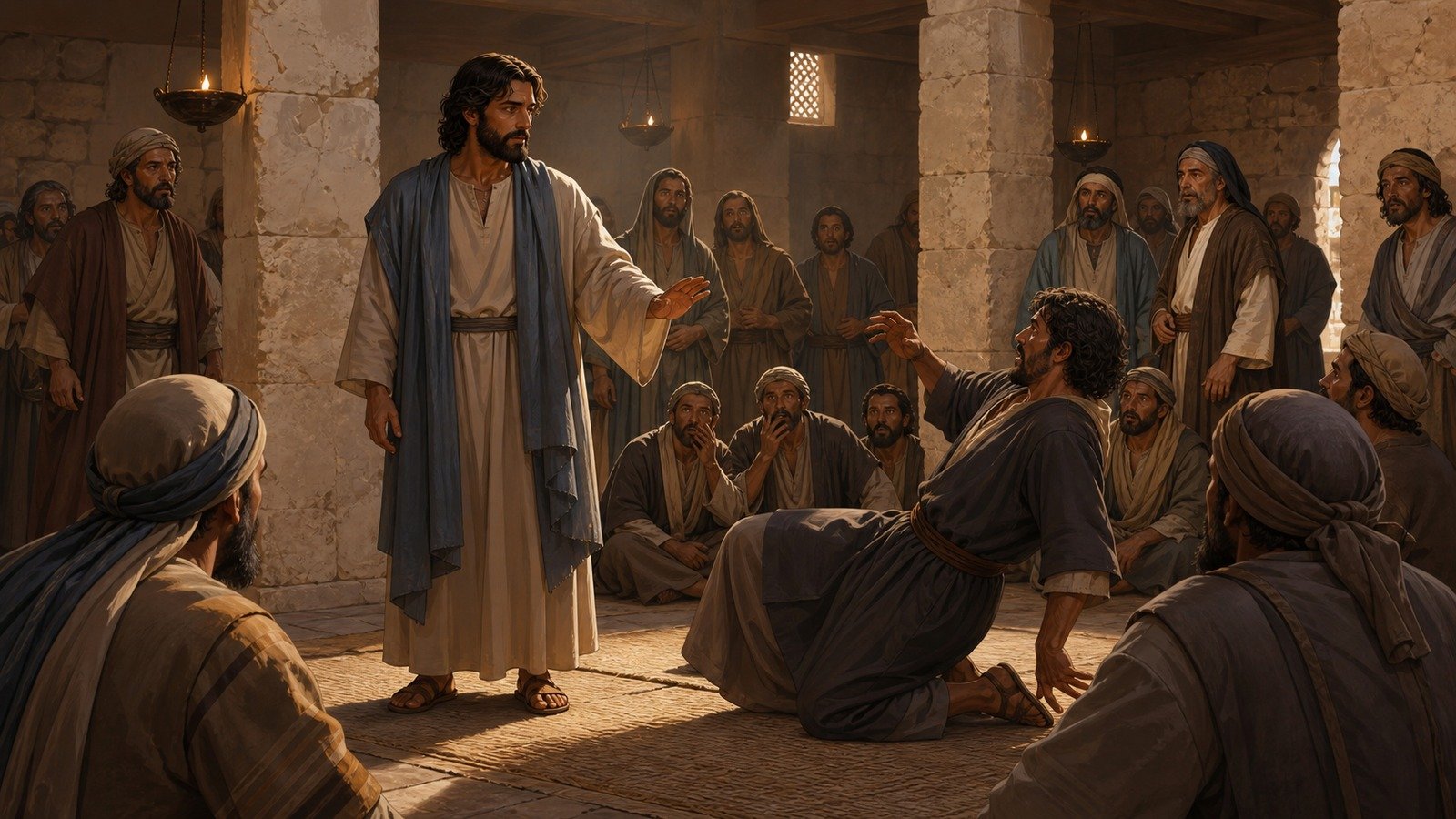
Teaching in Capernaum's synagogue "as one who had authority," Jesus casts out an evil spirit that had recognised him publicly as "the Holy One of God," astonishing the whole congregation.
Further context
3 min readCapernaum is a fishing village on the northern shore of the lake, on the road running from Damascus down to the coast, with a customs post and a small garrison. It becomes the base for Jesus' work in Galilee, and the remains of a synagogue stand there today, a fourth-century limestone building put up on the black basalt foundations of an earlier one.
He goes in on the Sabbath and begins to teach, and the first reaction recorded is about manner rather than content: the people were amazed at his teaching, because he taught them as one who had authority, not as the teachers of the law. The scribal method proceeded by citing earlier authorities, and somebody teaching without that scaffolding would have sounded either ignorant or extraordinary.
Then a man possessed by an impure spirit cries out, and what it says is a piece of information nobody in the room has. What do you want with us, Jesus of Nazareth? Have you come to destroy us? I know who you are, the Holy One of God.
Naming a spirit was understood in the exorcism practice of the period as a way of gaining power over it, and the shout is usually read as an attempt to do exactly that. The response is two words in Greek: be quiet, and come out of him. The first of them is a sharp verb meaning to muzzle.
The spirit shakes the man violently and comes out with a shriek, and the man is not harmed.
What is striking about the method is what is missing from it. Contemporary exorcism texts, including the magical papyri from Egypt, prescribe elaborate formulas, invocations of divine names, amulets, roots and ritual objects. There is none of that here. There is a command and it is obeyed.
The reaction in the room is a question rather than applause: what is this? A new teaching, and with authority! He even gives orders to impure spirits and they obey him. The news spreads quickly over the whole region of Galilee.
The synagogue at Capernaum is worth one more sentence because of what is under it. The white limestone building standing on the site today is fourth or fifth century, and it sits directly on black basalt foundations belonging to an earlier structure of the first century. Whichever building it was, the walls he taught inside are under the floor of the one visitors see.
Something else in the episode is worth noticing. The first public recognition of who he is comes from the wrong source entirely, and he silences it. That happens repeatedly through the following months, and it is one of the reasons Mark's Gospel keeps him telling people not to say anything. What is being refused is publicity of a kind he cannot control, from witnesses whose testimony would define him on their terms.
The synagogue at Capernaum has been excavated. A white limestone building of the fourth or fifth century stands on the site, and under its floor archaeologists found the black basalt walls and pavement of the earlier one that was in use in the first century.
What the congregation notices before anything happens is the manner of the teaching: he taught them as one who had authority, and not as the teachers of the law. Rabbinic teaching worked by citing earlier authorities, and a man who did not cite anyone was making a claim by his method alone.
The interruption comes from a man in the congregation, which means the spirit had been sitting quietly through the reading and the prayers until that morning.
What it says is a formula of defence, using a name to establish power over the one named: I know who you are, the Holy One of God!
The silencing is immediate, and the crowd's question afterwards is about the authority rather than about the man.