

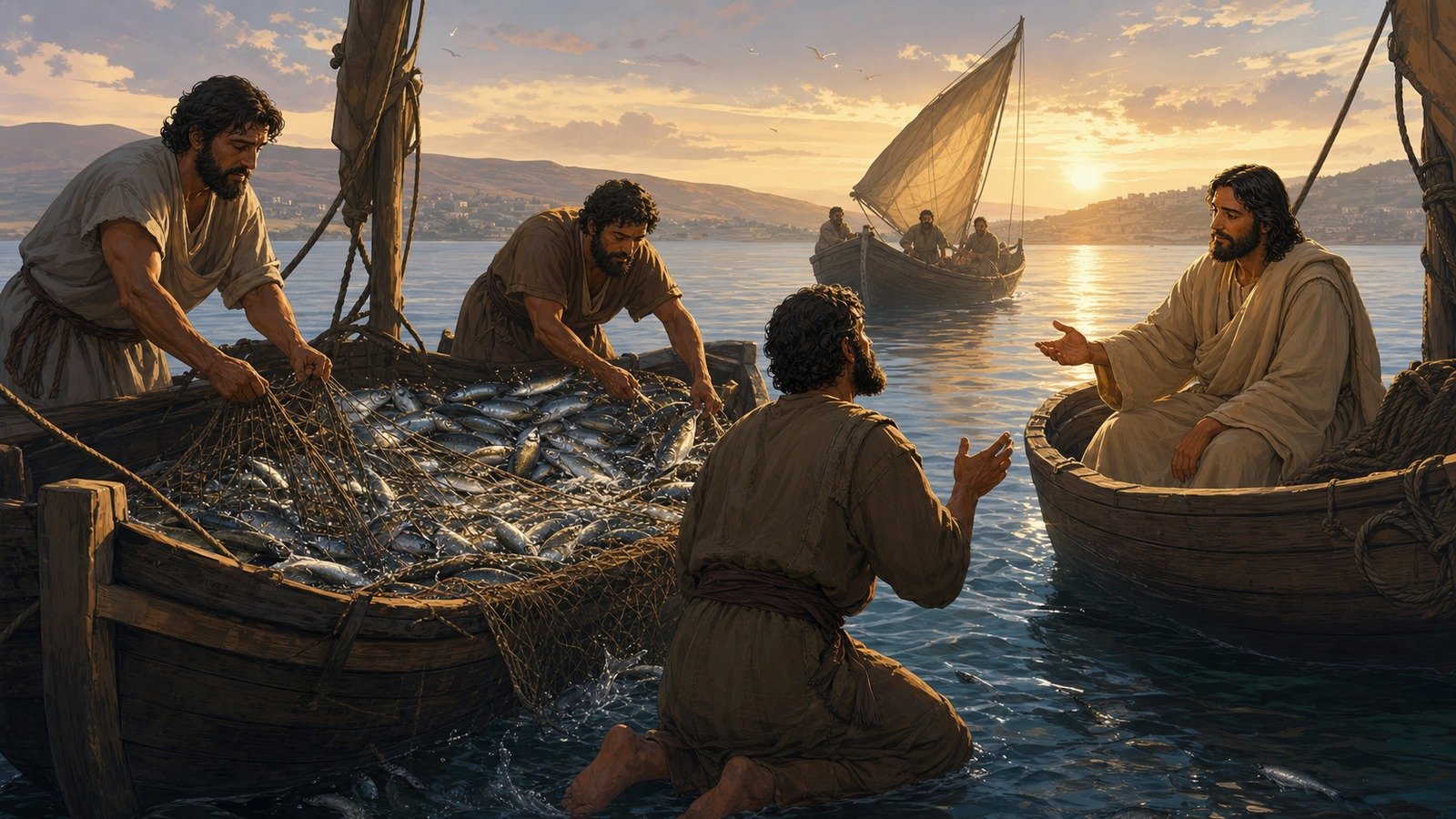
After a night of catching nothing, Peter obeys Jesus' instruction to let down the nets again and hauls in a catch so large it nearly sinks two boats; overwhelmed, Peter, James and John leave everything to follow Jesus permanently.
Further context
3 min readThe men involved are not strangers. Andrew and Peter had followed him in Judea months earlier, and this is the point at which they stop going back to work.
The crowd is pressing in on him at the lake to hear the word of God, so he gets into Simon's boat, asks him to put out a little from shore, and teaches sitting down from a few metres offshore, which turns the water into an amphitheatre. Lakeside acoustics carry a voice a long way.
When he finishes he tells Simon to put out into deep water and let down the nets for a catch. The reply is the reply of a professional to an amateur, and it is polite: Master, we have worked hard all night and have not caught anything. But because you say so, I will let down the nets. Night was the right time to fish that lake with these nets, deep water in daylight was not, and he says so before complying.
The catch is so large the nets begin to break. They signal to their partners in the other boat and fill both until they begin to sink.
Peter's reaction is not gratitude. He falls at Jesus' knees in a boat full of fish and says, go away from me, Lord; I am a sinful man. Something about the size of the catch has told him what he is dealing with, and his first instinct is that the two of them should not be in the same boat.
The answer is the sentence that renames the trade: do not be afraid; from now on you will fish for people. The Greek verb behind it means to capture alive.
The phrase about fishing for people has an edge that is easy to lose. In the Hebrew scriptures the image of catching people in nets is used by prophets of judgement, of enemies dragged off in a haul. Turning it into a description of rescue is a deliberate reversal, and it is delivered to men standing in a boat full of the ordinary kind of catch.
They pull the boats up on shore, leave everything and follow him, and the everything includes two boats, nets, a business and, in the case of James and John, a father with hired workers who is left sitting in the boat.
The lake itself explains the industry. It is about twenty-one kilometres long, two hundred metres below sea level, and its fisheries supported several towns on the shore; a first-century fishing boat about eight metres long was recovered from the mud near Ginosar in 1986 and is now on display, which is exactly the kind of vessel described here.
The scene begins as a practical arrangement. The crowd is pressing in, so he gets into Simon's boat, asks him to put out a little from shore, and teaches sitting down from the water.
Then an instruction that a professional fisherman would resent: put out into deep water and let down the nets for a catch. Night fishing in shallow water with a dragnet was the method; daytime fishing in deep water was not.
Simon's reply says so and then complies: Master, we have worked hard all night and have not caught anything. But because you say so, I will let down the nets.
The catch tears the nets and nearly sinks two boats, and his reaction is not gratitude: go away from me, Lord; I am a sinful man!
James and John are named as partners in the business, which together with the hired men mentioned elsewhere describes a small commercial fishing concern rather than subsistence work.