

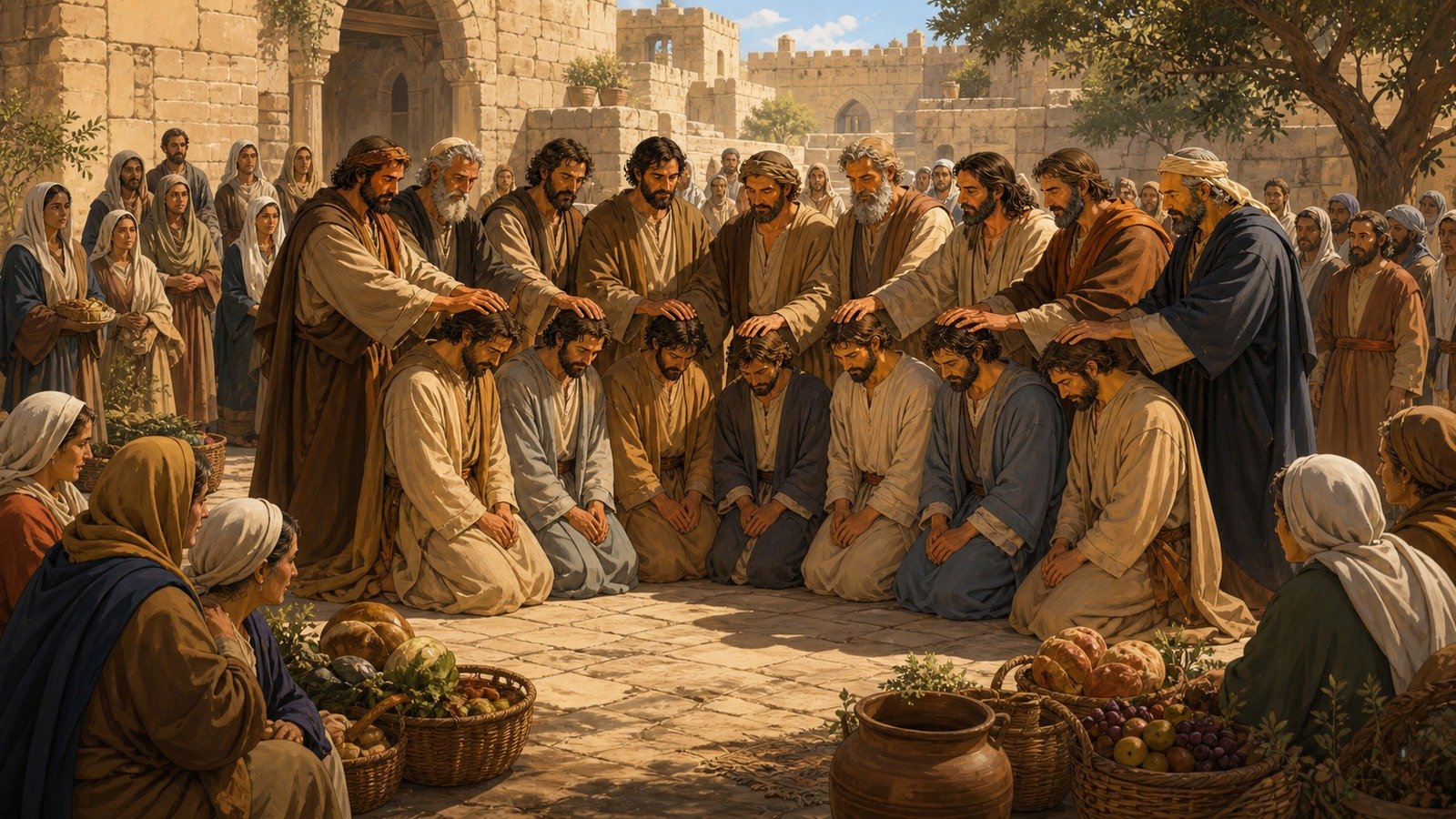
A dispute arises over the neglect of Greek-speaking widows in the daily distribution of food; the apostles have the community choose seven men, including Stephen, to oversee this practical work so the apostles can concentrate on prayer and teaching.
Further context
2 min readThe first internal dispute in the church is about food distribution, and it runs along a fault line that was already there.
The Hellenistic Jews among them complained against the Hebraic Jews because their widows were being overlooked in the daily distribution of food.
Both groups are Jewish and both are Christian. The difference is language and culture. Hellenists spoke Greek, read their Scriptures in Greek, and were often families who had returned to Jerusalem from elsewhere in the empire, sometimes late in life to be buried in the holy city, which left a disproportionate number of widows among them. The Hebraists spoke Aramaic and were locals. Synagogues in Jerusalem were organised along these lines, and inscriptions confirm Greek-speaking congregations in the city.
A widow with no husband and no household had no income, and daily distribution meant daily food.
The Twelve call the disciples together and set out the problem: it would not be right for us to neglect the ministry of the word of God in order to wait on tables. Choose seven men from among you who are known to be full of the Spirit and wisdom.
The proposal pleases the whole group, and the seven chosen are named: Stephen, Philip, Procorus, Nicanor, Timon, Parmenas and Nicolas from Antioch, a convert to Judaism.
Every one of those names is Greek. The community handed the problem to the group that had raised it, which is not the usual instinct of an aggrieved majority, and one of the seven is not even a Jew by birth.
They are presented to the apostles, who pray and lay their hands on them.
Whether this is the origin of the office of deacon has been argued for a long time. The noun is never used of them, though the corresponding verb appears in the description of the work, and the office exists a few decades later in the letters. Churches with quite different structures have all claimed the passage.
What is certain is that the two of the seven who reappear are not doing administration. Stephen is described immediately afterwards performing signs and arguing in the synagogues, and Philip is next seen preaching in Samaria and baptising an Ethiopian official on a desert road.
So the word of God spread. The number of disciples in Jerusalem increased rapidly, and a large number of priests became obedient to the faith.
The neglect described was probably administrative rather than deliberate. A community that had grown from a hundred and twenty to several thousand within months, organised by men whose previous experience was fishing, was always going to lose track of somebody, and the ones lost first are the ones with nobody to speak for them.
The solution took about a paragraph. What is striking is how quickly the complaint was believed, and by whom the remedy was chosen.
Nicolas of Antioch is described as a convert to Judaism, which makes him a Gentile who had joined Israel and then joined the church, and Antioch becomes the base of the Gentile mission twenty years later.