

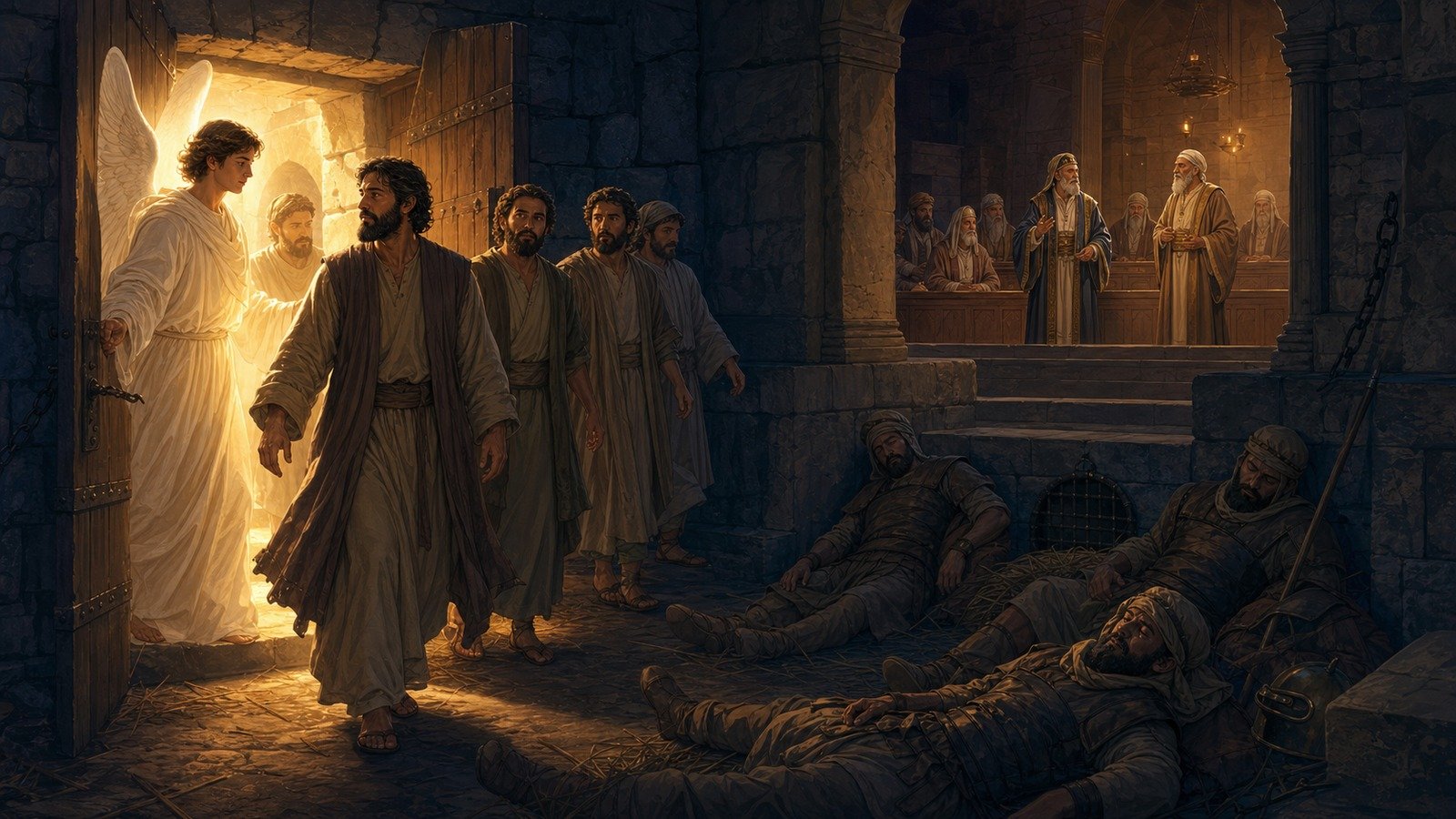
The high priest has the apostles imprisoned out of jealousy, but an angel releases them overnight; hauled before the Sanhedrin again, they are spared execution when the respected teacher Gamaliel counsels caution, reasoning that a movement not from God will collapse on its own.
Further context
2 min readDuring the night an angel of the Lord opens the doors of the jail and brings the apostles out, with an instruction that sends them straight back into the situation they were arrested for: go, stand in the temple courts and tell the people all about this new life.
At daybreak they do exactly that.
What happens next is close to comedy. The high priest and his associates call the full assembly of the elders of Israel and send to the jail for the prisoners. The officers find the jail securely locked, with the guards standing at the doors, and nobody inside. Then someone arrives to say the men they put in jail are standing in the temple courts teaching the people.
The captain goes with his officers and brings them without using force, because they feared the people would stone them. The temple guard, arresting men, is worried about being stoned by the crowd.
The charge is put to them: we gave you strict orders not to teach in this name. Yet you have filled Jerusalem with your teaching and are determined to make us guilty of this man's blood.
The reply is the sentence that has been quoted in every argument about conscience and authority since: we must obey God rather than human beings.
The council is furious and wants to put them to death. Then a member stands up who is one of the best attested figures of the period outside the New Testament.
Gamaliel was a Pharisee and a teacher of the law honoured by all the people, grandson or son of Hillel, and the rabbinic material treats him as one of the great authorities of the age. Paul later says he was brought up in Jerusalem and educated under him.
His argument is pragmatic rather than theological. He cites two failed movements: Theudas, who attracted about four hundred followers and was killed, and Judas the Galilean, who led the revolt at the time of the census and whose followers were scattered. Josephus mentions both men, though his dating of Theudas is later, which is a genuine chronological difficulty nobody has resolved.
Leave these men alone. If their purpose is of human origin, it will fail. But if it is from God, you will not be able to stop them; you will only find yourselves fighting against God.
They flog the apostles and let them go. And the apostles leave rejoicing, because they had been counted worthy of suffering disgrace for the Name.
Gamaliel's advice has been quoted approvingly by people who would have disagreed with everything else he held, and it has an obvious weakness that critics have pointed out for centuries: plenty of false movements have lasted a long time, and plenty of true things have been crushed. As a test of truth it does not work. As a reason for a court to stay its hand, it worked that morning.
Flogging in a Jewish court meant thirty-nine lashes, one short of the forty the law permitted, so that a miscount could not exceed the limit. Paul later says he received it five times.