

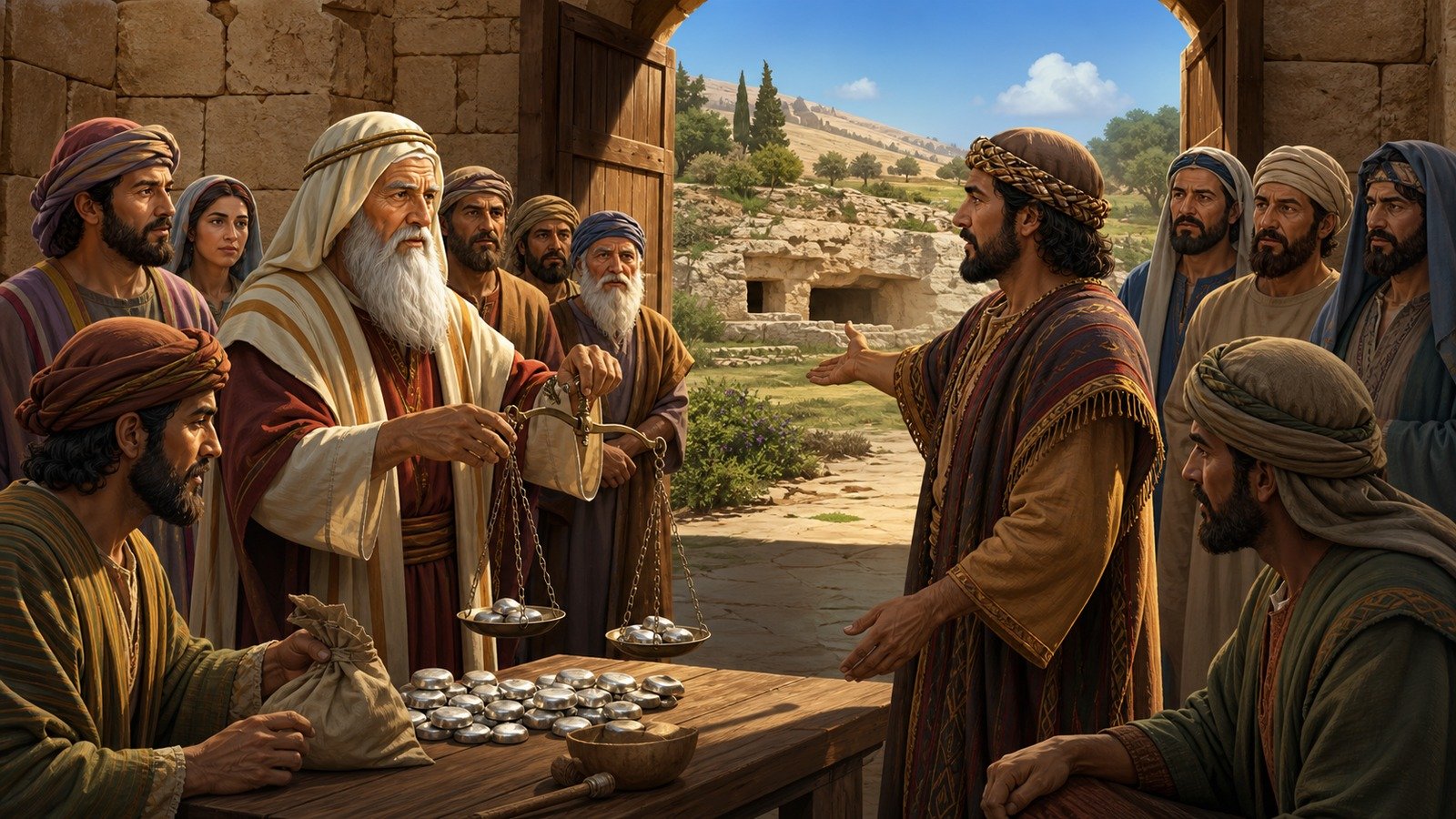
Abraham negotiates the purchase of the cave of Machpelah from Ephron the Hittite as a family burial site, the first piece of land in Canaan he owns outright despite decades of God's promise that the whole land would be his descendants'.
Further context
2 min readAbraham rises from mourning and opens a negotiation, and the way he introduces himself sets the terms: I am a foreigner and stranger among you. Sell me some property for a burial site here so I can bury my dead.
What follows is conducted with elaborate courtesy and is hard bargaining underneath. The Hittites tell him he is a mighty prince among them and may bury his dead in the choicest of their tombs, and none of them will refuse him. That is an offer of use rather than of ownership, and he does not take it. He bows and asks them to intercede with Ephron son of Zohar so that Ephron will sell him the cave of Machpelah at the end of his field, for the full price.
Ephron, sitting among them at the city gate where such matters were settled, answers that he gives Abraham the field and the cave in it, in the presence of his people, and tells him to bury his dead. Abraham bows again and asks him to accept the price of the field. Ephron then names it: four hundred shekels of silver, adding, what is that between you and me?
Offering a gift and then stating a figure was a recognised bargaining convention, and the figure itself is steep. Jeremiah later buys a field for seventeen shekels, and Omri buys the entire hill of Samaria for six thousand. Four hundred shekels for one field with a cave in it is what a man in a weak position pays without arguing, and Abraham pays it without a word.
One technical detail confirms the antiquity of the setting. He weighs out the silver according to the weight current among the merchants. Coinage did not exist anywhere in the Near East until the seventh century BC, and until then silver was traded by weight against standard stones. The transaction is described as it would actually have been conducted.
The closing formula reads like a deed: the field, the cave in it, and all the trees within its borders, were made over to Abraham as his property in the presence of all the Hittites who had come to the gate of the city. Specifying the trees has been compared with Hittite legal documents from Anatolia, an argument advanced in the 1950s and criticised since on the grounds that the Hittites here are unlikely to be the Anatolian empire of that name and that the parallels are loose. Either way, it reads as a record rather than as a story.
The result is the point. He has been promised an entire country and dies owning a grave. He pays a high price for it publicly, in front of the whole assembly at the gate, so that nobody can question the title afterwards.
The site is identified with the Cave of the Patriarchs in Hebron, underneath a massive rectangular enclosure of Herodian masonry that still stands to a considerable height and is one of the very few structures of its kind to survive intact.